Repeated punctures make pale structures from pressure, shadow, and the small displacement of paper itself.
Untitled · 1977View larger image ↗︎
Works shownUntitled, 1977 and Untitled, 1978
TechniquePin drawing · punctured paper
1977 sheet12 × 10 in.
1978 sheet27¾ × 21⅝ in.
Related museum workUntitled, 1979 · MoMA
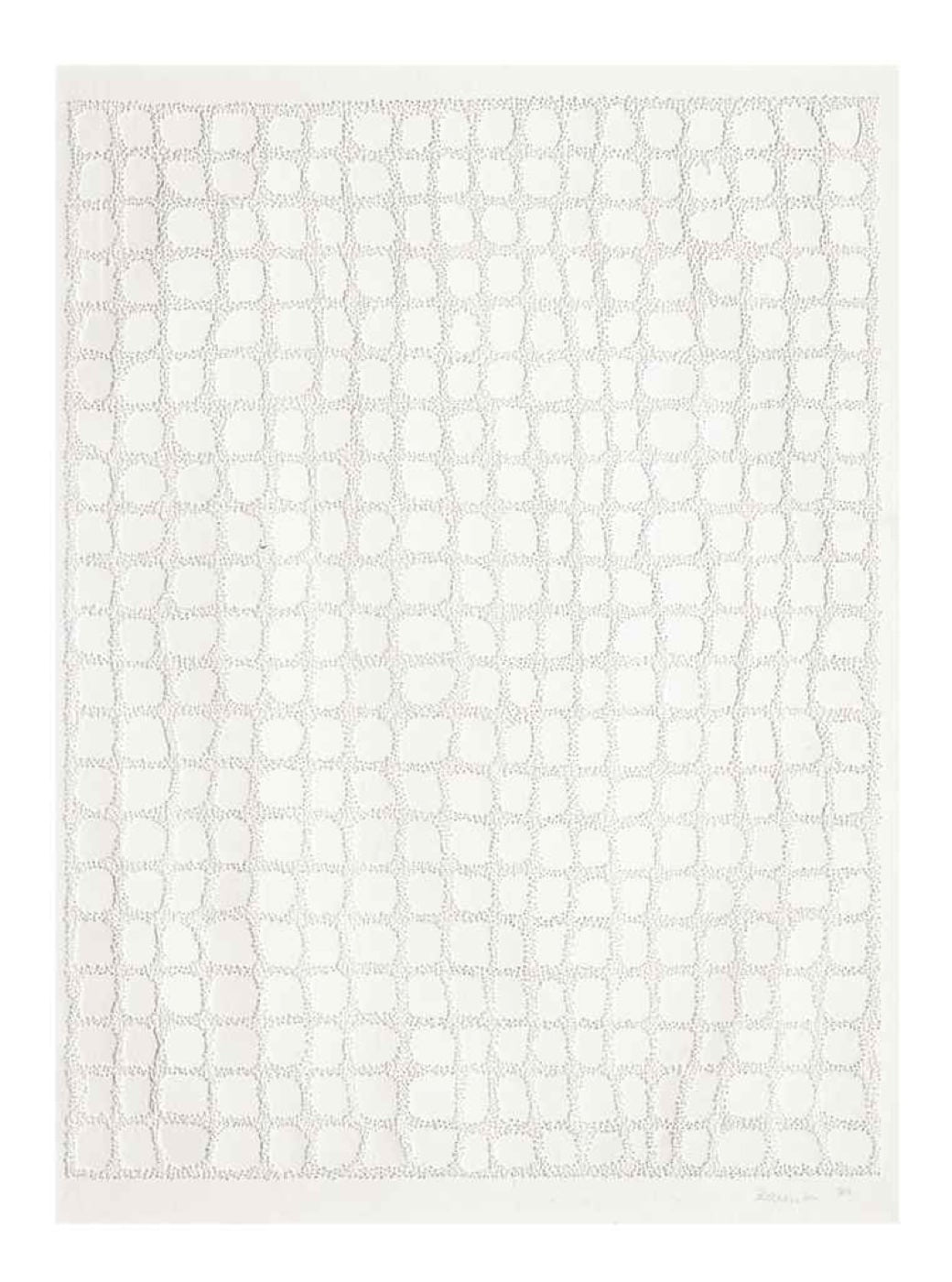
The smaller 1977 sheet gathers individual punctures into measured rows; the larger 1978 sheet builds an irregular mesh from dense fields of pin marks. In both, a simple action accumulates into an architectural field.
The pin does not add ink. It presses through the sheet, leaving displaced fibres and minute edges that become visible through light and shadow. Luhring Augustine describes puncturing as one of Zarina’s material approaches to paper, alongside scratching, weaving, and sewing.
A related Untitled work from 1979 in MoMA’s collection extends this exploration of punched paper. In a MoMA interview, Zarina’s late-1970s pin drawings are discussed alongside her growing engagement with space, sculpture, and materiality: the sheet becomes both image and object.
The tentative question mark in the estate-register wording is retained as evidence; the exact former-site caption and photograph establish the public pin-drawing identification.