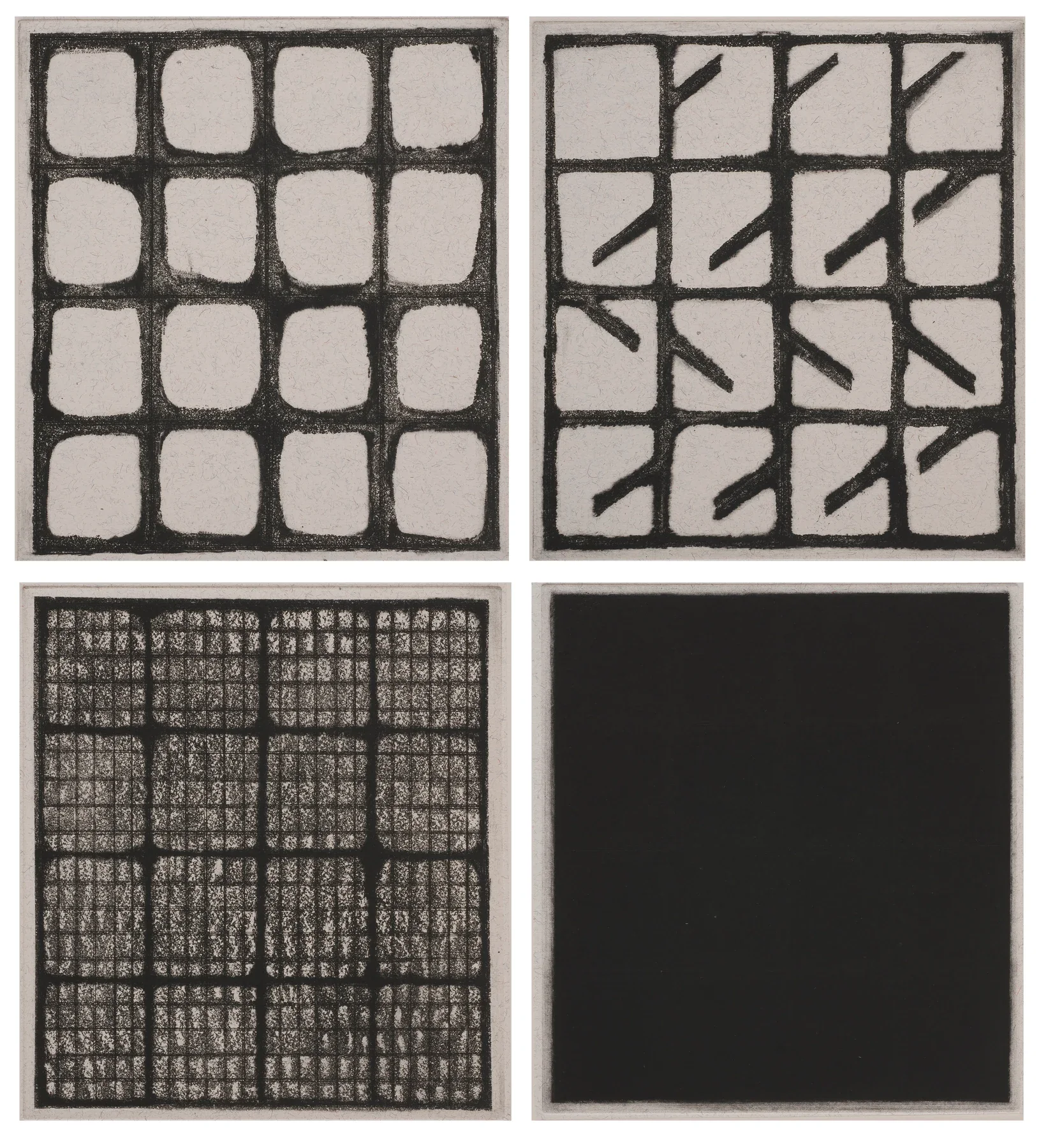
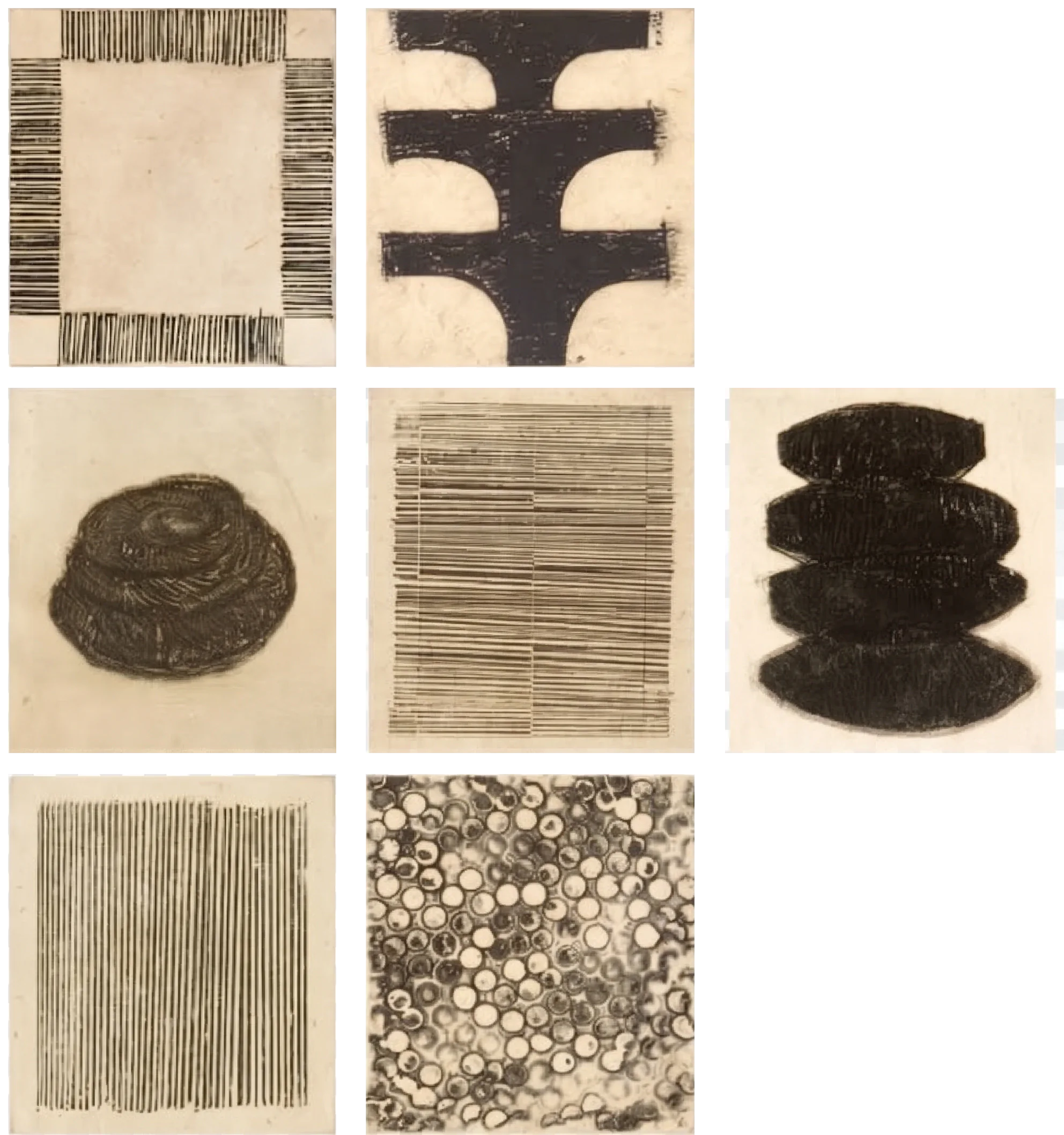
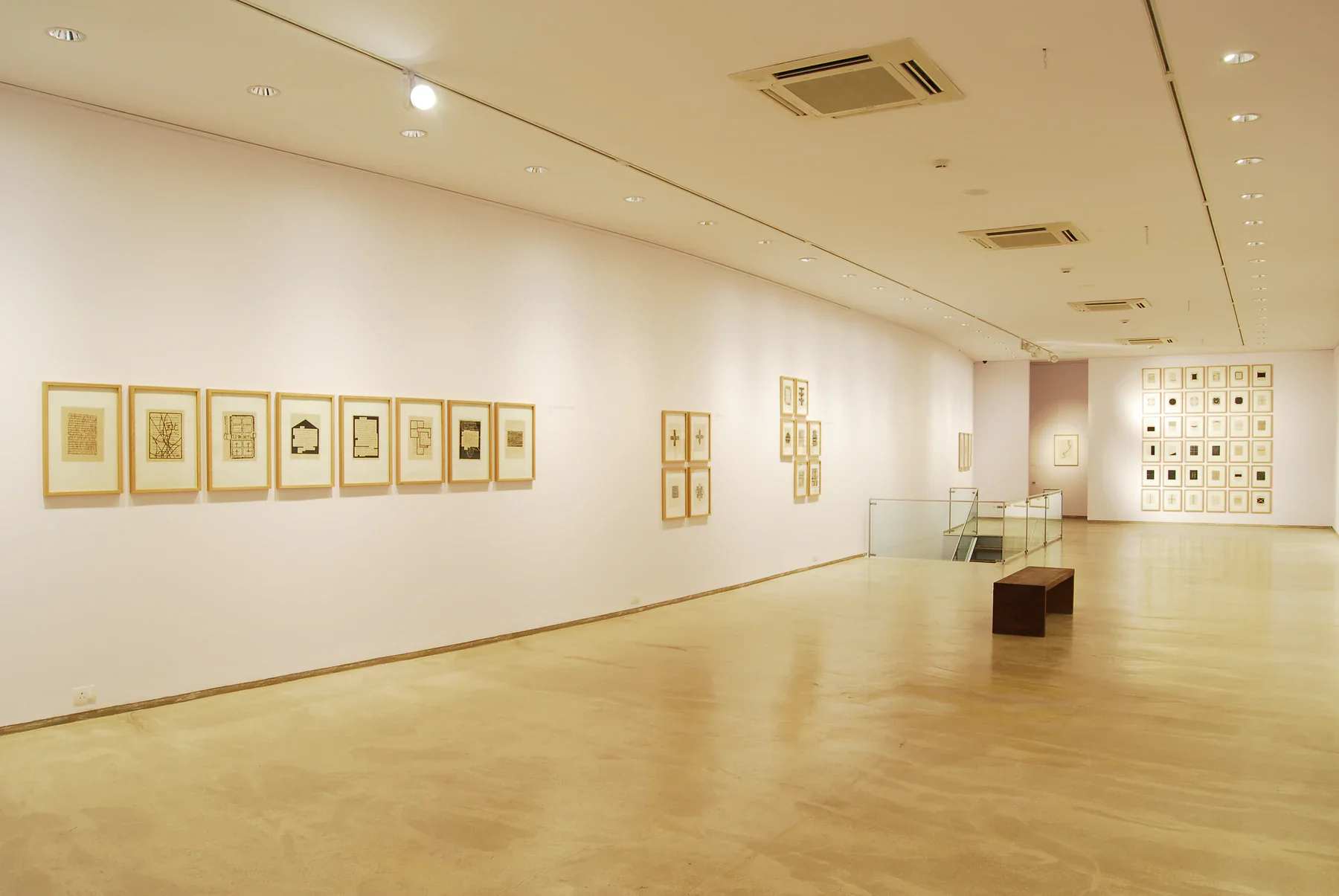
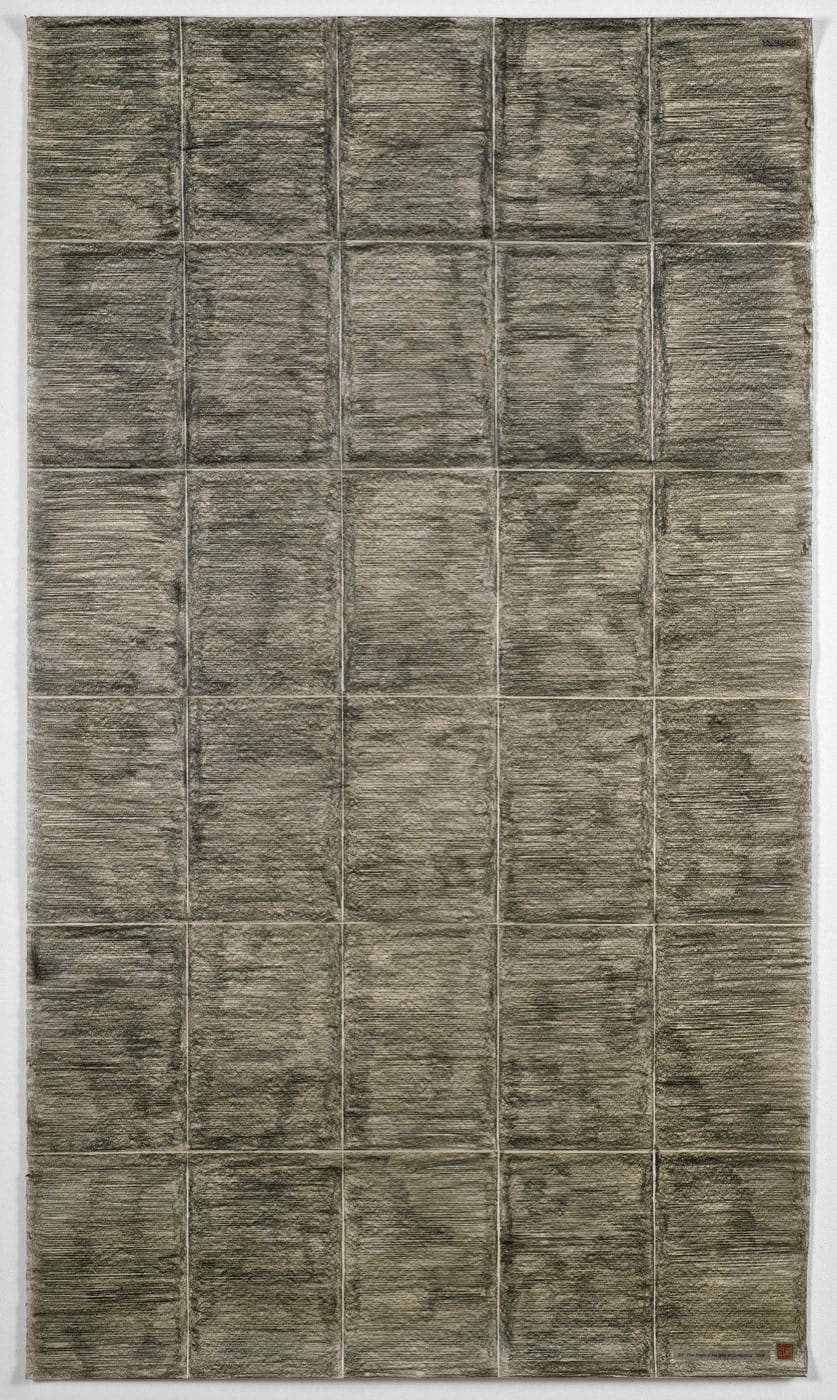
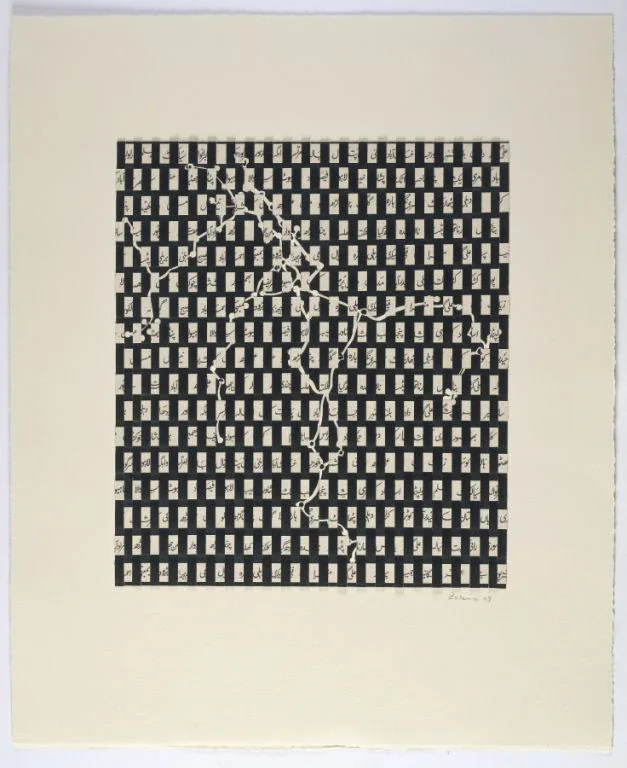
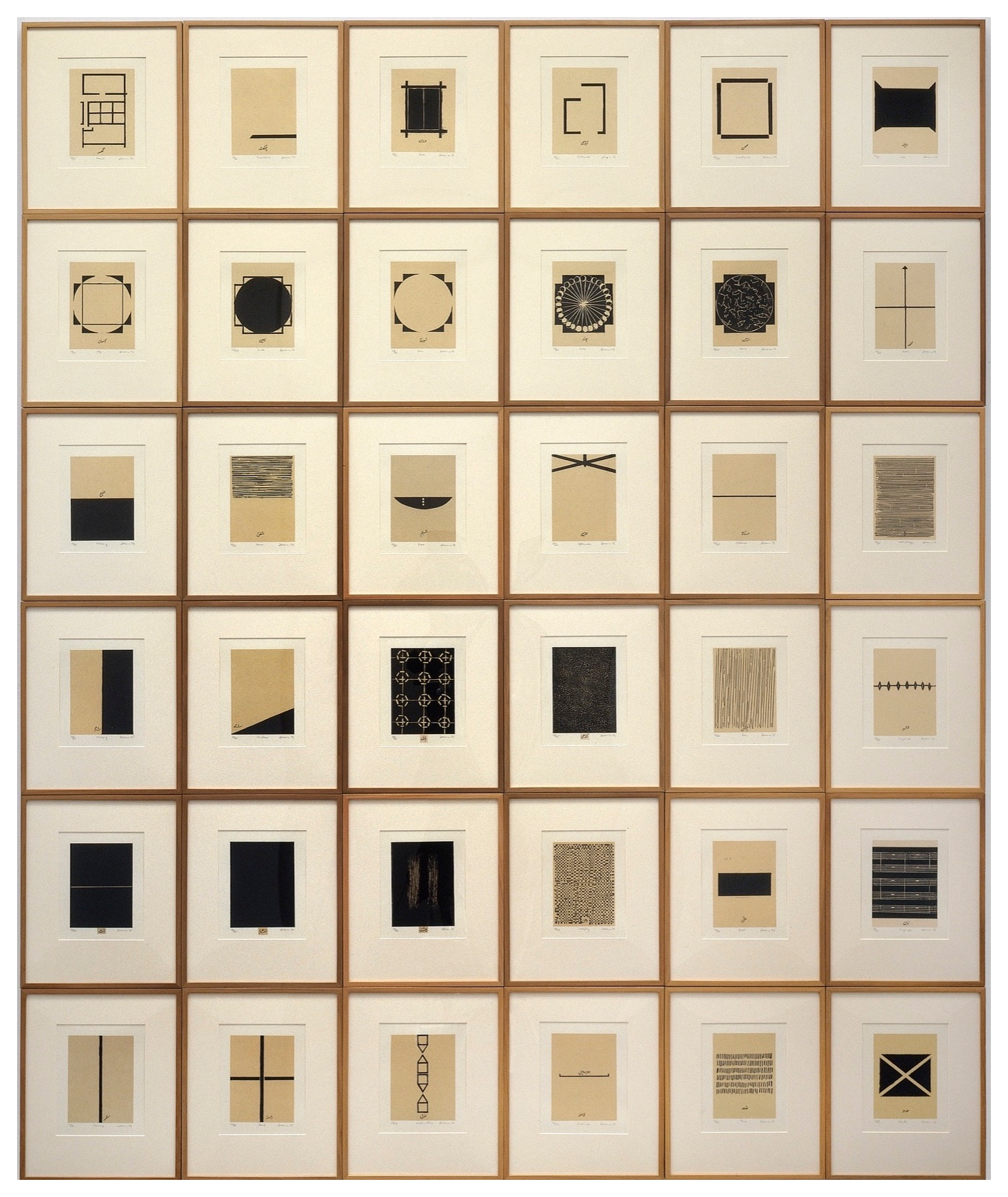
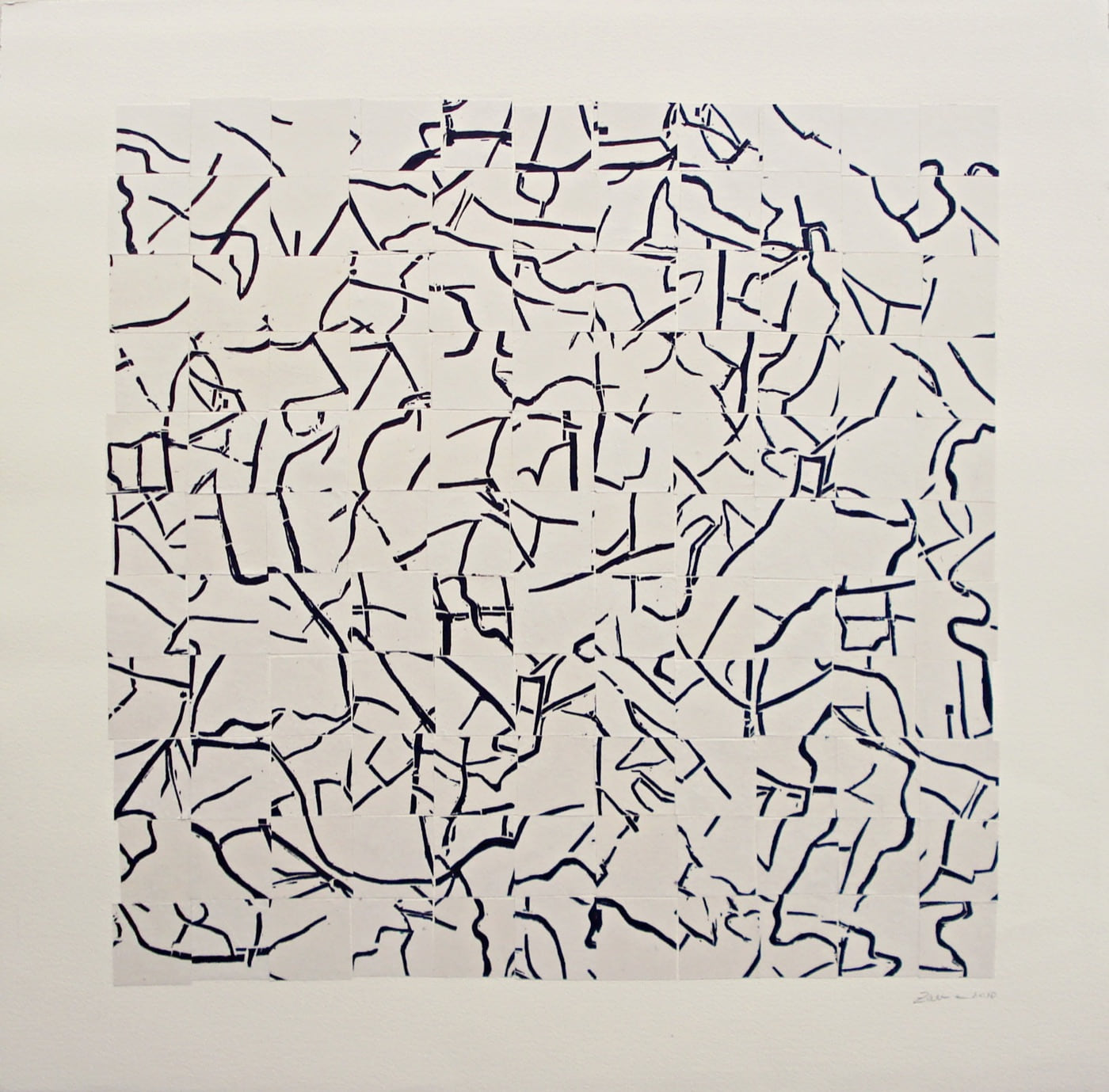
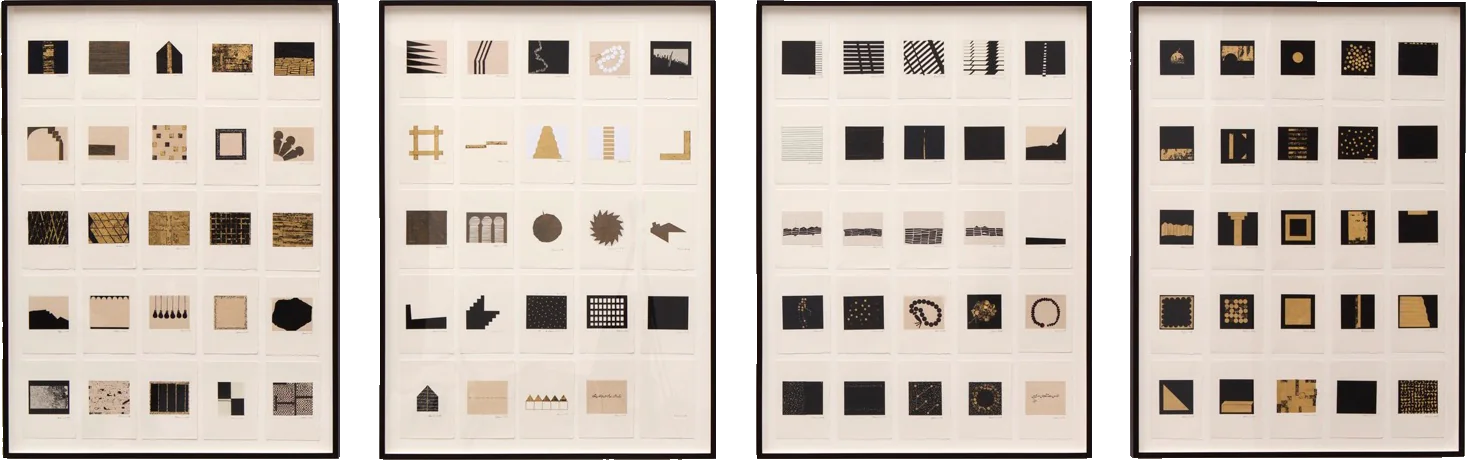
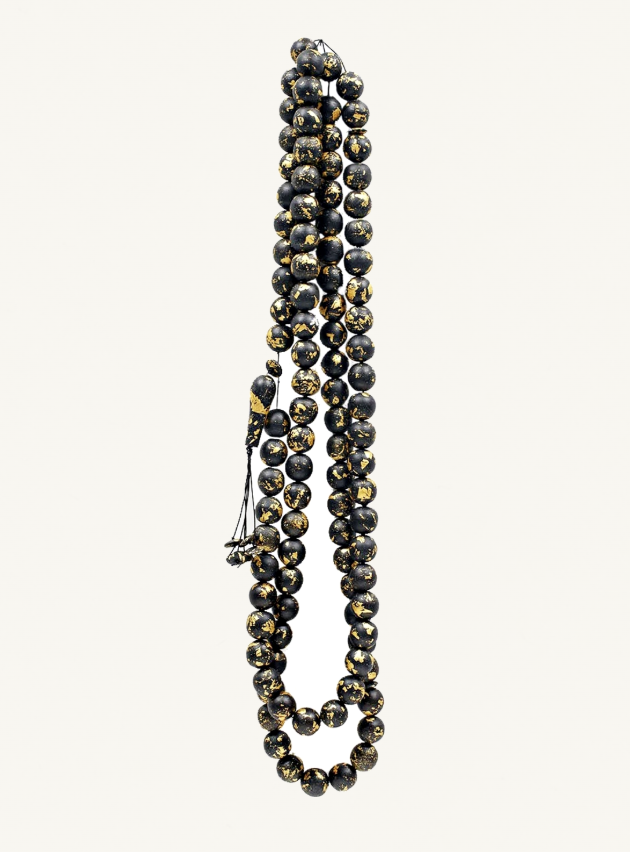
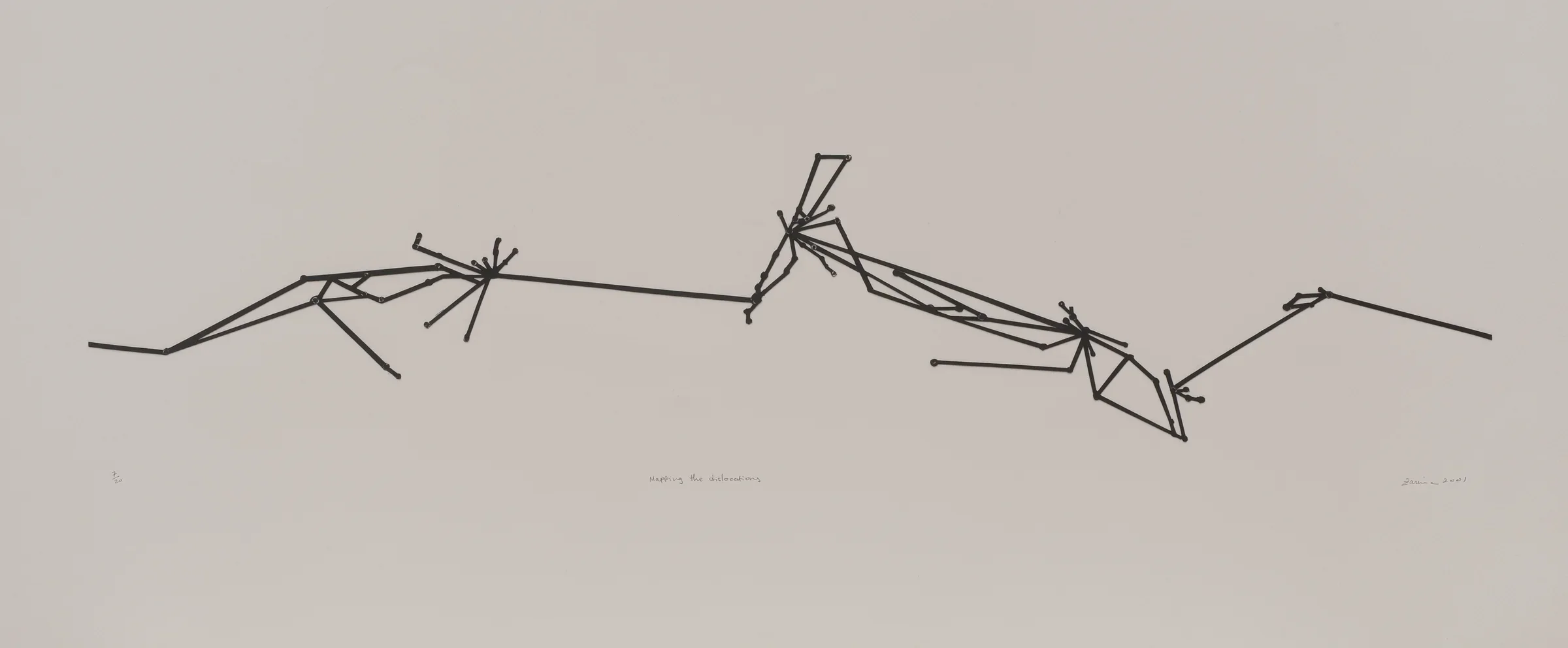
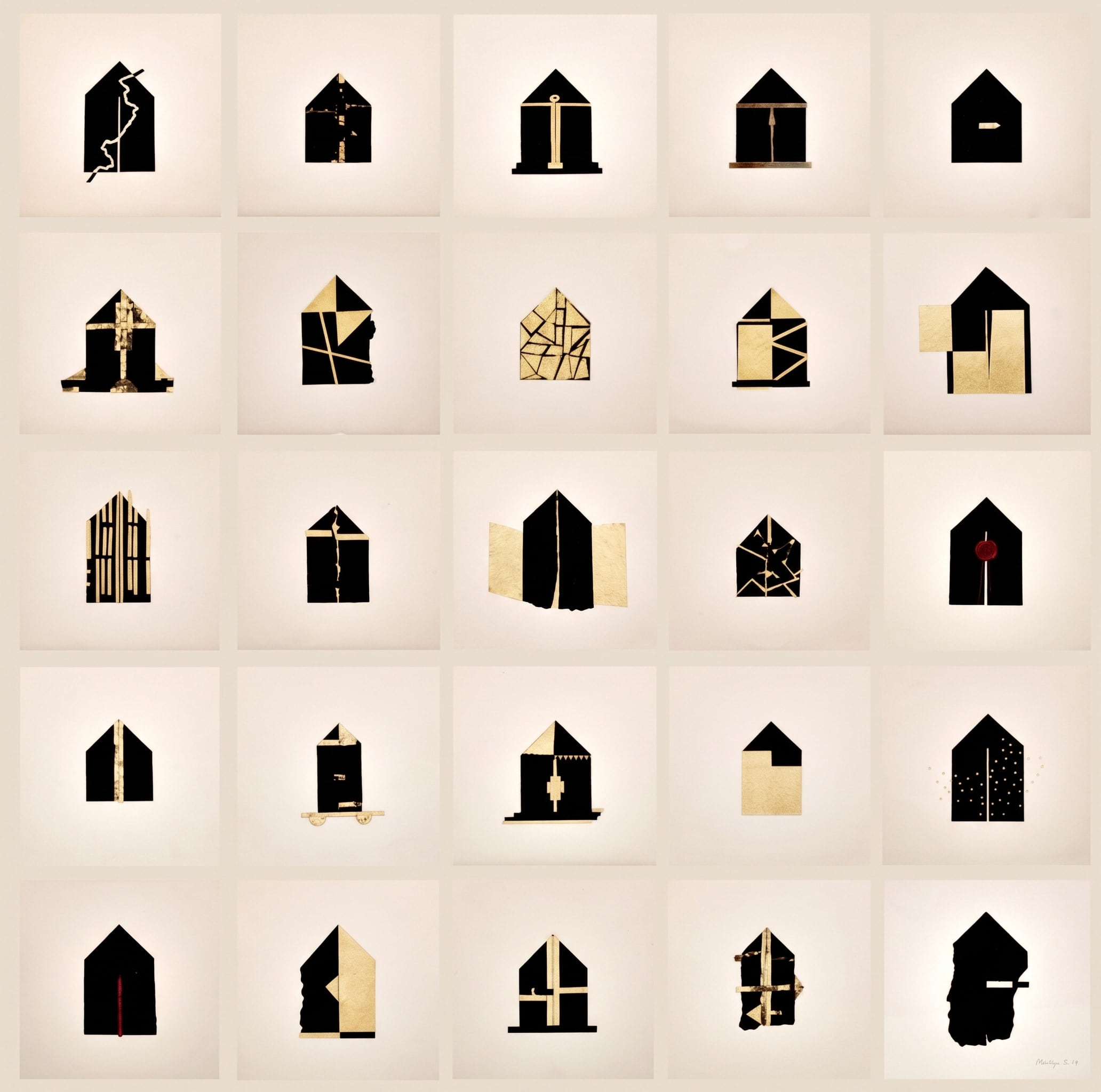
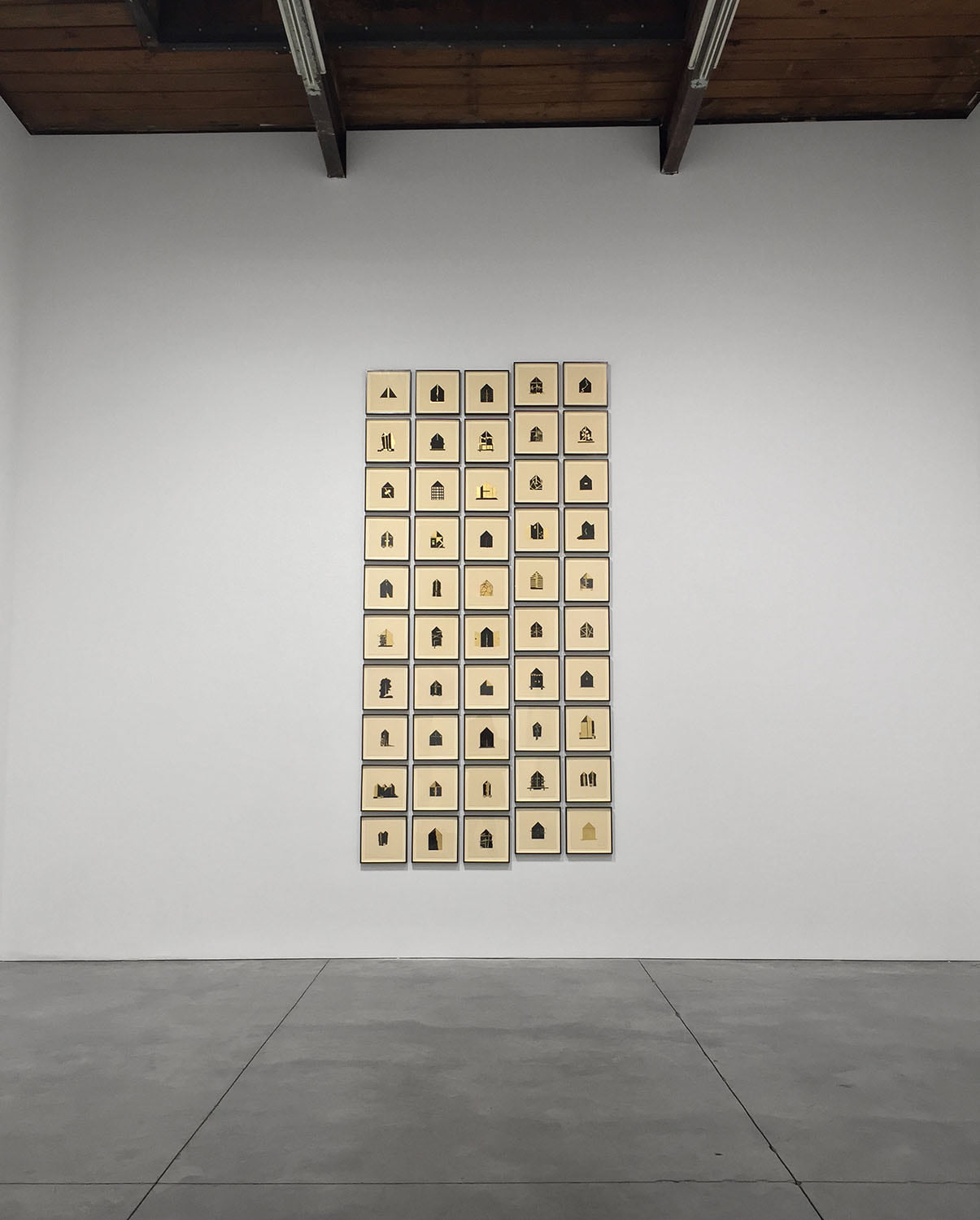
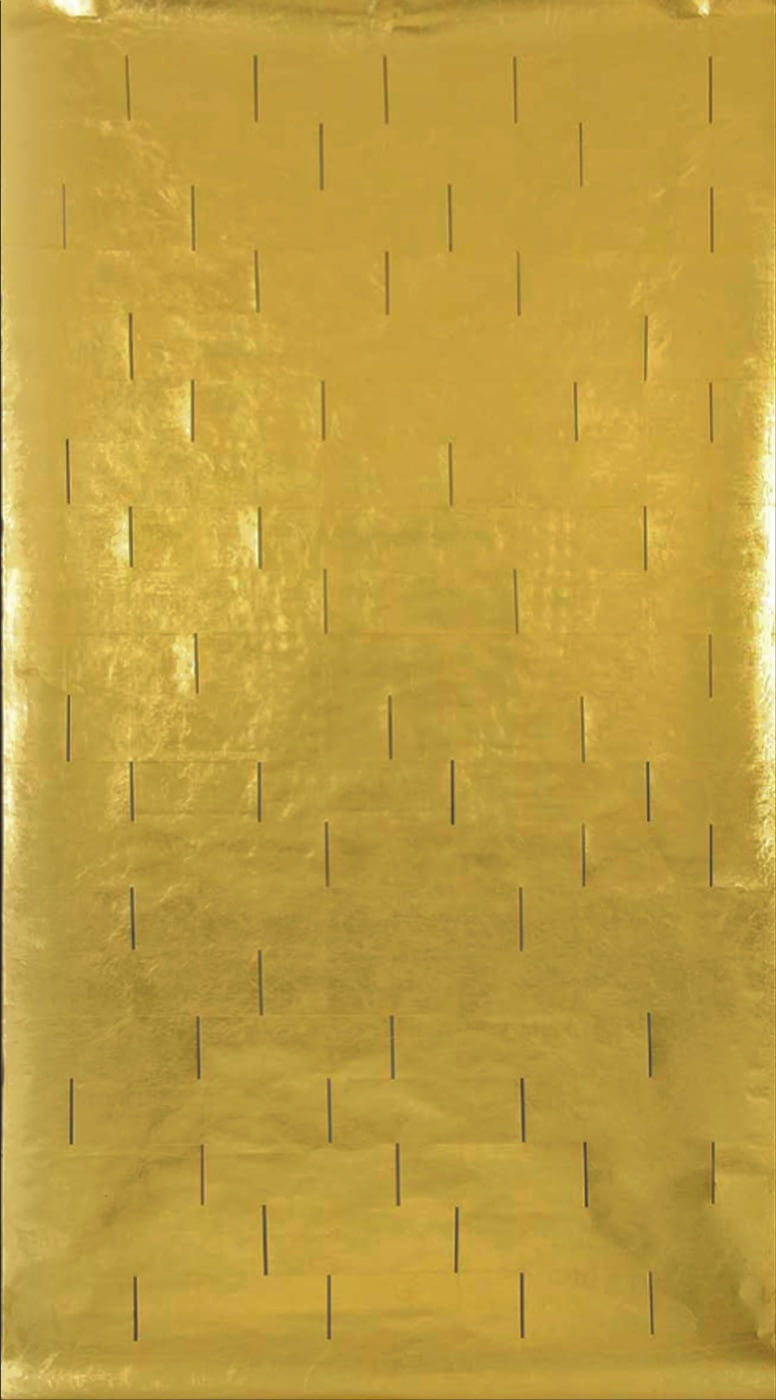
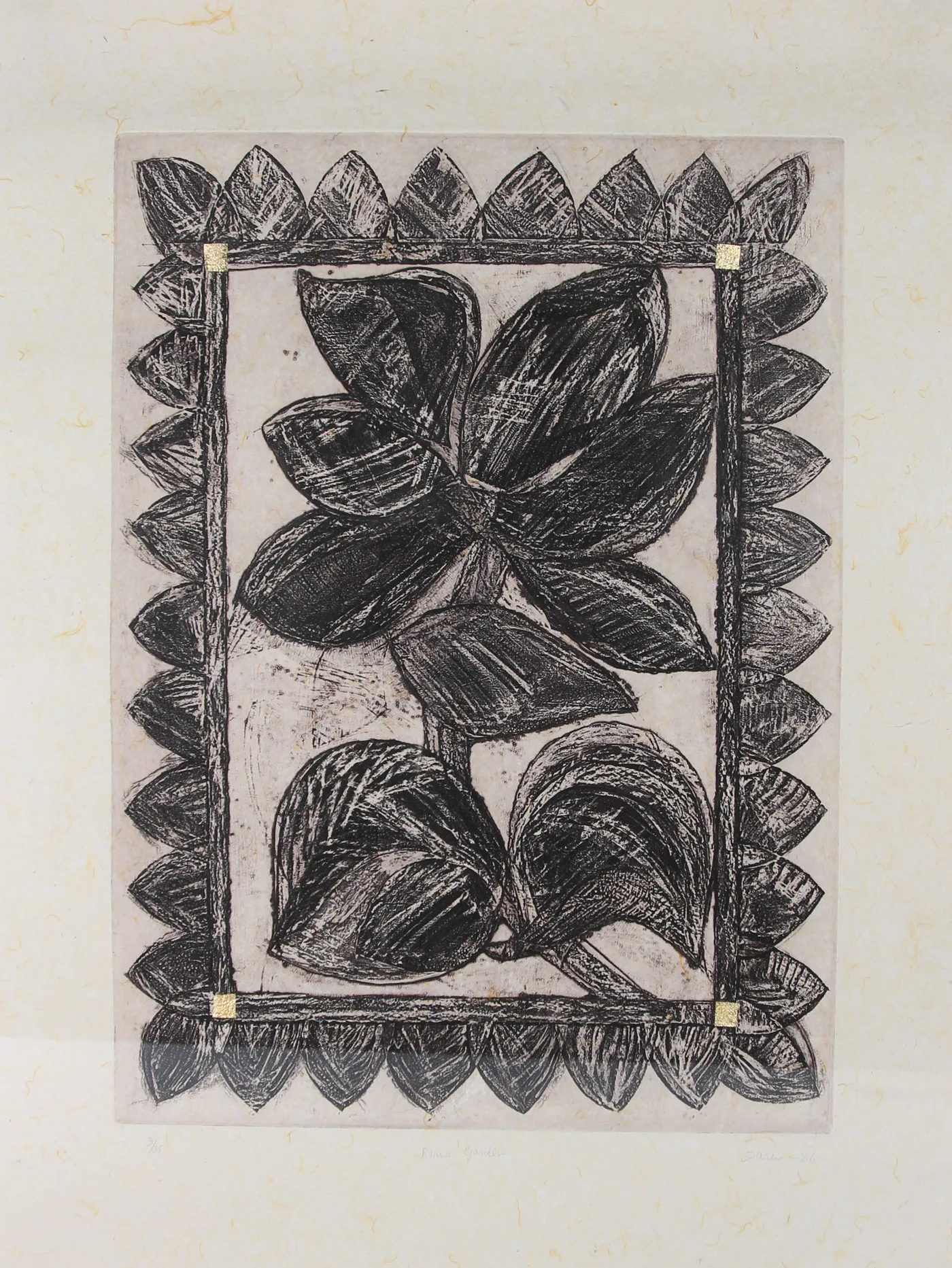
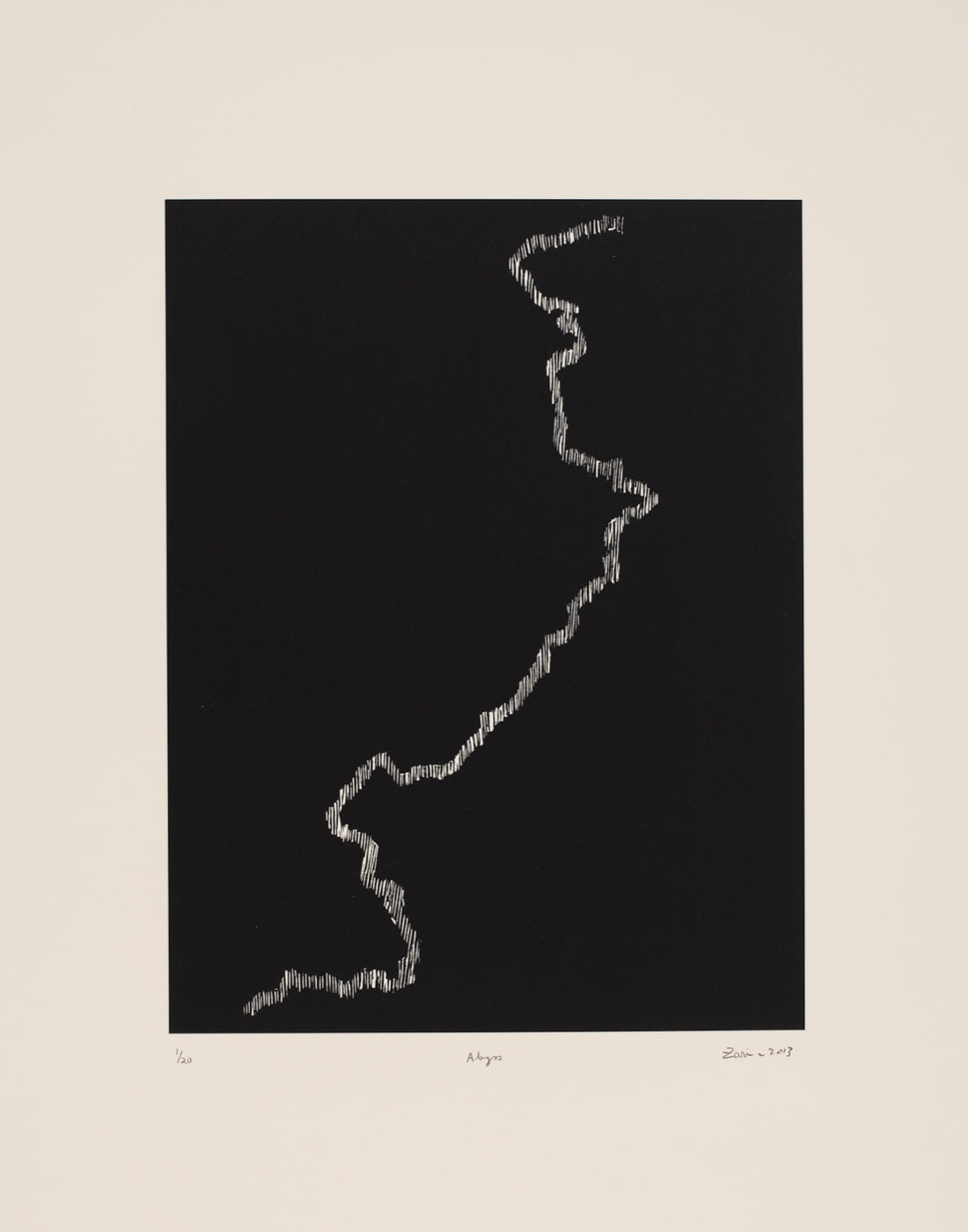
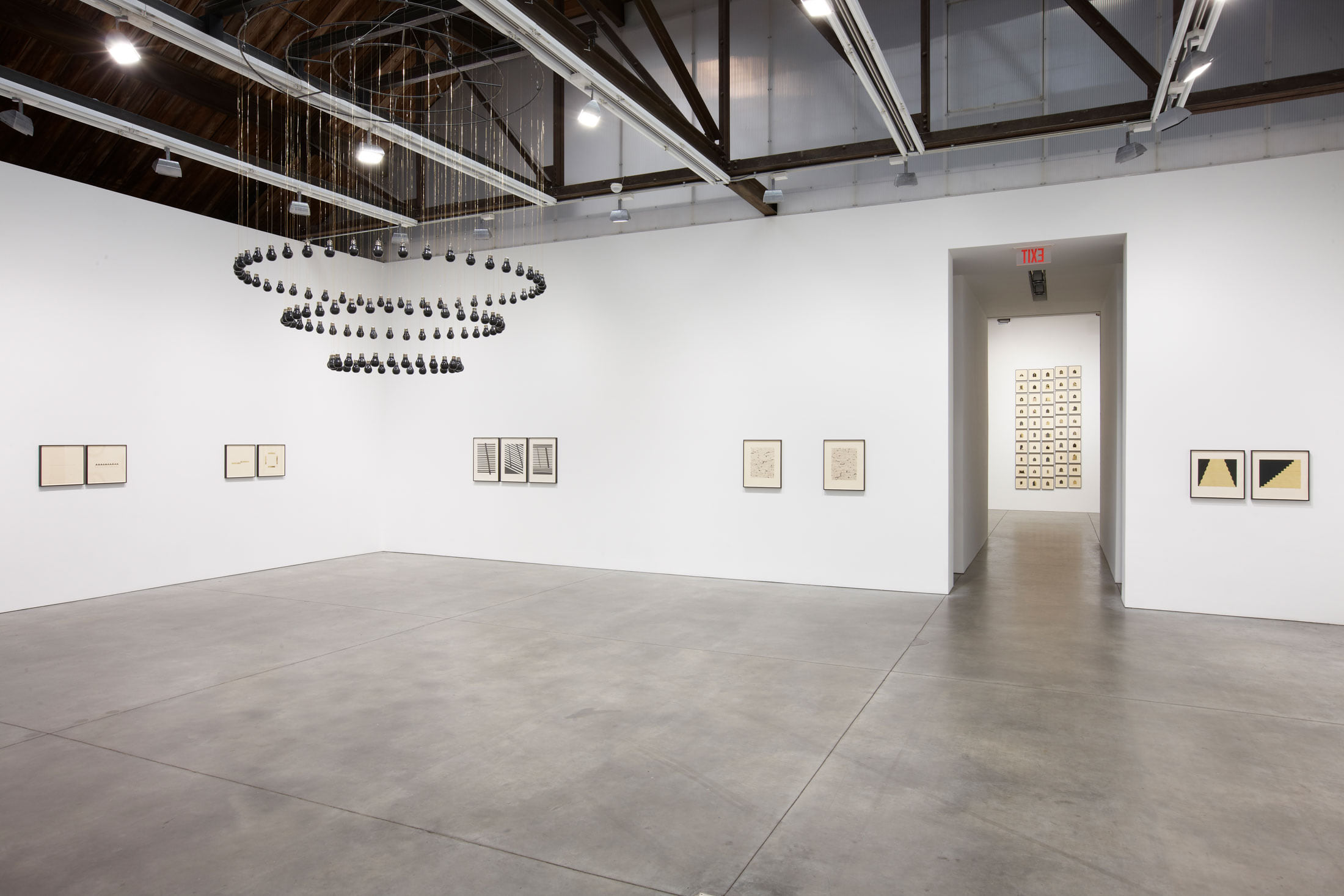
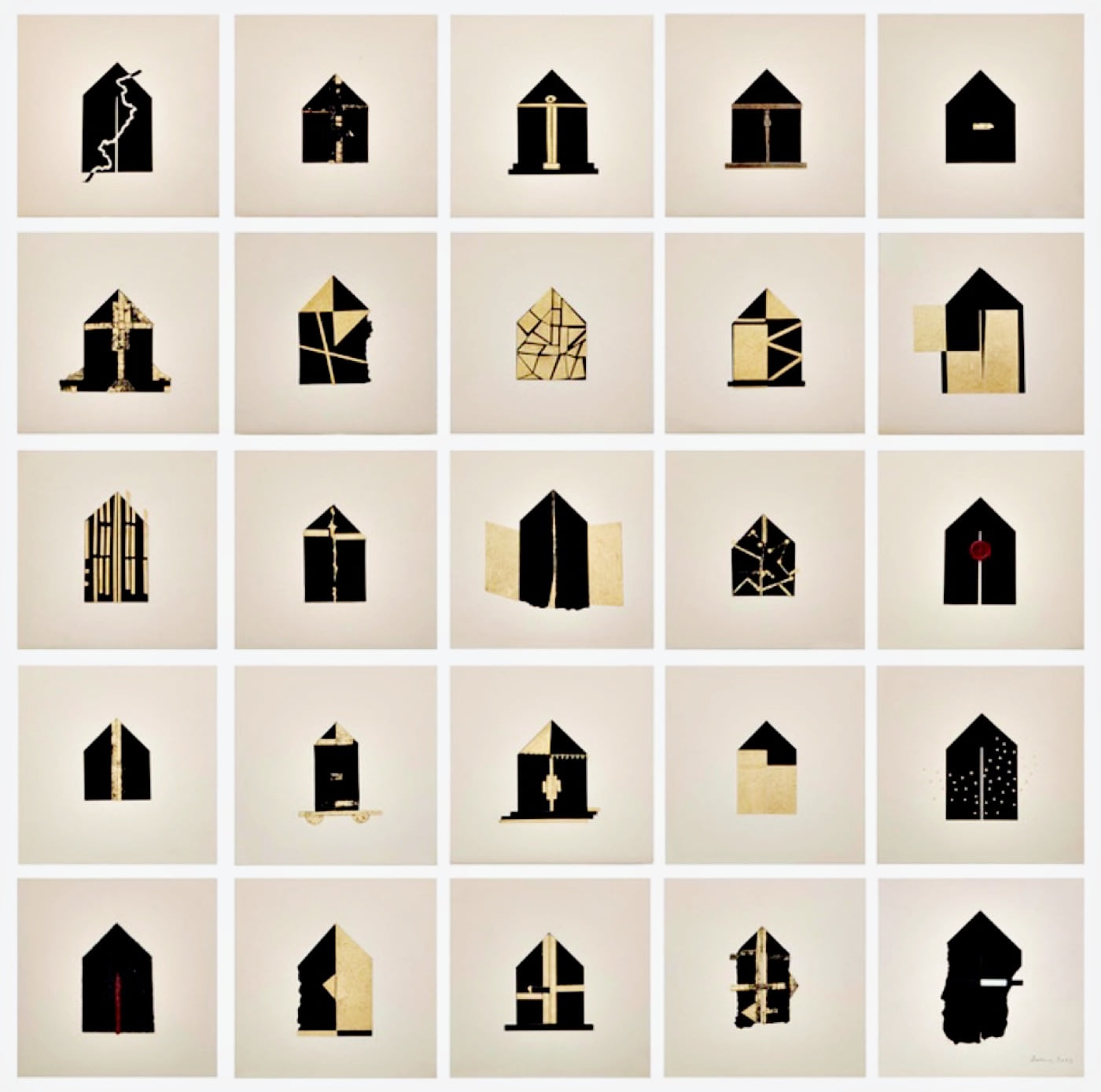
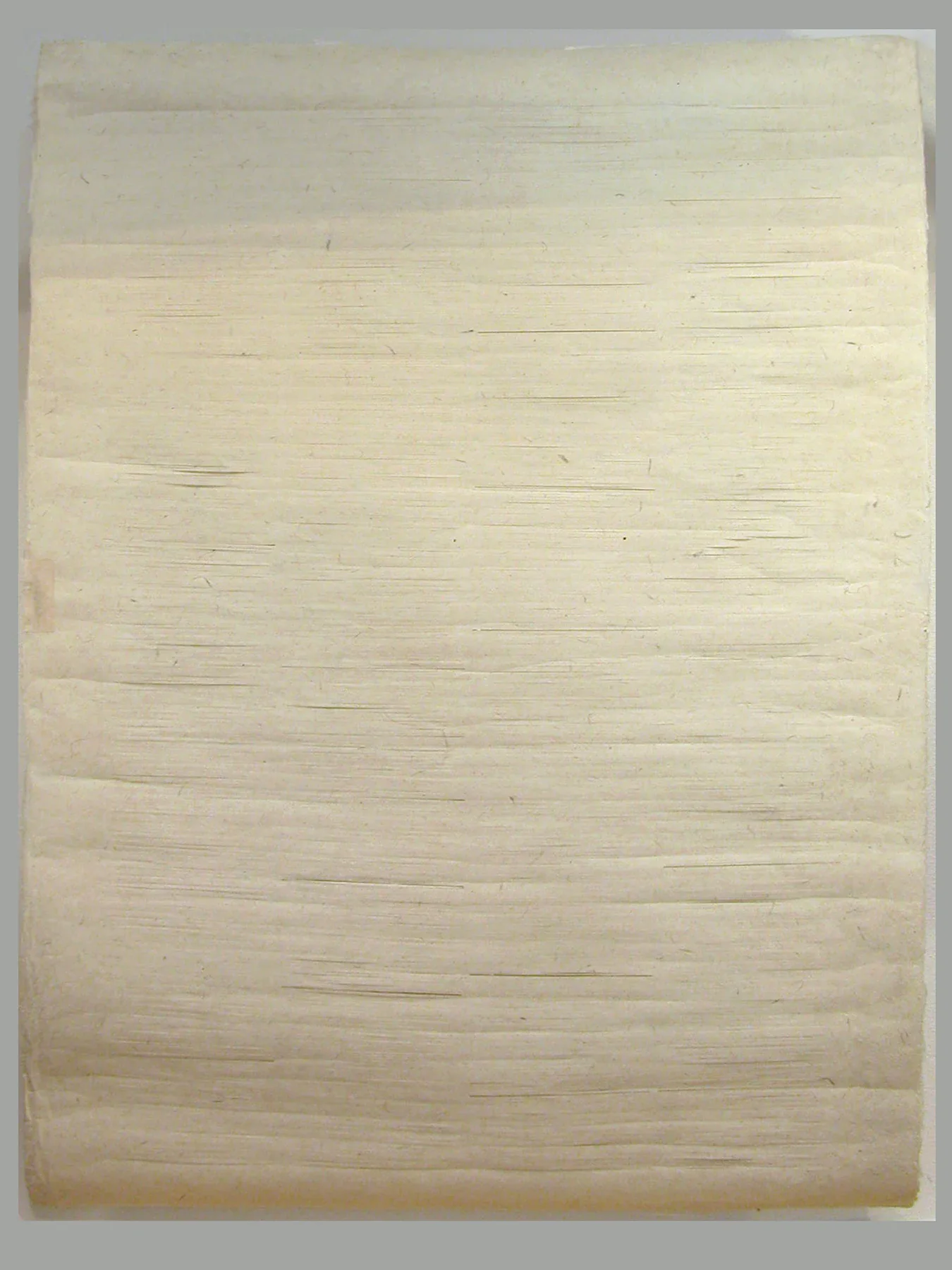
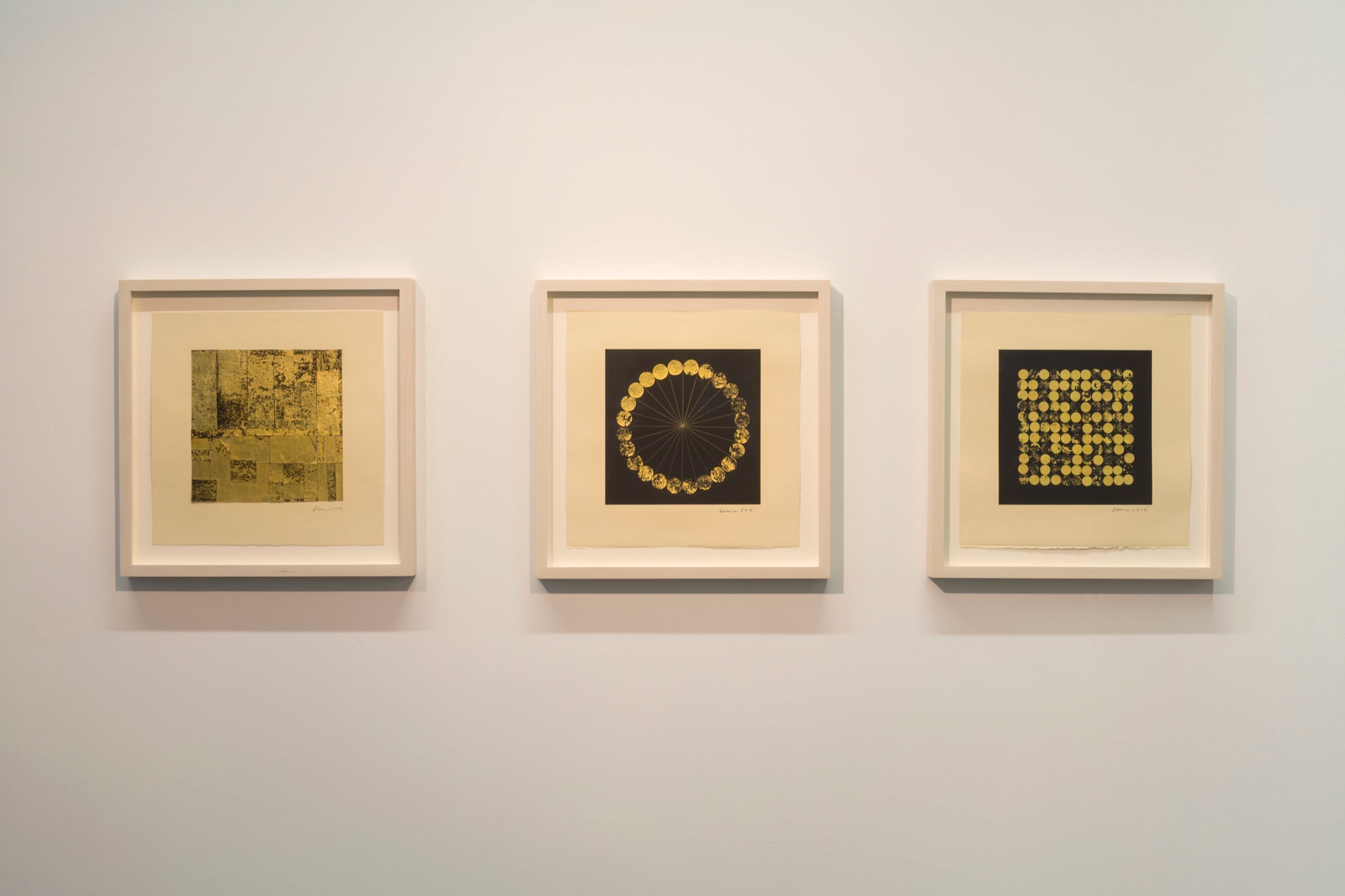
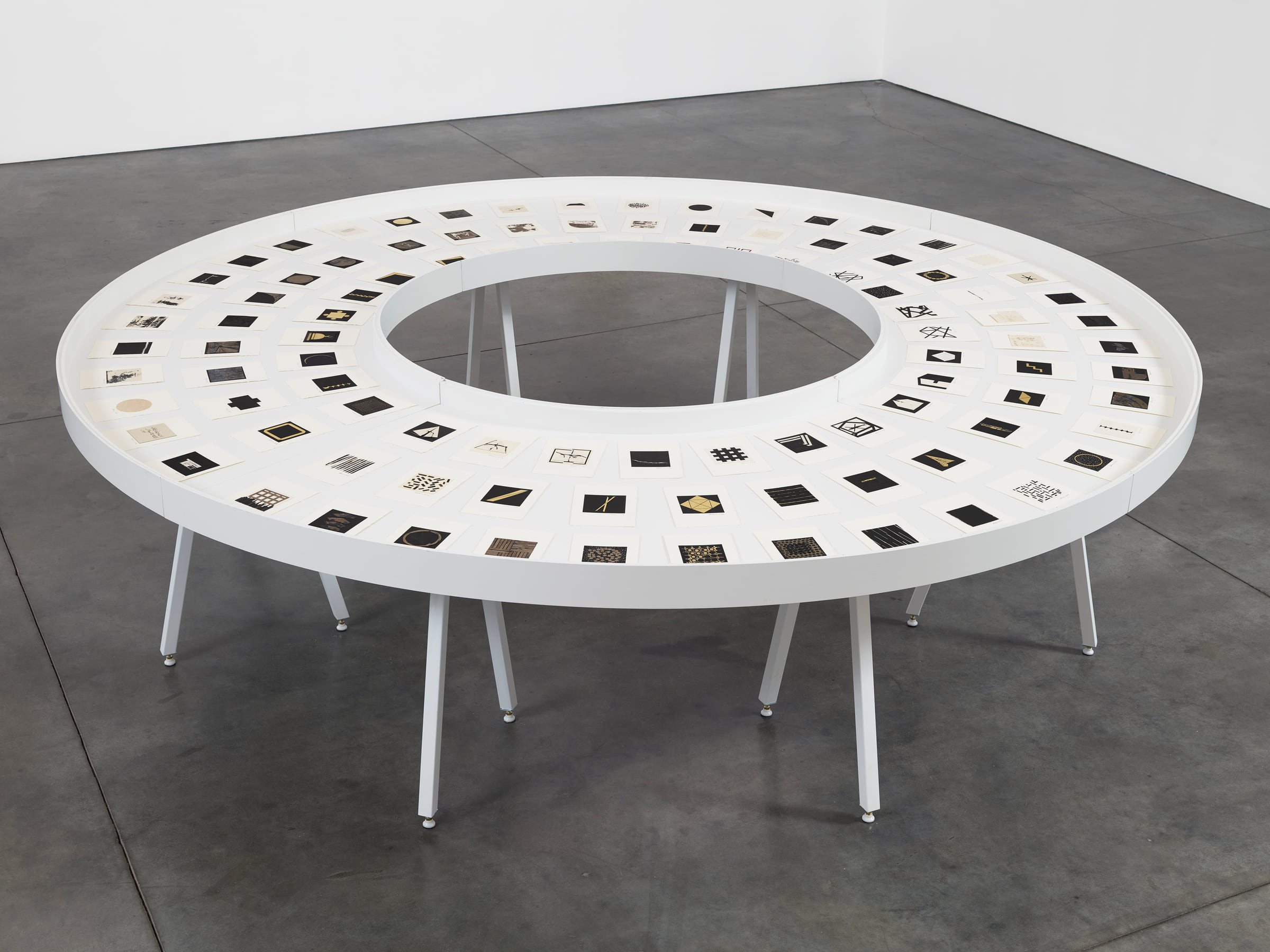
Current and recent presentations are shown alongside an exhibition history spanning Zarina’s international career.
Begin here
See the work, then follow its history
The current programme and historical record are connected, but they answer different questions: where the work can be seen now, and how it has circulated over time.
Each presentation opened a distinct way of seeing Zarina’s work: through the physical life of paper, the artistic traditions she carried with her, and the routes through which home and memory endured.
Solo exhibition · 1968
Zarina at Kunika-Chemould Art Centre
Kunika-Chemould Art Centre · New Delhi
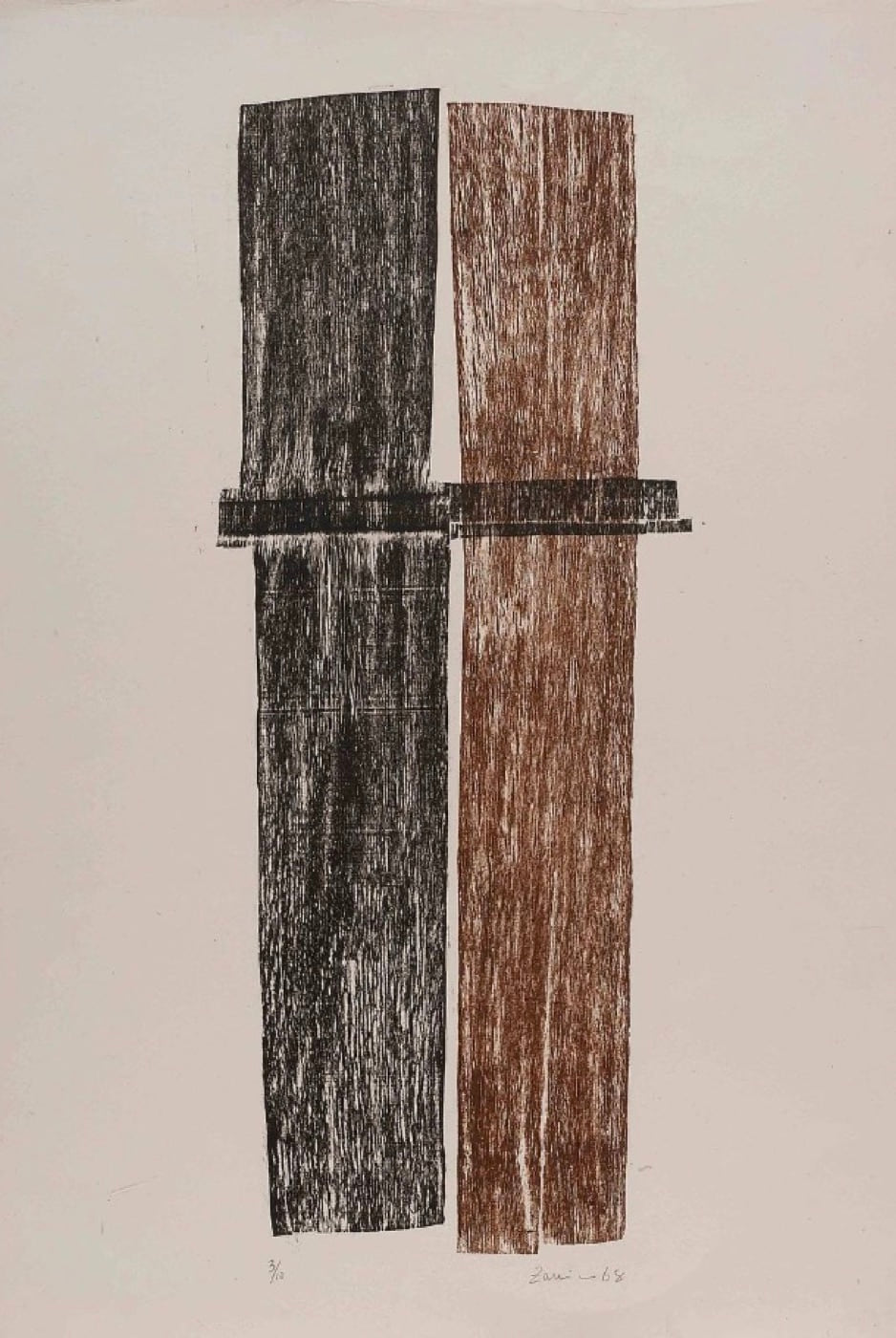
Zarina’s 1968 exhibition at Kunika-Chemould Art Centre belongs to the moment when printmaking became the centre of her practice in New Delhi. Returning from Atelier 17 in Paris, she worked with the grain, resistance, and irregular edges of wood rather than disguising them. The exhibition helped establish a language in which material contact could carry emotional and architectural force.
Kiss, made that year, brings two upright fields of black and burnt umber into a close encounter. Their fibrous surfaces retain the movement of the block, while a dark horizontal band holds the composition together without making the two sides identical. Intimacy appears not as a descriptive scene but as pressure, proximity, difference, and touch.
Solo exhibition · 1969
Zarina at Gallery Chanakya, 1969
Gallery Chanakya · New Delhi
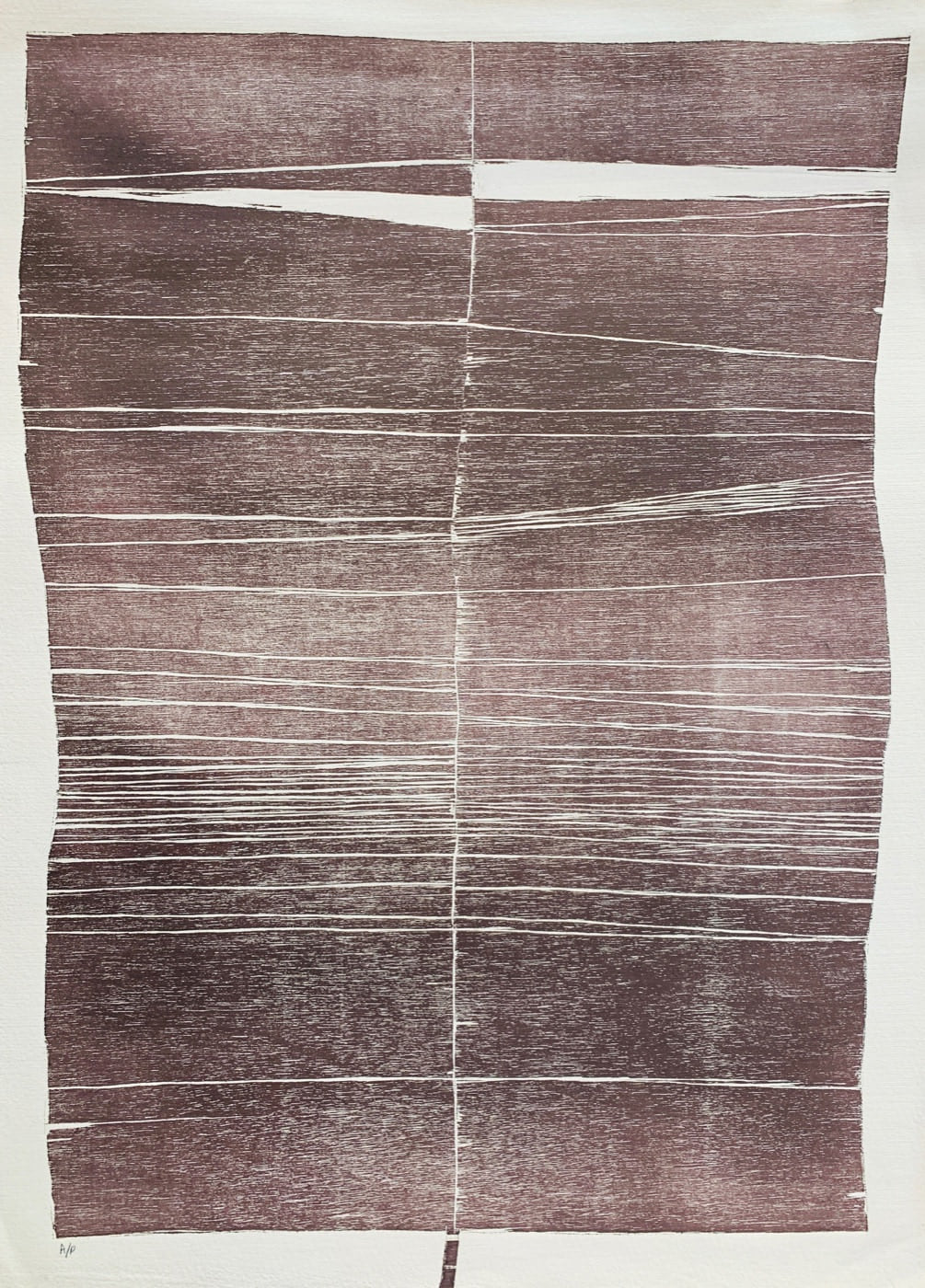
Zarina’s 1969 exhibition at Gallery Chanakya belongs to the first sustained period of her public life as a printmaker in New Delhi. After learning intaglio at Atelier 17 in Paris, she returned to India with an expanded understanding of the print as an original encounter between block, paper, ink, and pressure. The exhibition formed part of a sequence of presentations through which that language became visible on its own terms.
Untitled, made the same year, transforms the grain of wood into an architecture of compression and release. Broad horizontal bands accumulate like courses of masonry, while a slender vertical interruption prevents the surface from closing into a solid mass. The work already holds several ideas that Zarina would revisit for decades: the wall as protection and division, the line as both structure and wound, and handmade paper as an active field rather than a passive support.
Solo exhibition · 1970
Graphics by Zarina
Pundole Art Gallery · Bombay
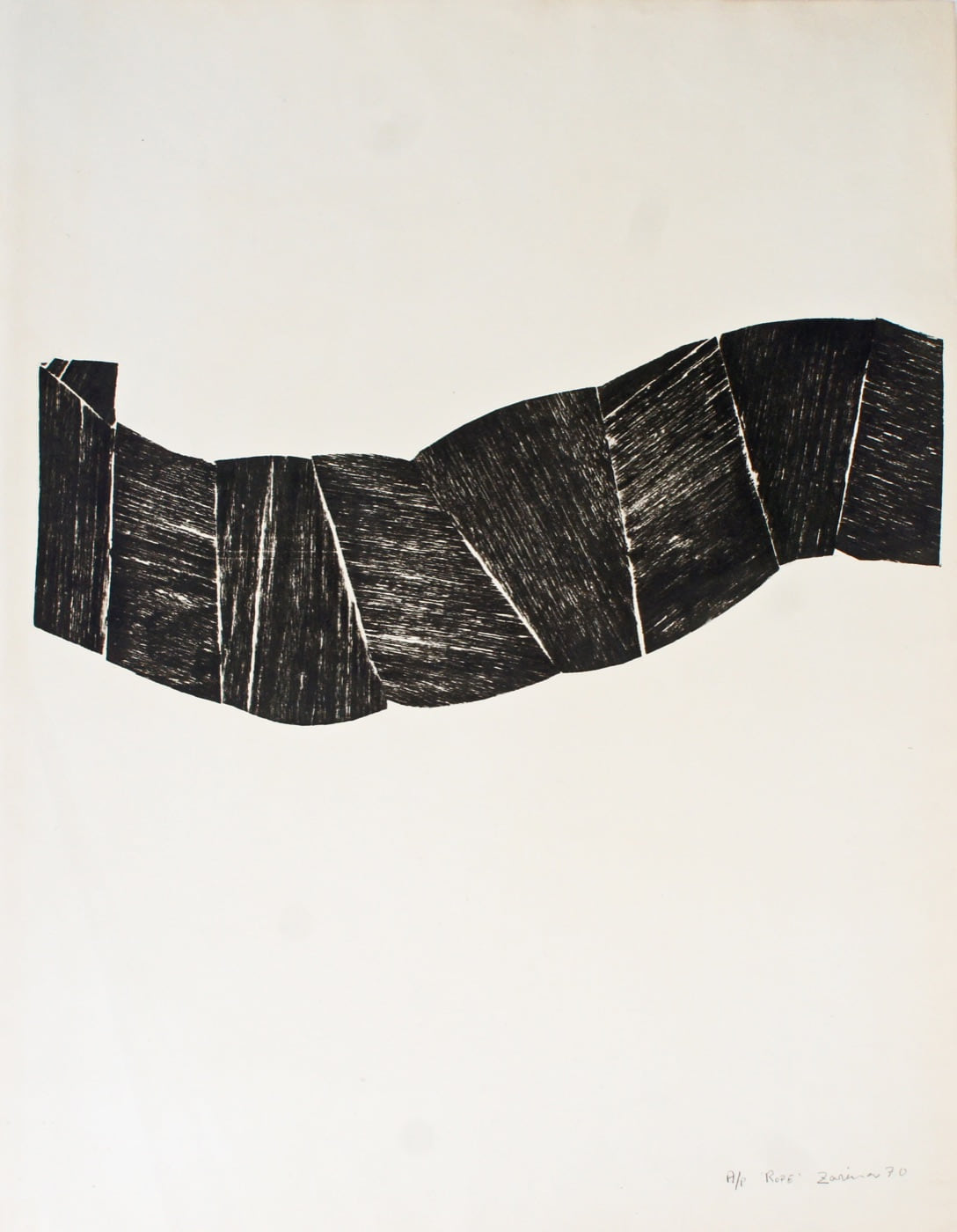
Graphics by Zarina at Pundole Art Gallery marked an early solo presentation of the relief prints she was developing after Paris. At a moment when printmaking in India was gaining new institutional and critical attention, Zarina treated the medium neither as reproduction nor as a secondary form. Found boards, cut fragments, ink, and handmade paper gave each image the physical presence of an object.
Rope, 1970, moves across the sheet as a heavy, twisting body assembled from separate wood-grained sections. Its changes of direction make the form seem flexible even as the printed black carries the resistance of timber. The image can be read as cord, path, boundary, or binding, yet it remains grounded in how it was made: individual pieces brought into tension and joined through pressure on paper.
International group exhibition · 1971
9th International Exhibition of Graphic Arts
Moderna galerija · Ljubljana
Zarina’s participation in Ljubljana’s ninth international graphic-arts exhibition placed her work within one of the most consequential postwar forums for printmaking. The 1971 edition brought together an unusually broad international field while its accompanying symposium asked how graphic art could retain originality amid new techniques and mechanical processes. Zarina’s practice answered that question through attention to paper, pressure, sequence, and the distinct life of each impression.
Her 1971 serigraphs sharpened the relation between printed form and open space. Across the sequence, black and silver planes tilt, divide, and reassemble without settling into a single image. Repetition becomes active: each interval changes the weight of what came before, and the unprinted paper becomes a structure of pause, distance, and possibility.
Solo exhibition · 1971
Zarina at Gallery Chanakya, 1971
Gallery Chanakya · New Delhi
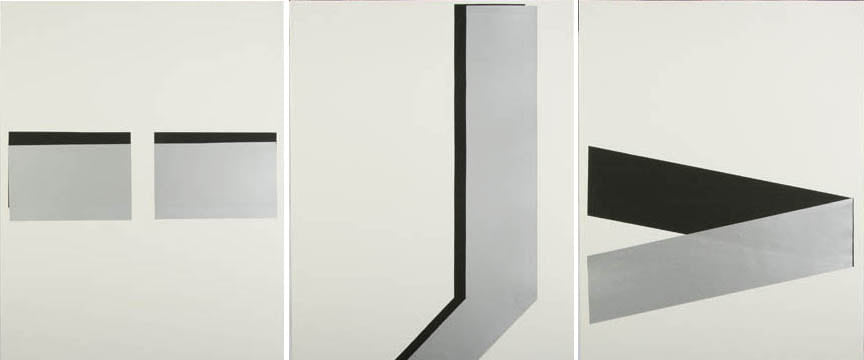
The 1971 Gallery Chanakya exhibition followed Zarina’s move from relief printing toward the sharper edges and open intervals of the serigraph. Contemporary reviews singled out the new graphic clarity of the work. Black and silver forms were no longer contained by conventional pictorial space; they crossed, separated, and changed position across the paper as if testing the stability of the image itself.
This Untitled triptych distributes related forms across separate panels. A diagonal bar descends, lifts, and breaks apart from one panel to the next, while silver appears as a quieter counterweight to black. Read in sequence, the composition refuses a single fixed arrangement. Repetition becomes movement, and the spaces between the panels become as consequential as the printed shapes within them.
Solo exhibition · 1971
Zarina at Cultural Centre Ora
Cultural Centre Ora · Athens
Zarina’s Athens exhibition placed her early printmaking within Ora’s deliberately international and experimental programme. Founded only two years earlier, the cultural centre joined exhibitions to publishing, lectures, and discussion during a politically constricted period in Greece. For an artist whose life already moved between cities and languages, the venue offered a setting in which abstraction could travel without becoming detached from lived experience.
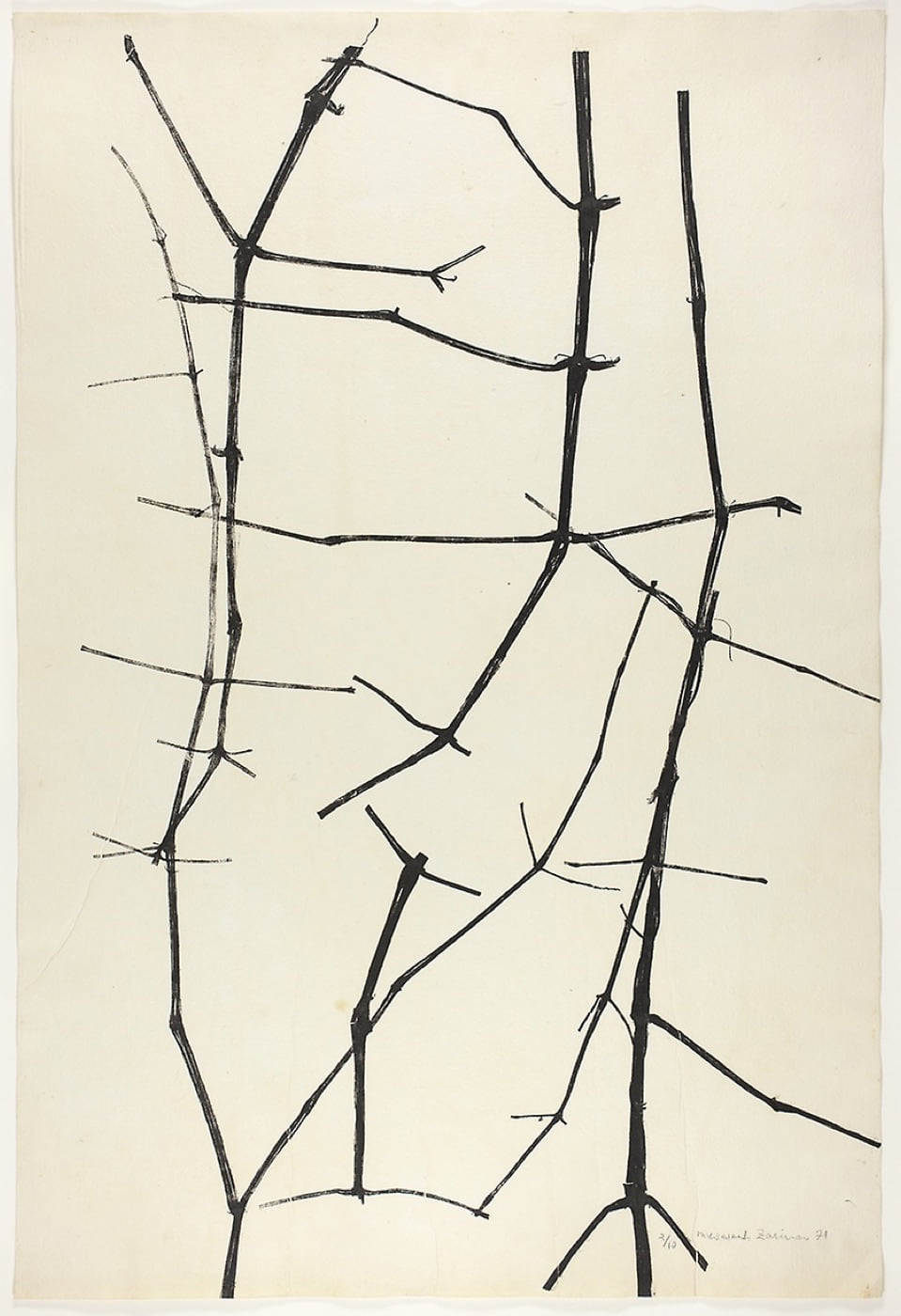
In the Woods II, made in 1971, carries the direct pressure of dried plants across four joined sheets of Indian handmade paper. Branching lines divide the pale field without settling into a descriptive landscape. They resemble paths, boundaries, or a fragile structure held together across seams. Natural material becomes both printing tool and image, preserving contact while turning growth into a spare architecture of movement and interruption.
Solo exhibition · 1972
Zarina at Gallery Chanakya
Gallery Chanakya · New Delhi
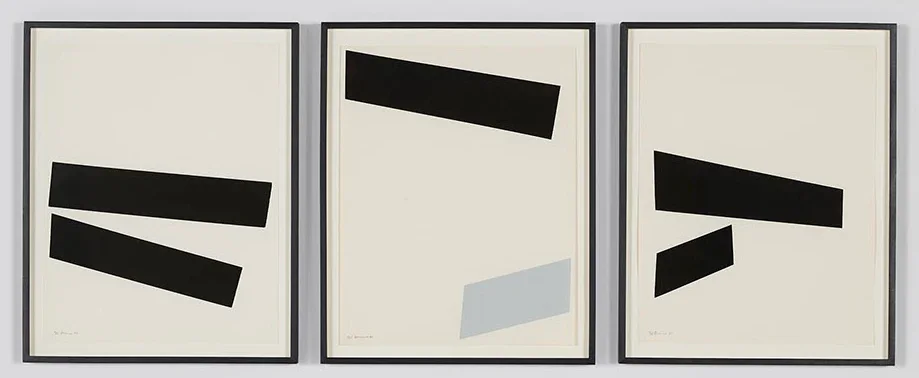
The 1972 Gallery Chanakya exhibition belongs to Zarina’s return to New Delhi after her years at Atelier 17 and a period in Bonn. Printmaking had become her central language, but she resisted treating an edition as mechanical repetition. Variations of ink, pressure, paper, and alignment allowed each impression to retain the circumstances of its making.
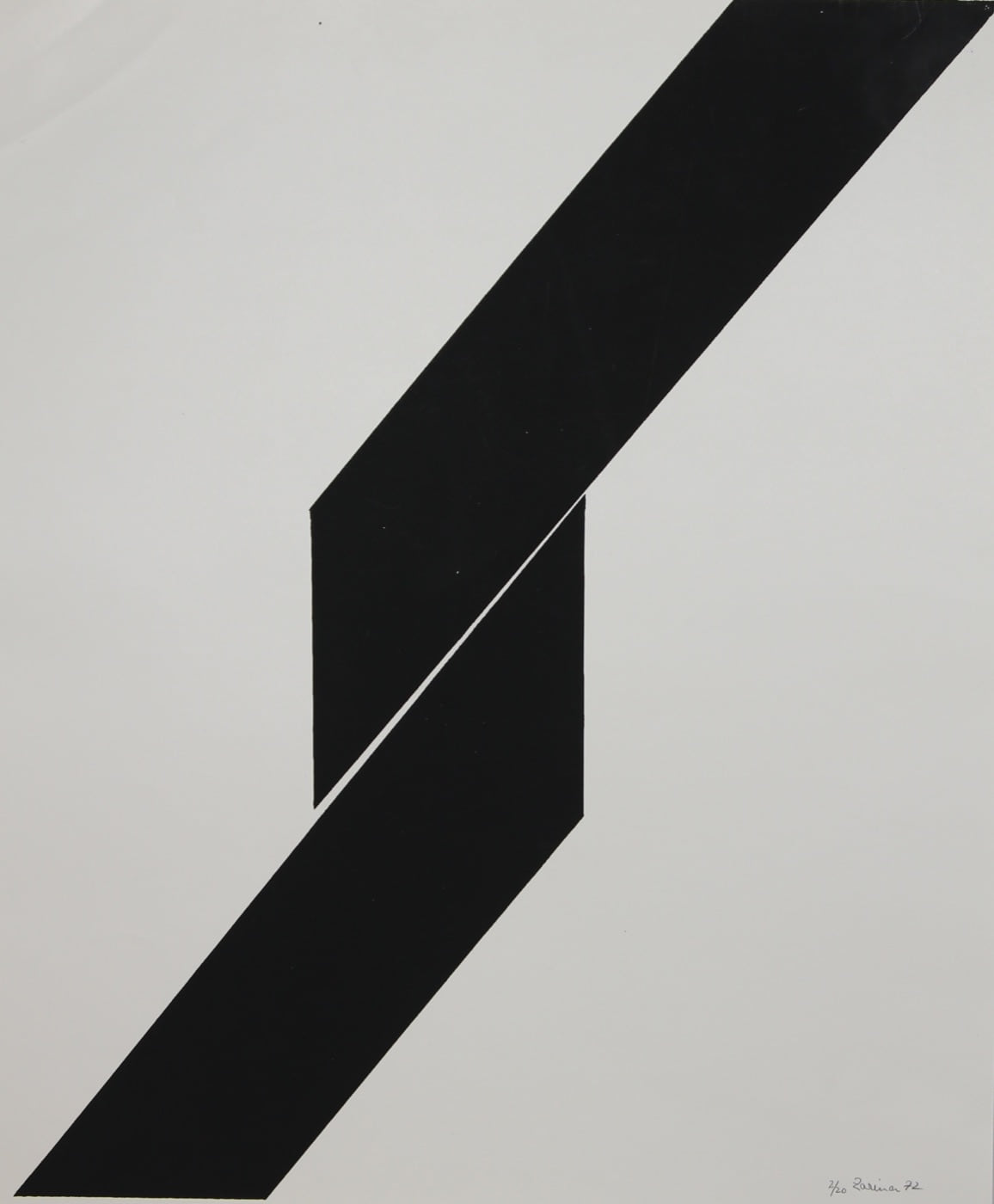
Untitled, 1972, reduces the image to two black diagonal bands and the slender white interval between them. The composition is forceful but not sealed: open paper remains active, and the break at the centre turns separation into the work’s most charged line. Geometry becomes a relation between weight and breath, contact and distance—concerns that would later return through borders, divided maps, walls, and remembered rooms.
Solo exhibition · 1972
Zarina at Galleri F 15
Galleri F 15 · Jeløy, Norway
At Galleri F 15, Zarina’s work entered a young Norwegian institution with an unusually international outlook. The gallery had moved to Alby farm on Jeløy in 1967 and was building a programme that placed contemporary art and material practice in sustained conversation. The exhibition extended the circulation of Zarina’s New Delhi prints beyond the metropolitan centres in which they had been made.
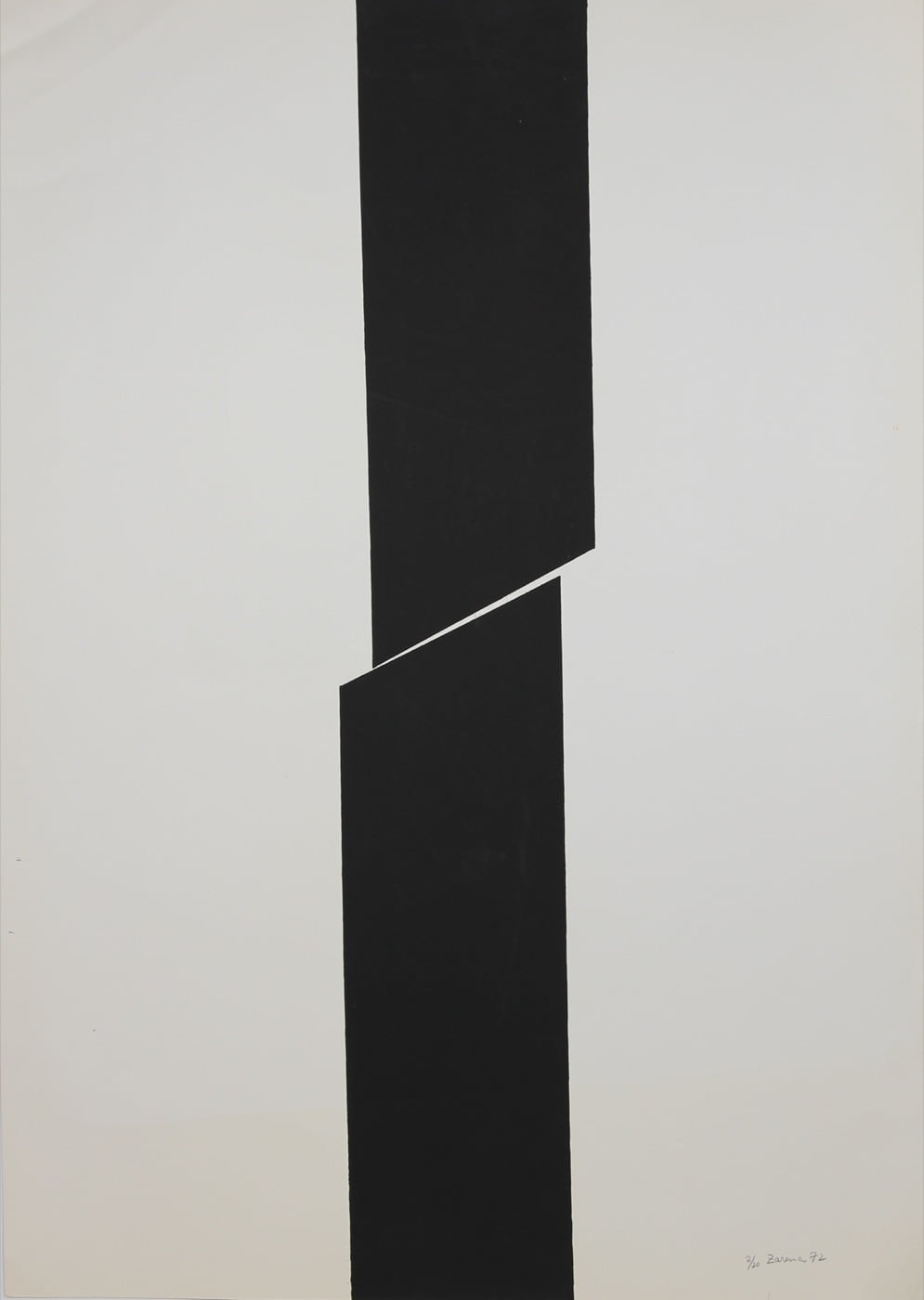
A second Untitled serigraph from 1972 sets two upright black planes against the open sheet. Their edges approach but do not lock together; a narrow diagonal opening interrupts the column and makes the surrounding white inseparable from the printed form. The work is both stable and precarious. A minimal shift in alignment becomes an event, anticipating Zarina’s enduring attention to thresholds, cuts, borders, and structures that almost hold.
Solo exhibition · 1973
Zarina: Woodprints
India Ink Gallery · Los Angeles
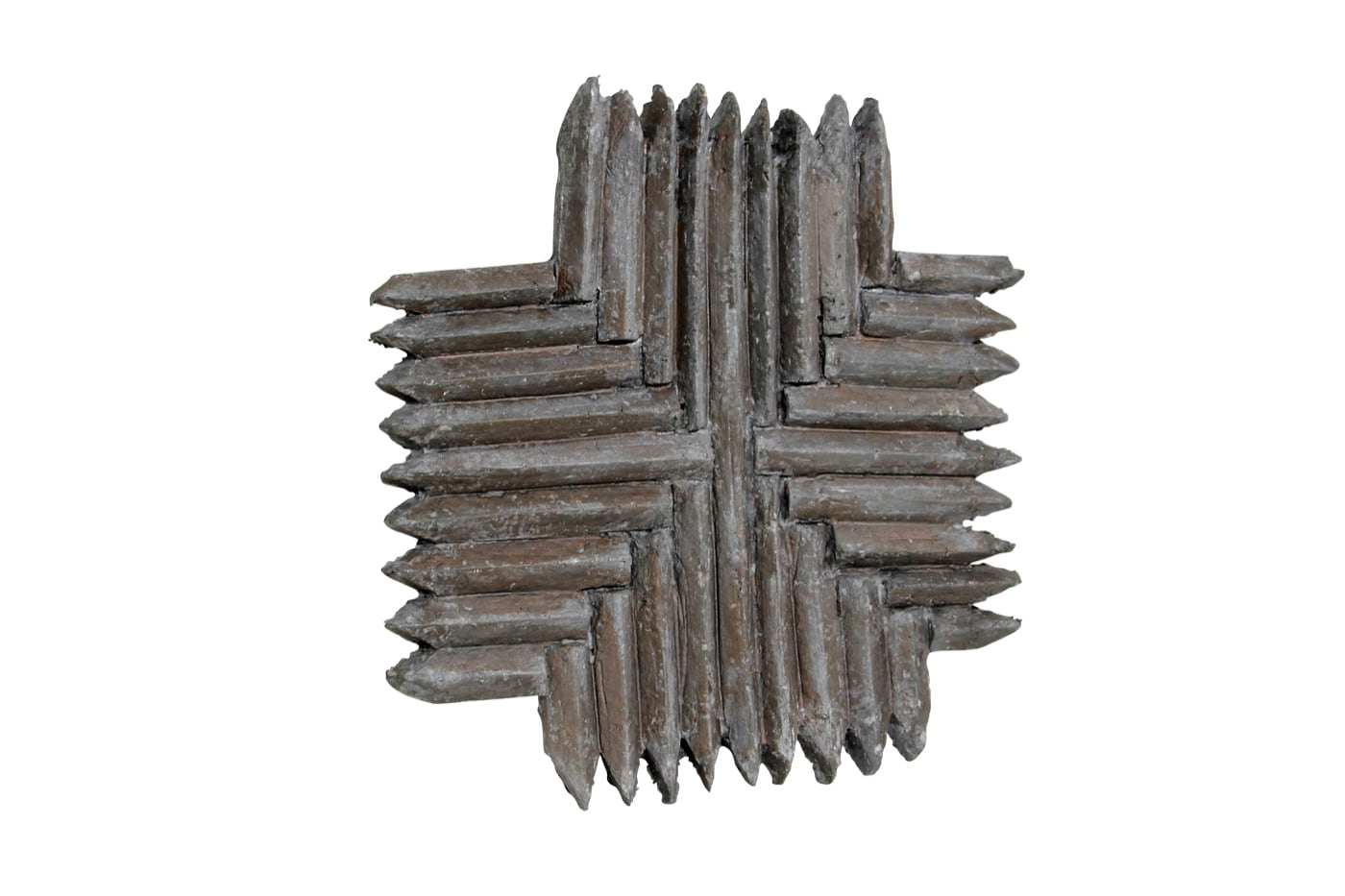
Woodprints introduced Los Angeles audiences to the material language Zarina had been developing after her return to India from Paris. She assembled discarded planks, branches, and fragments of wood into printing surfaces, allowing grain, joins, and irregular edges to remain visible. The block was not a hidden tool behind a polished image; its history entered the print as texture and pressure.
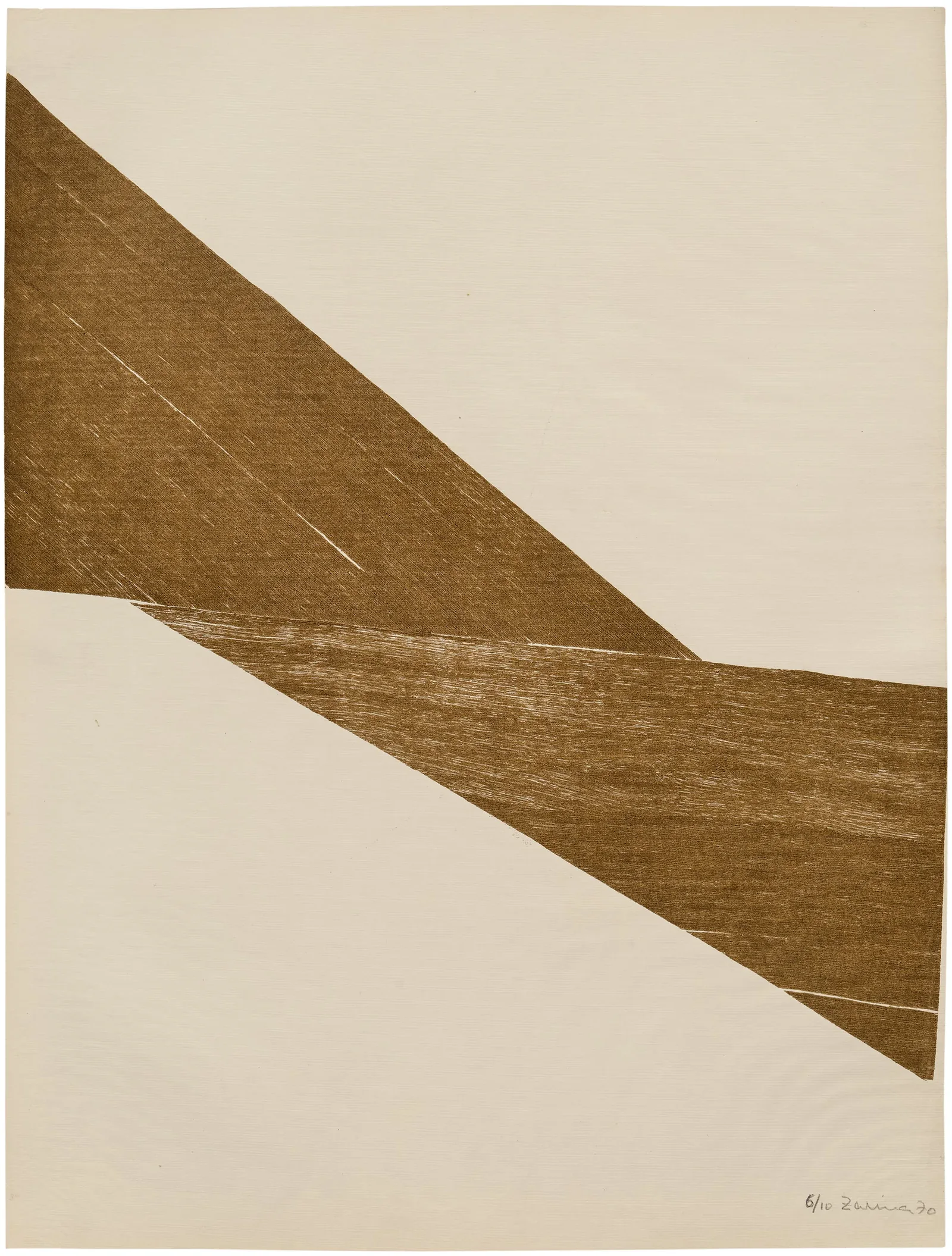
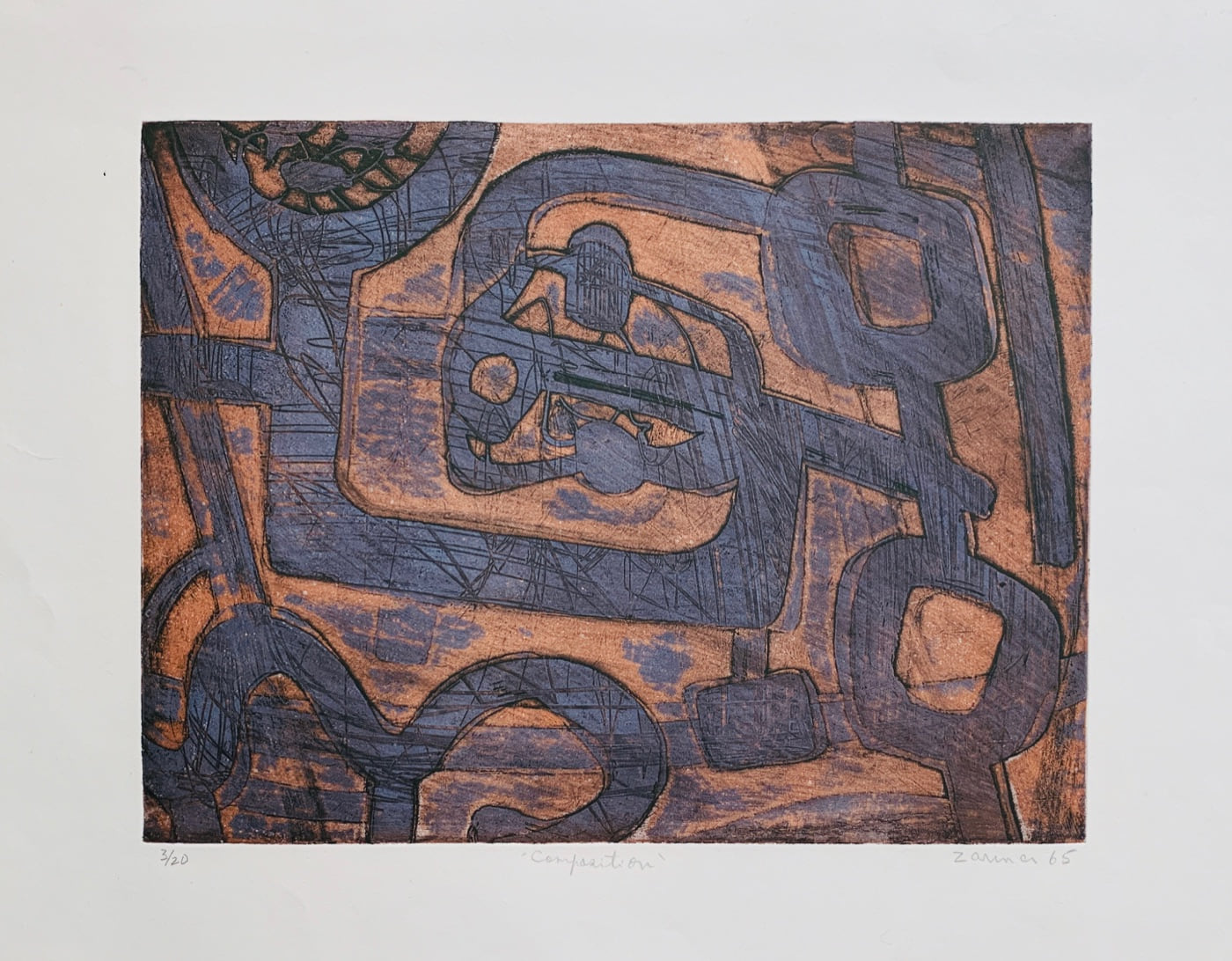
Untitled, 1970, brings two broad planes into a taut crossing. Their burnt-umber fields look monumental from a distance, yet close viewing reveals the streaks and resistance of the wood. Geometry is made through contact rather than perfect measurement. The work establishes an enduring principle in Zarina’s practice: an abstract form could be rigorous while still preserving the evidence of material, labor, and the hand.
Solo exhibition · 1974
Zarina at Triveni Kala Sangam
Triveni Kala Sangam · New Delhi
The Triveni Kala Sangam exhibition belongs to a year of passage between New Delhi and Tokyo, where Zarina deepened her study of Japanese woodblock printing. Her work was already moving toward radical restraint: color diminished, the sheet became an active field, and embossing, cutting, thread, and cord brought touch and shadow into the image.
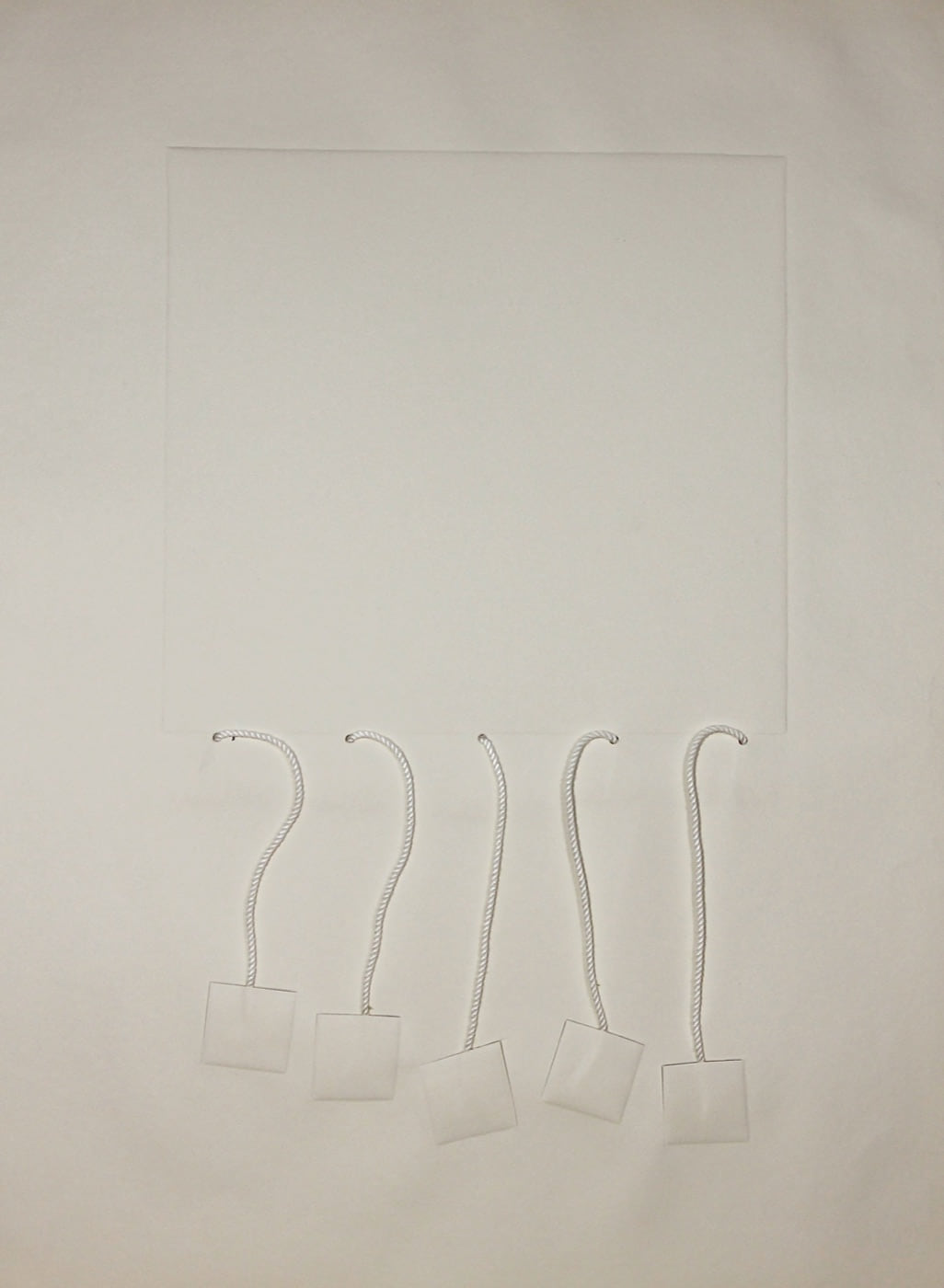
In Untitled, 1974, five silk cords descend from a barely visible embossed rectangle and end in small, uneven squares. The work must be read slowly. White ink, relief, and fiber disclose themselves as light changes, while the cords make drawing physical—lines that hang, bend, and carry weight. What appears empty becomes an intimate construction of interval, balance, and suspension.
International group exhibition · 1974
9th International Biennial Exhibition of Prints
National Museum of Modern Art · Tokyo
The ninth Tokyo international print biennial brought Zarina into a wide survey of contemporary printmaking at the National Museum of Modern Art. The museum’s checklist records Poem for Spring, Untitled, and Family Portrait among her contributions to the international exhibition. Her participation coincided with her study of Japanese woodblock printing in Tokyo, an experience that deepened her understanding of paper, restraint, and the physical intelligence of the print.
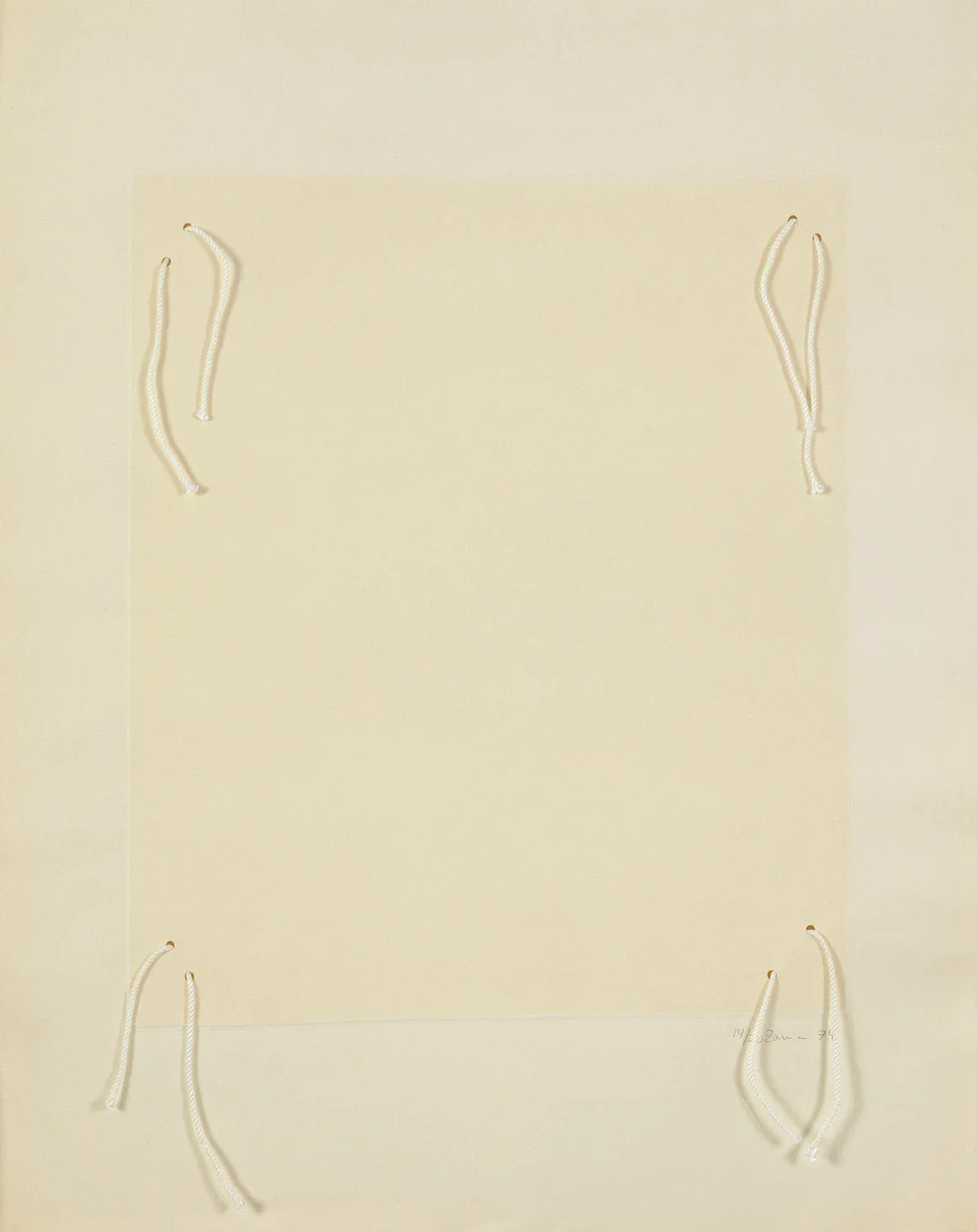
A 1974 Untitled work gives that economy a tactile form. A lightly embossed rectangle is secured near its corners by short lengths of silk cord, so that the sheet reads as image, surface, and constructed object at once. Almost-white materials ask the eye to adjust to shadow and relief. The work’s quietness is exacting: attachment, enclosure, and tension are carried by the smallest shifts in depth.
Group exhibition · 1975
Director’s Choice: 5 Printmakers
Martha Jackson Gallery · New York
Director’s Choice: 5 Printmakers placed Zarina in a focused New York presentation during the year she moved to the United States. Within Martha Jackson Gallery’s program of modern American and European art, the exhibition offered an early encounter with a practice that was already testing where printmaking ended and the object began.
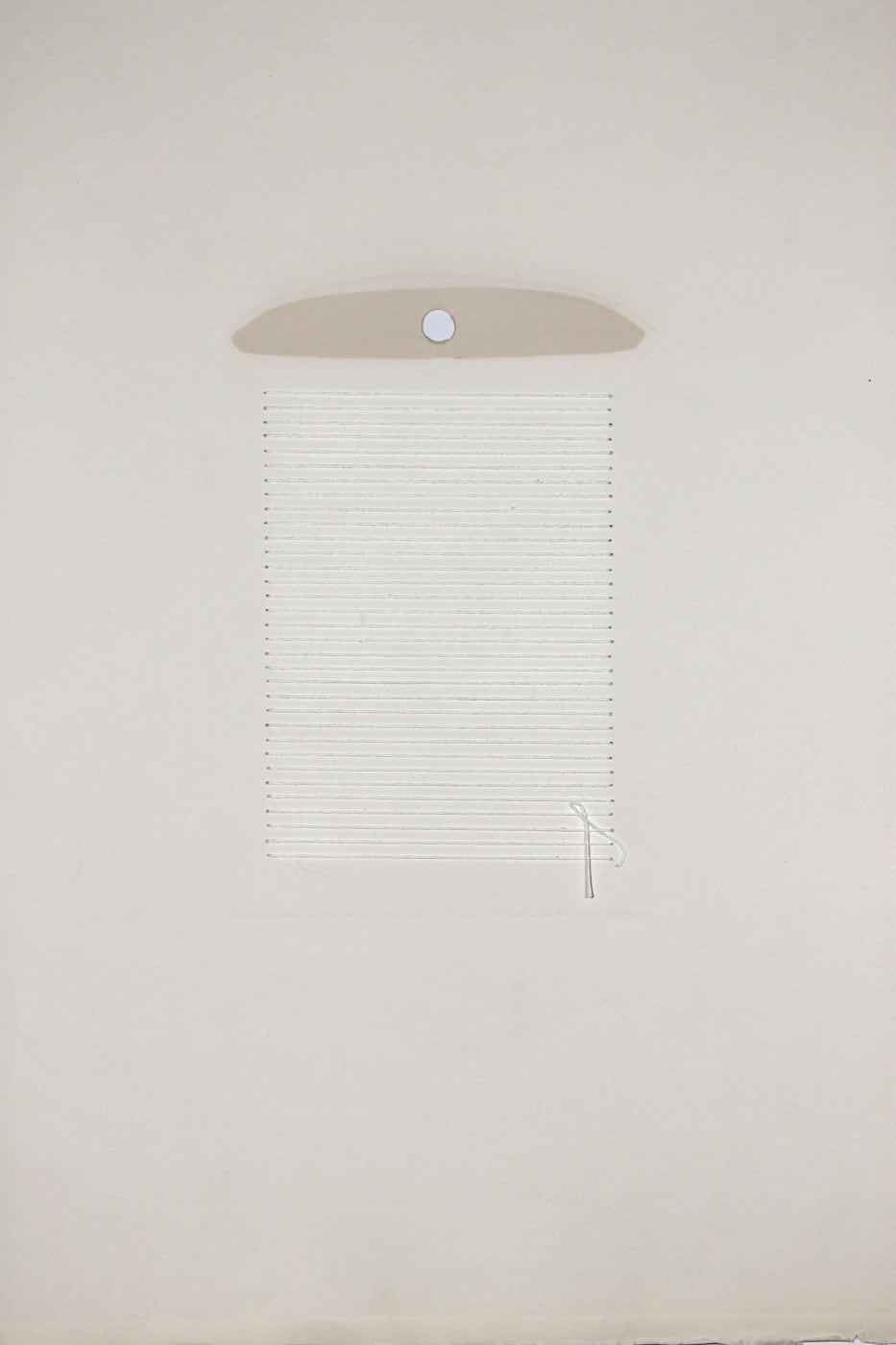
Spool, made in 1975, draws almost entirely with pressure, thread, and shadow. Parallel white lines gather into a measured field before one loose end slips free; above them, a narrow raised form and circular opening suggest the tools and motions of winding. The work turns an ordinary act of making into an image of duration, restraint, and touch.
Solo exhibition · 1976
Zarina at India Ink Gallery
India Ink Gallery · Los Angeles
Zarina’s 1976 return to India Ink Gallery followed her move to the United States and a period in Los Angeles before she settled in New York. The work of these years pares image and color almost to disappearance. Paper, incision, embossing, thread, and wax carry meaning through their physical presence, asking the viewer to approach the surface rather than consume it at a glance.
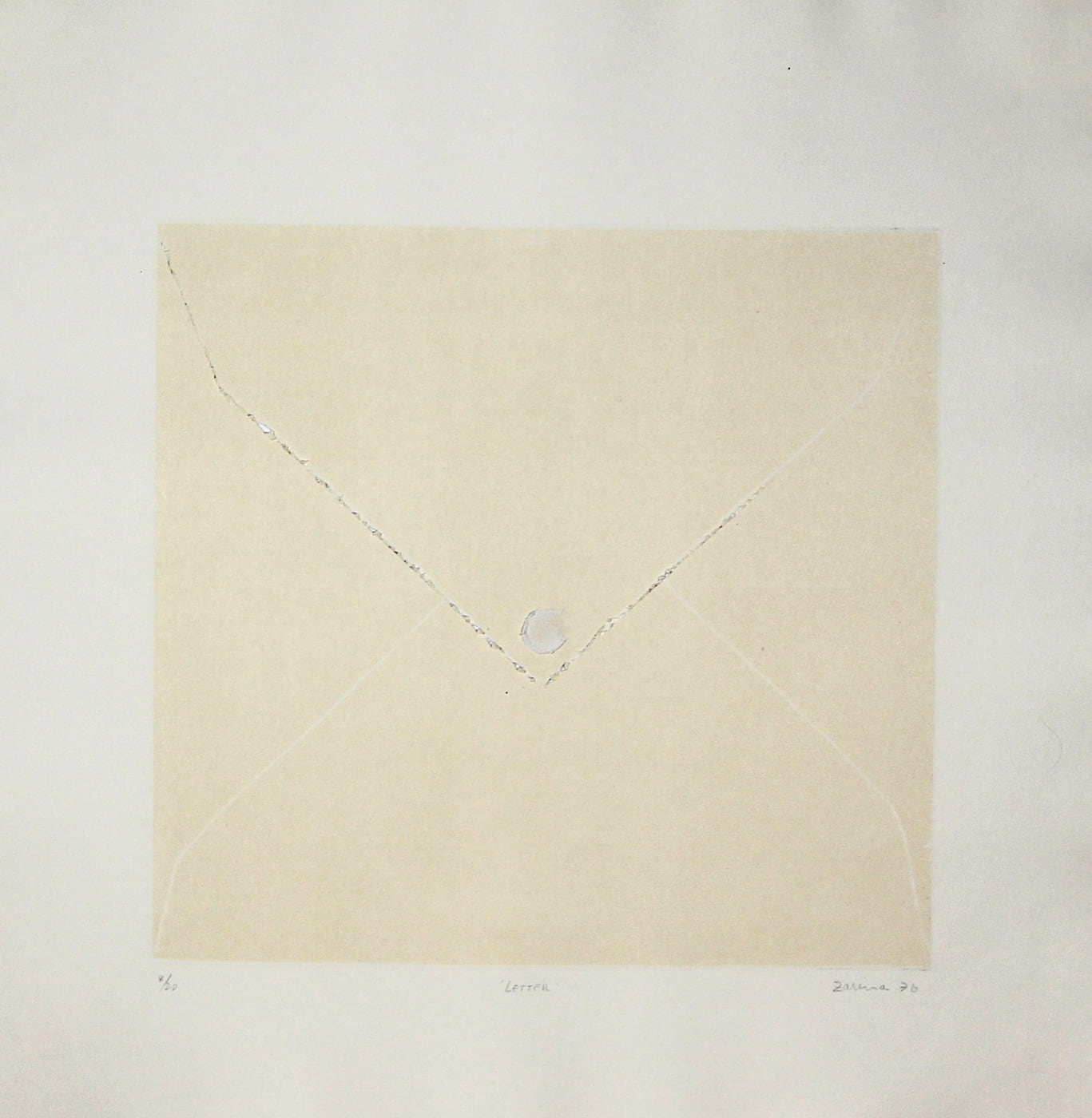
Letter, 1976, turns an envelope into a quiet field of withheld communication. Its folds are traced in scratches and white aquatint; a small disk of sealing wax gathers the composition at its center. The image holds intimacy and distance together. A letter promises connection, but while it remains sealed its contents belong to memory, anticipation, and absence.
Solo exhibition · 1977
Zarina Hashmi at Galleri Alana
Galleri Alana · Oslo
The Oslo exhibition belongs to a pivotal passage in Zarina’s work. Having settled in New York in the mid-1970s, she was moving beyond the conventional boundary of the print: ink could recede, the sheet could be pierced or pressed, and the smallest physical intervention could make light and shadow part of the image.
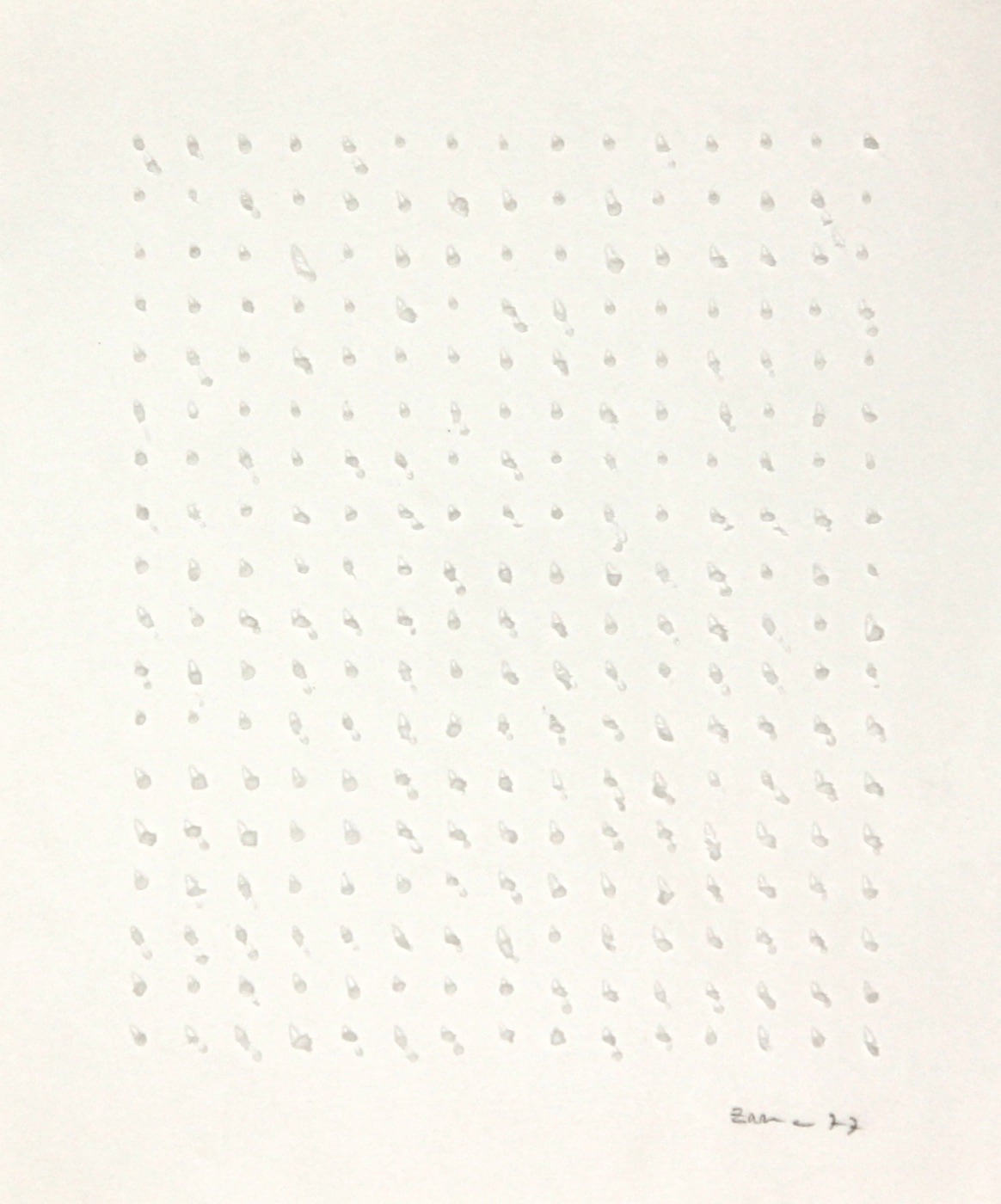
Untitled, 1977, gives that economy an almost architectural scale. Hundreds of punctures form a quiet, ordered field, but their slight differences preserve the rhythm of the hand. The marks are at once present and absent—openings made by removing material—and anticipate Zarina’s later cast-paper reliefs, in which the sheet would become both image and object.
Invitational exhibition · 1978
1978 Invitational
SOHO20 Gallery · New York
Zarina’s inclusion in SOHO20’s 1978 invitational connected her to an artist-run gallery founded by women to create opportunities that the established art world withheld. The exhibition preceded her work with the feminist journal Heresies and her co-organization of Dialectics of Isolation, but it already places her within the networks of women artists through which she would help widen the terms of feminist practice in New York.
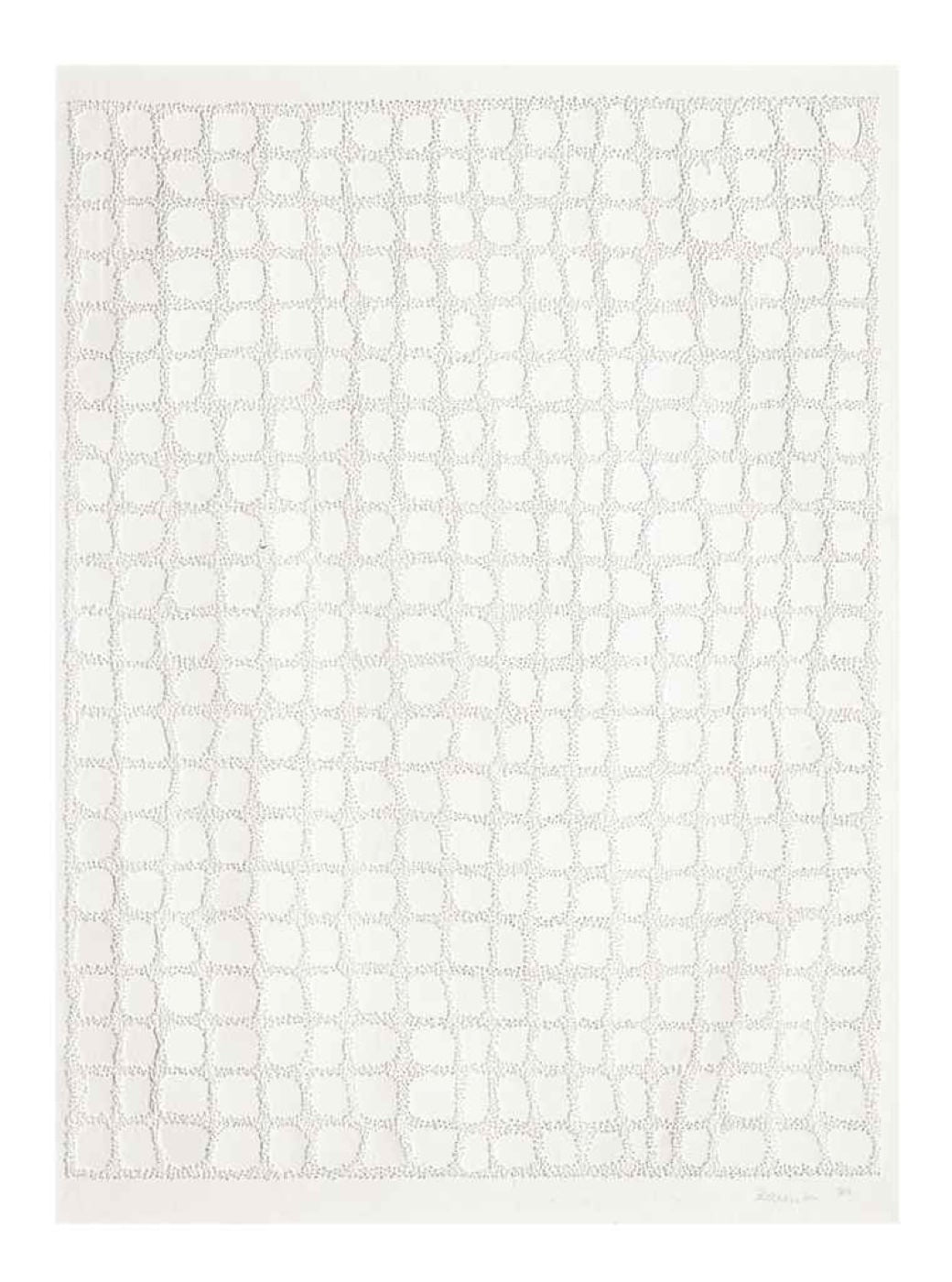
An Untitled pin drawing from 1978 makes that period’s quiet intensity visible. Thousands of punctures accumulate into an uneven lattice, allowing air and light to pass through the sheet. The repeated mark is disciplined but never mechanical: each opening records the pressure of a hand, and absence becomes the substance of the drawing.
Group exhibition · 1978
Contemporary Artists of India
Alternative Center for International Art · New York
Contemporary Artists of India brought Zarina’s work into an alternative New York institution founded in response to a segregated art world. Rather than treating modernism as a single Western story, the exhibition made space for artists whose practices moved across nations, materials, and cultural histories. For Zarina, those crossings were not an abstract internationalism: they were lived through travel, migration, language, and the continuing pull of home.
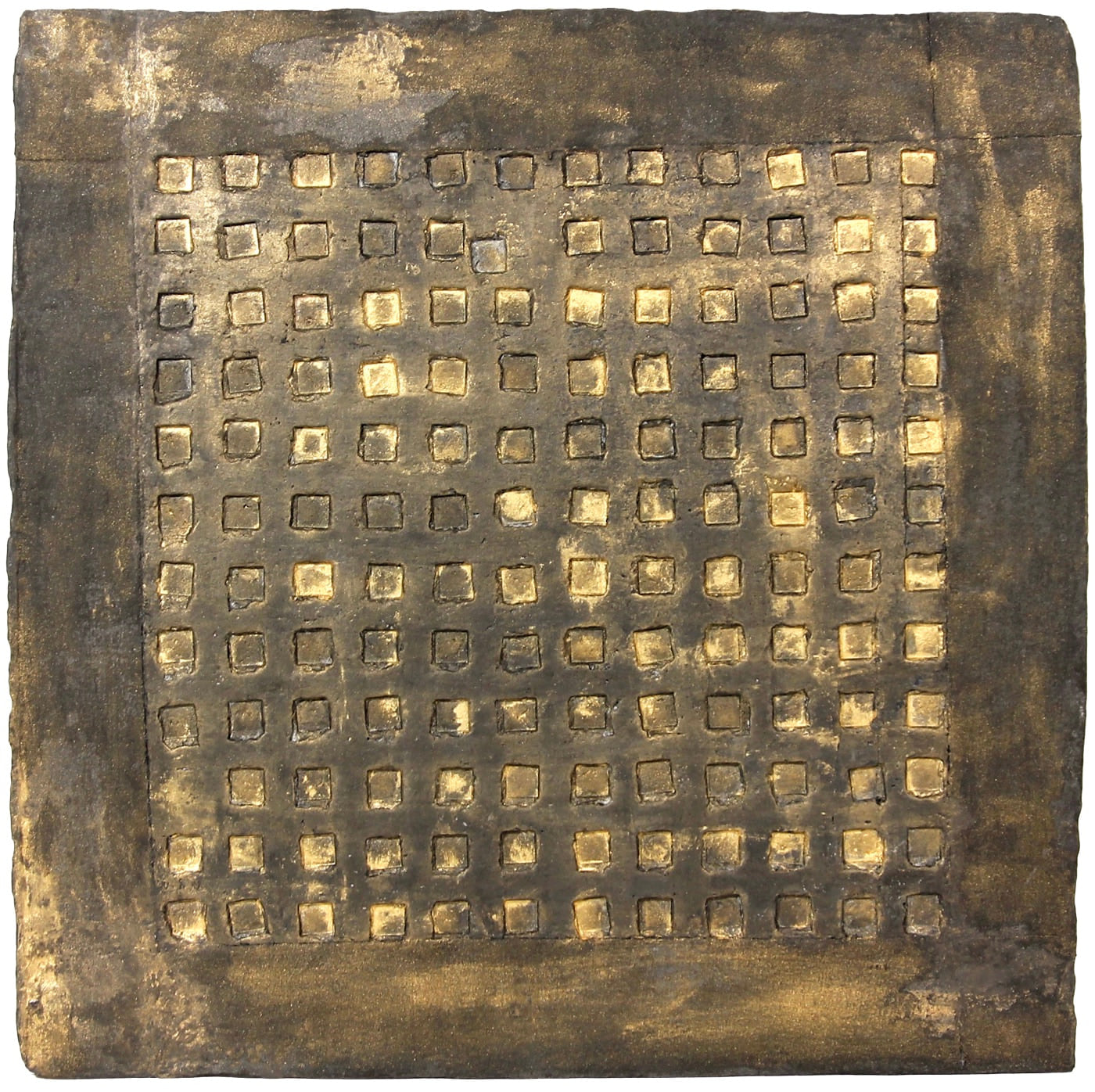
Wall, made the following year, shows how forcefully those experiences could enter abstraction. Cast paper is worked into a dark, roughly edged square whose recessed grid catches flashes of gold. The structure can suggest a city, a plan, or an enclosure, yet its handmade surface refuses architectural certainty. Order and instability remain present together.
Group exhibition · 1978
Contemporary Indian Artists
New India House · New York
Contemporary Indian Artists formed another point of encounter between Zarina’s New York practice and artists connected to India. Such a title can suggest a stable national category, but Zarina’s work complicates that frame. By 1978, her life and practice had already crossed Aligarh, Bangkok, New Delhi, Paris, Bonn, Tokyo, Los Angeles, and New York. Place remained essential, yet belonging could no longer be contained by one address or nation.
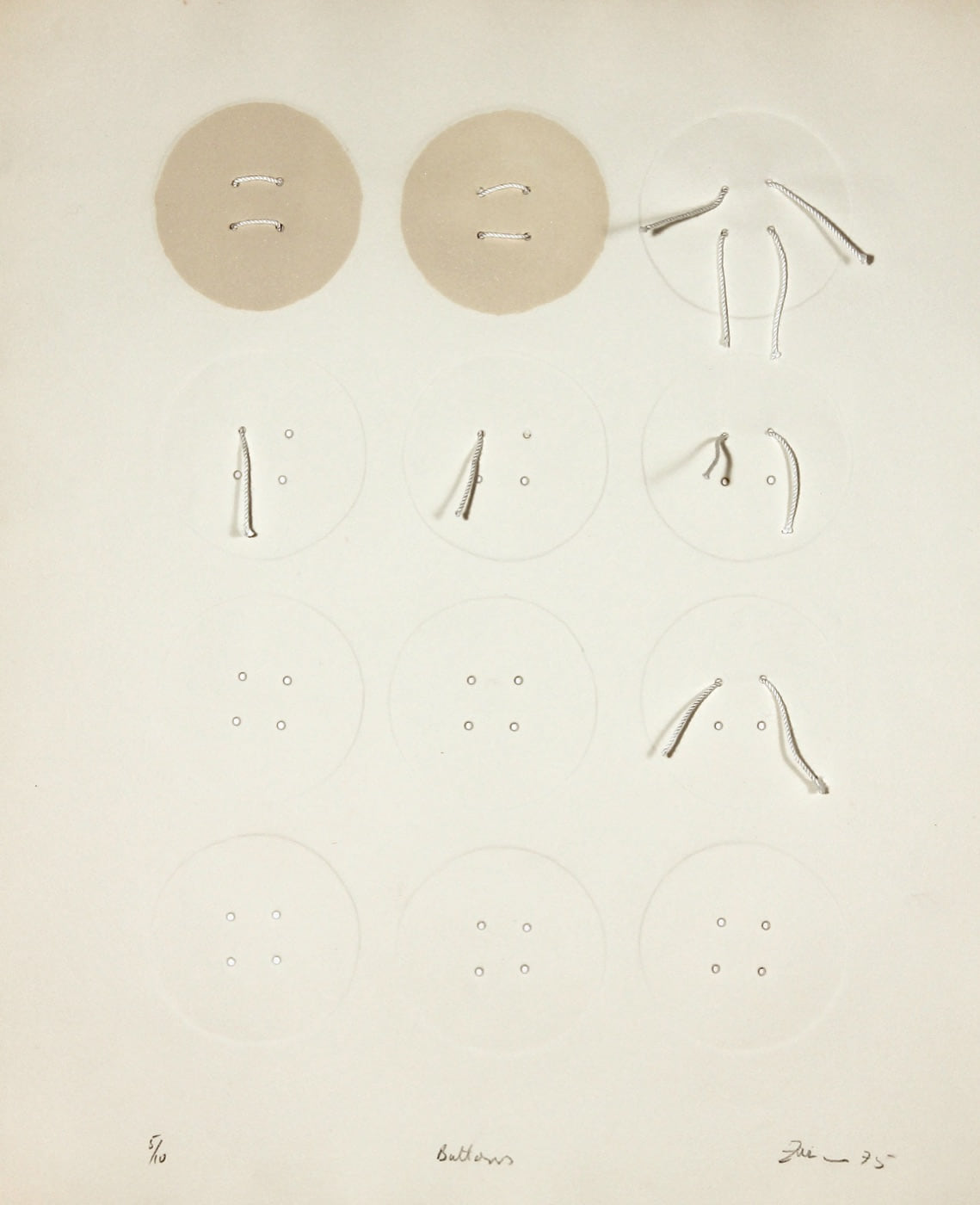
Buttons, made in 1975, offers a nearby material point of reference. A vertical column of small circular forms interrupts a white embossed sheet, while shallow pressure and minute shadows make the surface change with the viewer’s position. The familiar object is reduced to rhythm and trace: modest, intimate, and held close to the body without depicting it.
Artist-organized exhibition · 2–20 Sep 1980
Dialectics of Isolation
A.I.R. Gallery · New York
Co-curated by Zarina, Ana Mendieta, and Kazuko Miyamoto, Dialectics of Isolation created a space for artists whose work had been marginalized within both the New York art world and the predominantly white feminist movement. The exhibition grew from friendship, shared organizing, and an internationalist understanding of “Third World women” as a political coalition rather than a single identity.
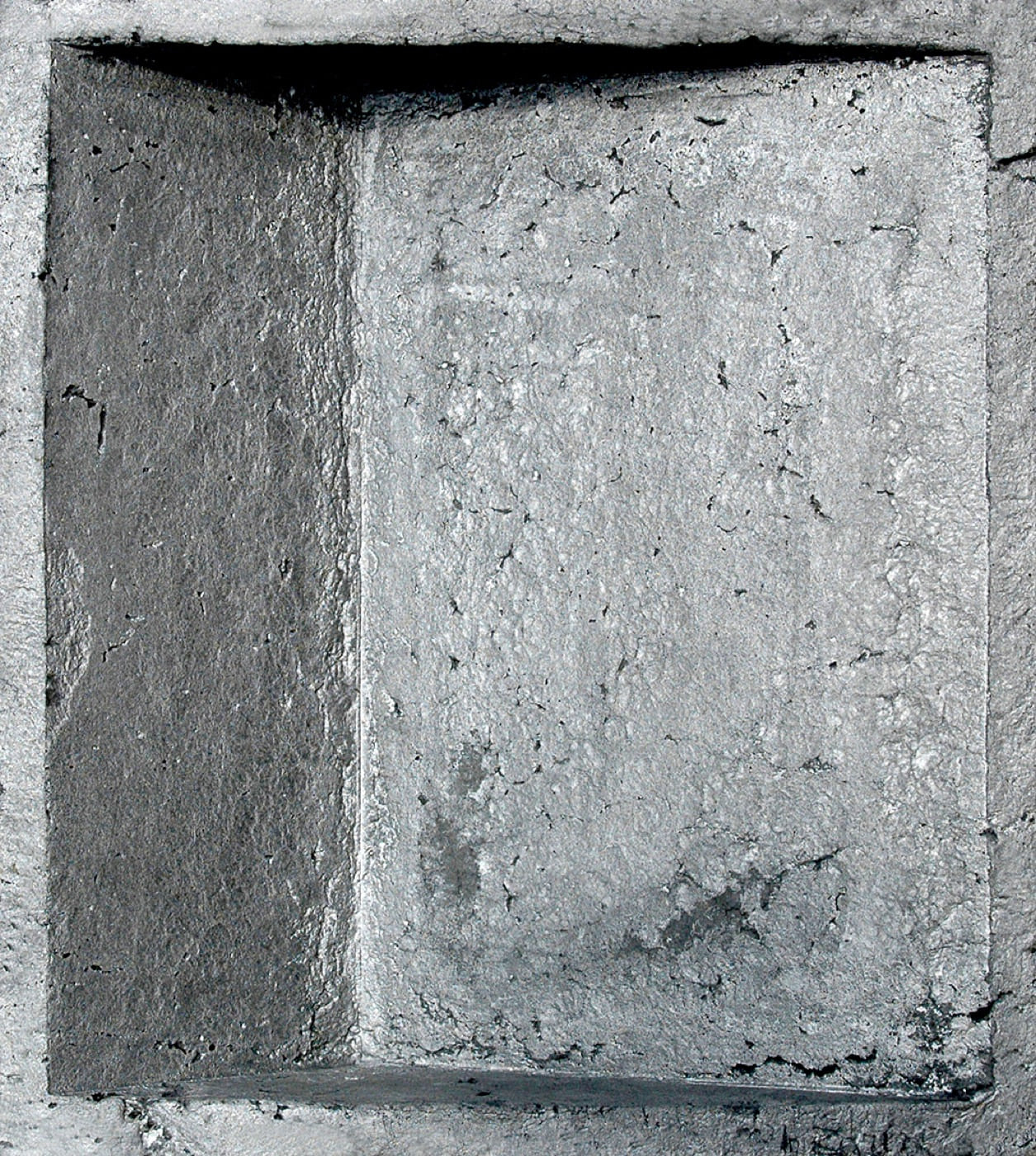
Zarina exhibited Corners, a graphite-dark relief cast from handmade paper pulp. Its compressed surface and recessed geometry gave apparent weight to a materially light object. In the company of works by artists including Beverly Buchanan, Senga Nengudi, and Howardena Pindell, its abstraction carried history through material and form rather than illustration, joining a collective refusal of the idea that political art must always announce itself literally.
Group exhibition · handmade paper · 1980
Rag Suite
Kleinert/James Center for the Arts · Woodstock, New York
Organized by Women’s Studio Workshop as an exhibition of handmade paper, Rag Suite belonged to a moment when artists were testing paper beyond its familiar role as a surface for drawing or print. Fibres could be coloured, pressed, moulded, layered, and built into low relief. For Zarina, those processes extended the physical logic of printmaking: pressure still made the image, but paper itself now carried the depth, edge, and weight of the work.
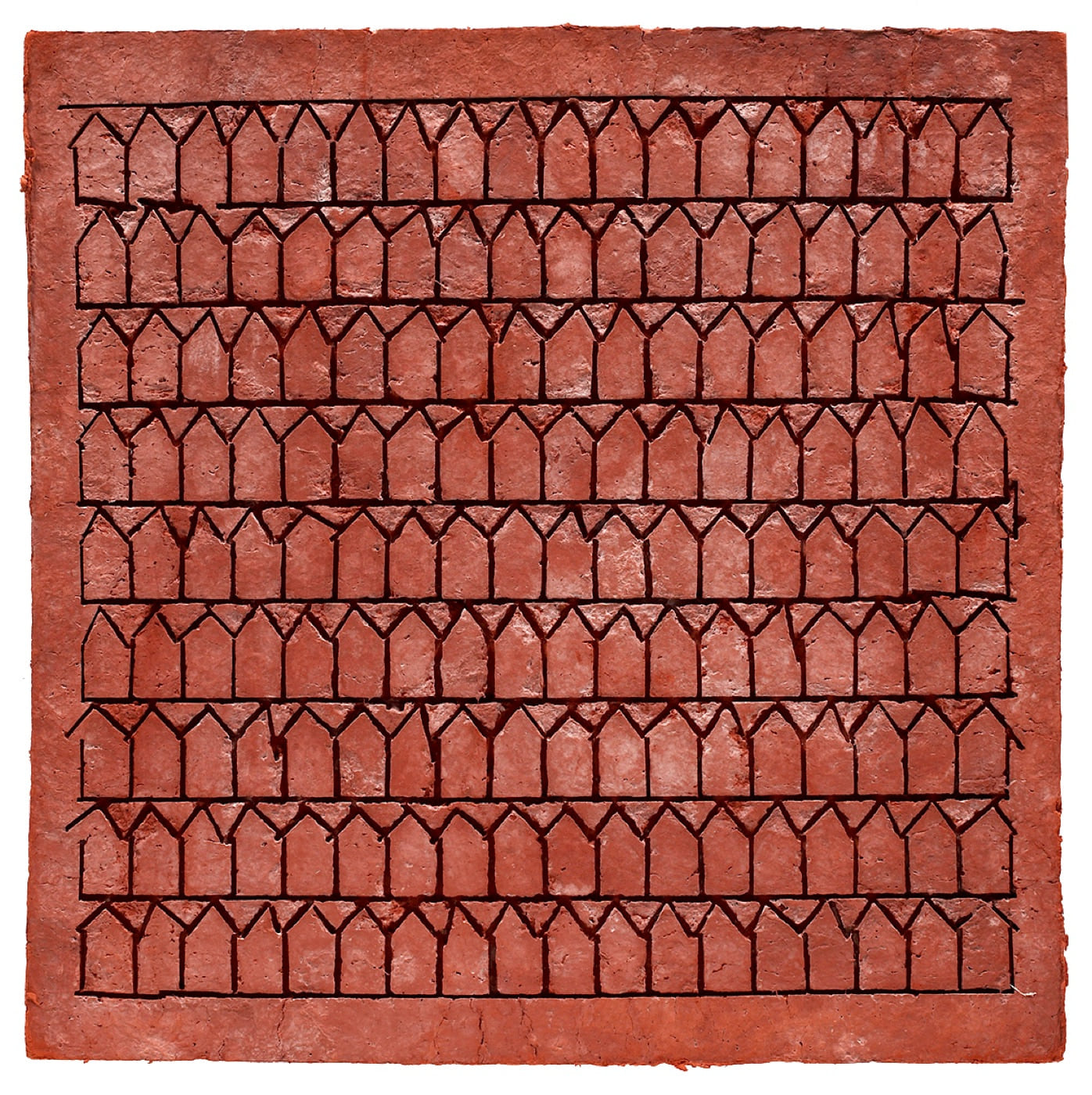
Traces, made in 1980, provides a period point of reference. Rows of small house forms are pressed into terra-rosa pulp, each one recognizable yet altered by the irregular handmade surface. The repeated dwelling becomes less a stable building than a mark left behind—a memory counted through touch, material, and the small differences that survive repetition.
Group exhibition · organized by the New York Feminist Art Institute · 5–9 Mar 1981
Transformations: Women in Art 70’s–80’s
New York Coliseum · New York
Organized by the New York Feminist Art Institute, Transformations placed work by women across the 1970s and the opening of the 1980s into a public, intergenerational frame. Zarina entered that conversation after teaching papermaking at the institute and after helping create spaces in which women of colour could speak from materially and culturally distinct positions. Her work enlarged feminist art without requiring identity to appear as a literal image.
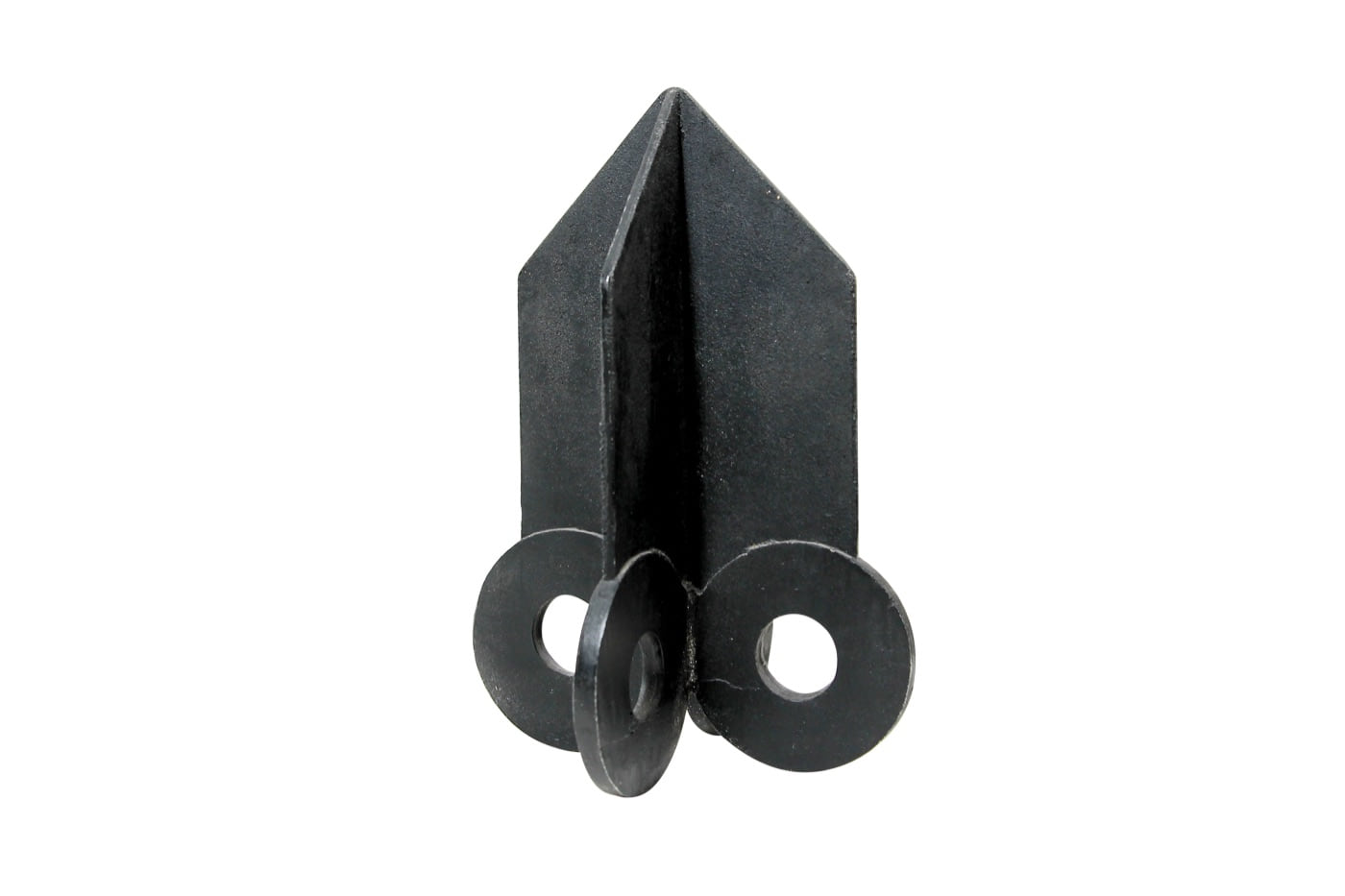
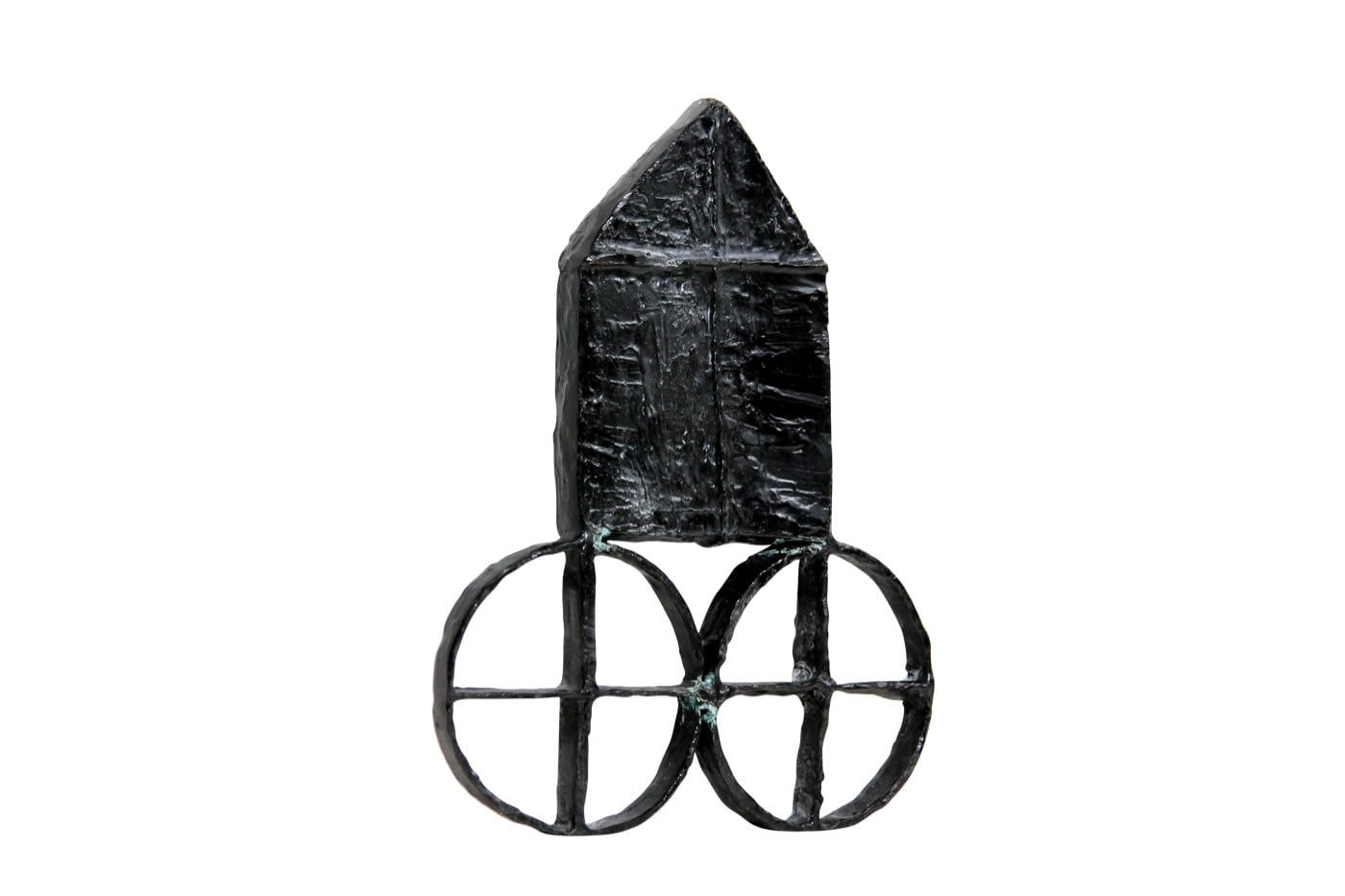
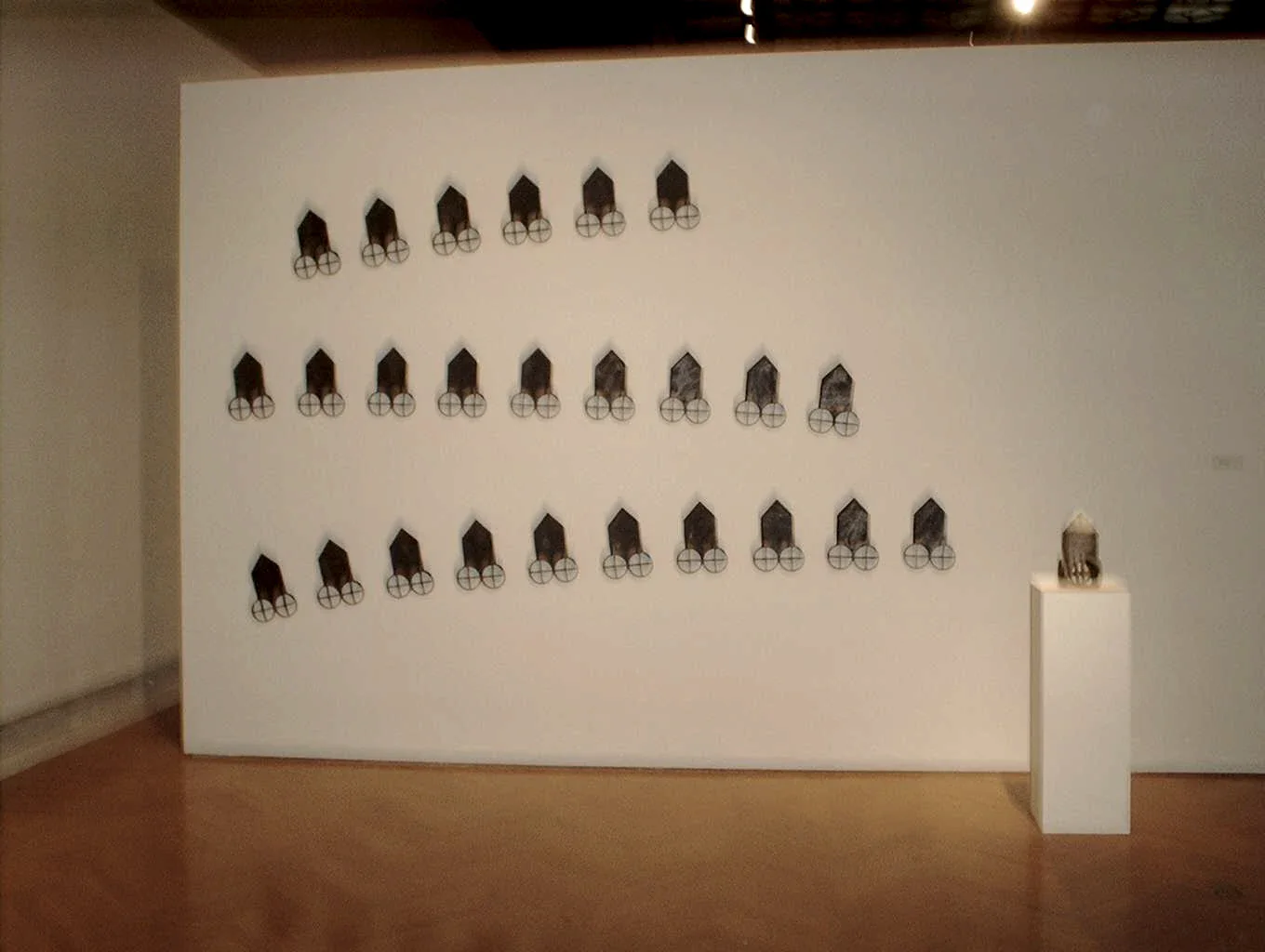
House on Wheels II, made in 1981, turns the compact sign of a dwelling into a mobile cast-aluminium object. Three open wheels support a dark, sharply folded house, giving shelter the possibility of movement while denying it permanence. The sculpture condenses migration, autonomy, and precarious belonging into a form that appears sturdy yet cannot settle.
Group exhibition · selected by Camille Billops · 1981
Installations in the Five Elements
Kenkeleba House · New York
Installations in the Five Elements gathered twenty-four women at Kenkeleba House, most of them women of colour, around an elemental theme that encouraged artists to adapt their own materials and languages. The setting mattered. Kenkeleba had been founded to sustain African American culture while opening space to artists overlooked by the mainstream, and the exhibition joined formal experiment to that broader work of visibility and community.
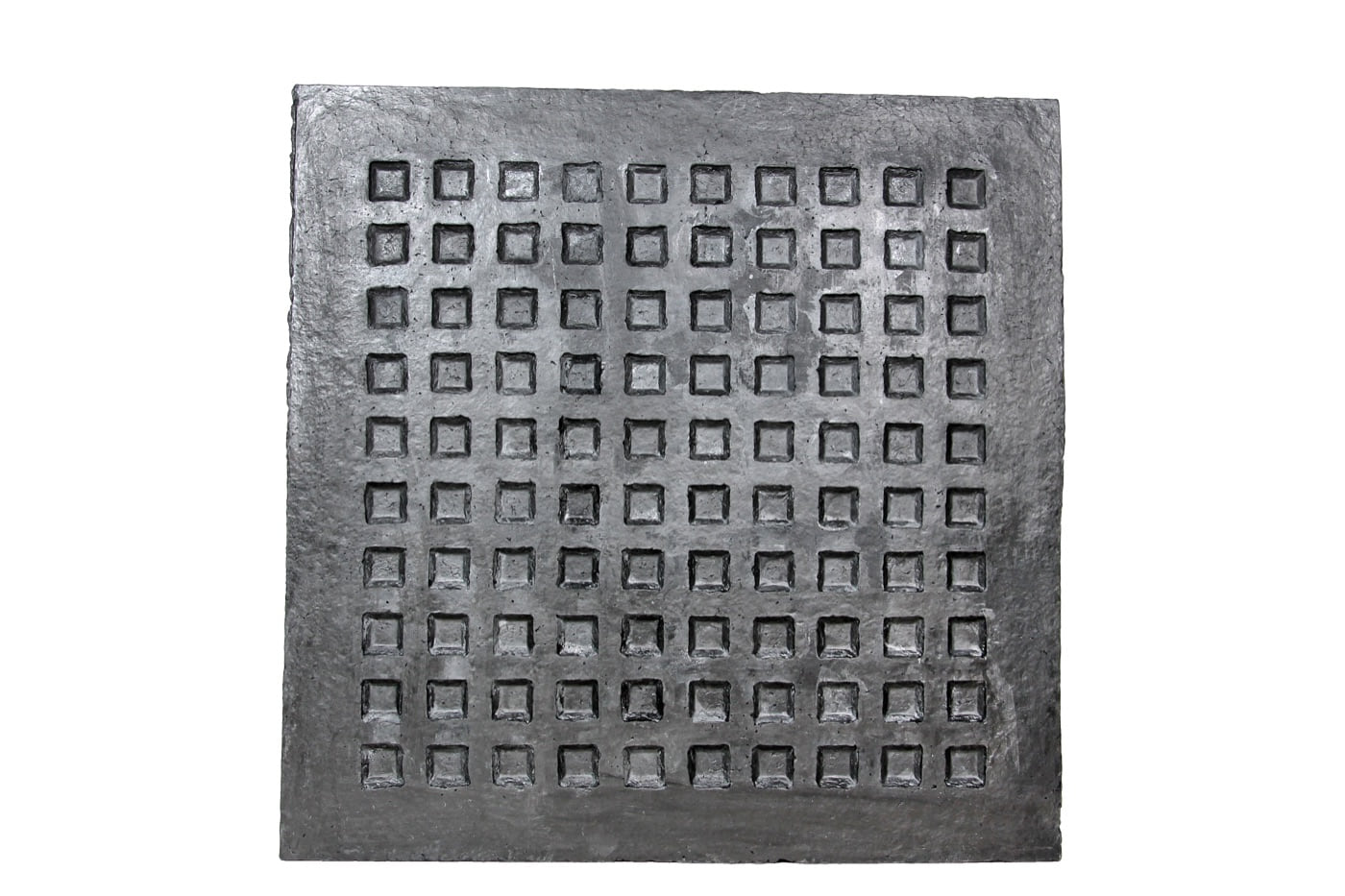
Pools, made the previous year, offers a closely related material lens. A field of recessed squares emerges from a dark, uneven sheet of cast paper. Light settles differently in every hollow, so a strict grid becomes tactile and changeable. The work moves between diagram and terrain, suggesting contained water, rooms, or repeated sites without fixing a single reading.
Group exhibition · paper and print · 1981
Paper: Painted, Printed, Plyed
Kala Gallery · Berkeley
At Kala Gallery, the exhibition title treated paper as an active material with several lives: it could receive paint, carry a printed impression, or be folded, layered, and worked into form. Kala had been founded as an international workshop and forum for exchange, a context well suited to Zarina’s refusal of a fixed boundary between print, drawing, sculpture, and handmade paper.
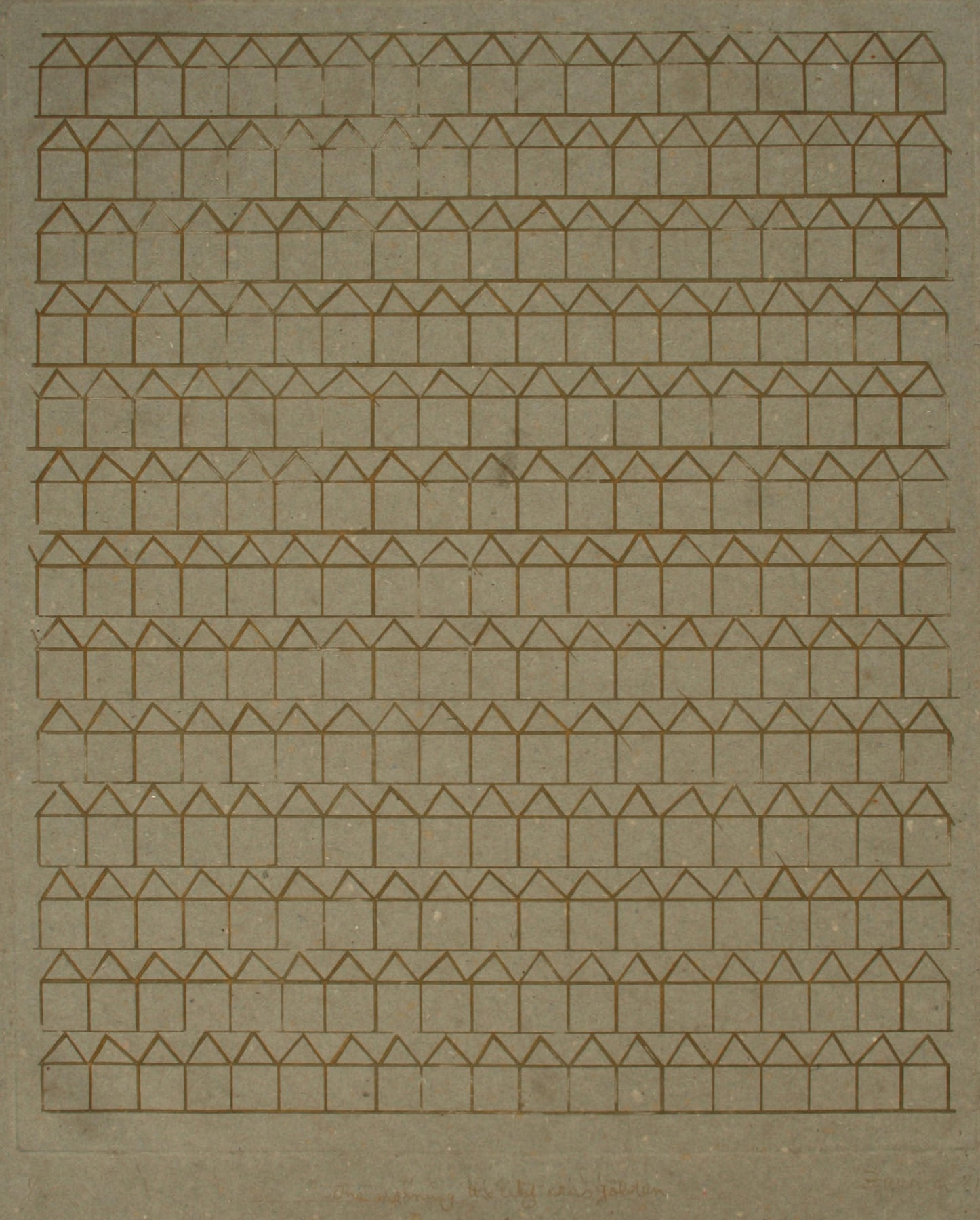
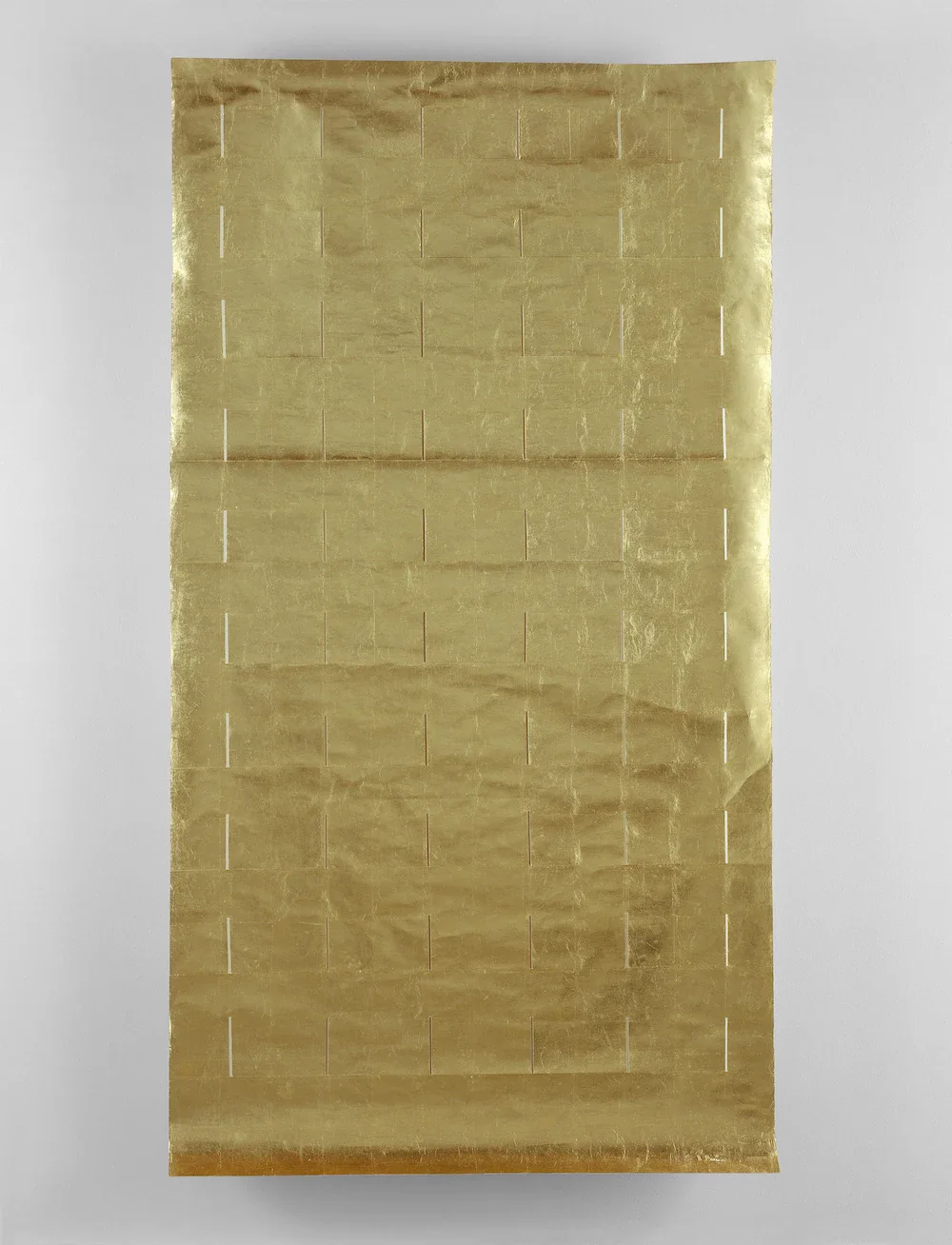
In One morning the city was golden, made that year, repeated house outlines extend across zaan paper in restrained gold ink. Their apparent regularity is interrupted by gaps, overlaps, and changing pressure. The city is built from a single remembered sign, but it never becomes uniform; repetition holds together abundance and loss, collective dwelling and individual absence.
Group exhibition · six Asian printmakers · 1982
An Asian Vision: Identity and Conflict: 6 Asian Printmakers
Fred Parker Giles Gallery, Eastern Kentucky University · Richmond, Kentucky
An Asian Vision brought six printmakers together around identity and conflict at a moment when “Asian” named neither one visual language nor one uncomplicated geography. For Zarina, who had lived and worked across South Asia, Europe, Japan, and the United States, the print could hold that complexity without turning experience into illustration. A line might be a route, a border, a memory, or a structure of belonging.
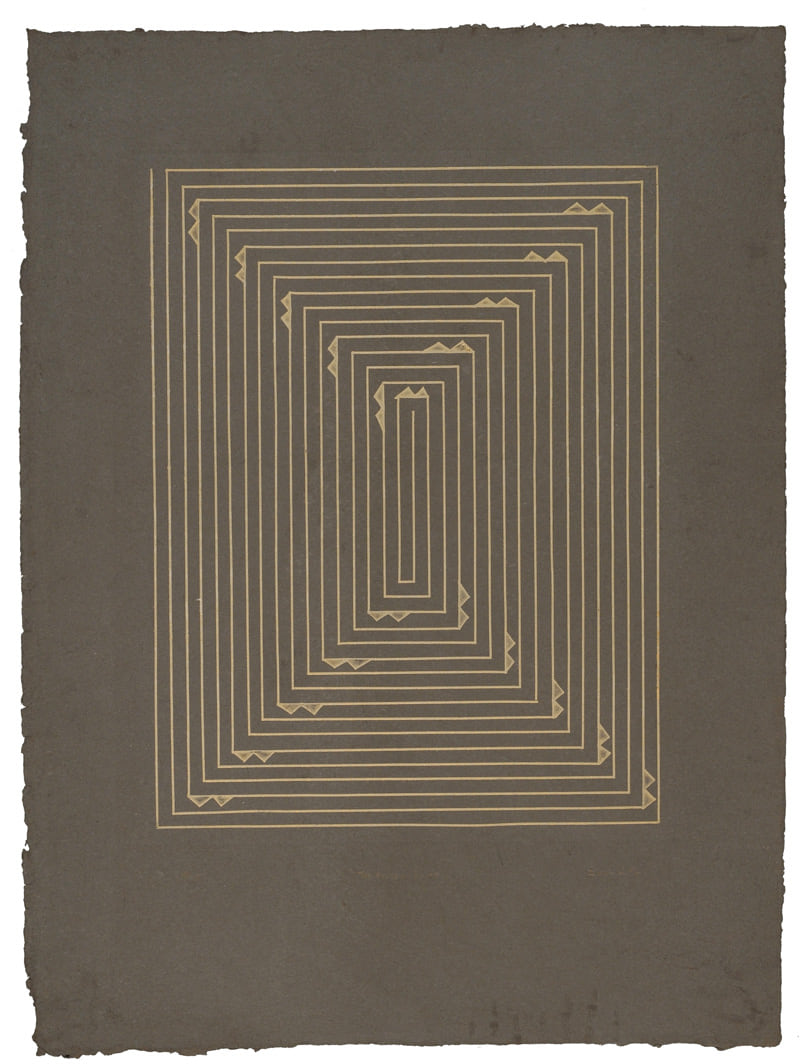
Golden Route, made in 1982, offers a period point of reference. Fine gold lines cross and double back over a grey handmade sheet, joining small forms that resemble houses, markers, or destinations. The precious metal catches light, but the route never resolves into a map that can be followed. Movement becomes both possibility and distance, shaped by the places one carries as much as by the places one reaches.
Group exhibition · artists living beyond India · 1982
Indian Artists Abroad
Gallery Chemould · Bombay
Indian Artists Abroad placed geographic distance at the centre of its frame, but Zarina’s practice resists treating “abroad” as a single condition. Her life moved through many cities, while language, memory, and the architecture of Aligarh continued to shape the work. Place was not exchanged for placelessness; it became layered, carried, and remade through material and form.
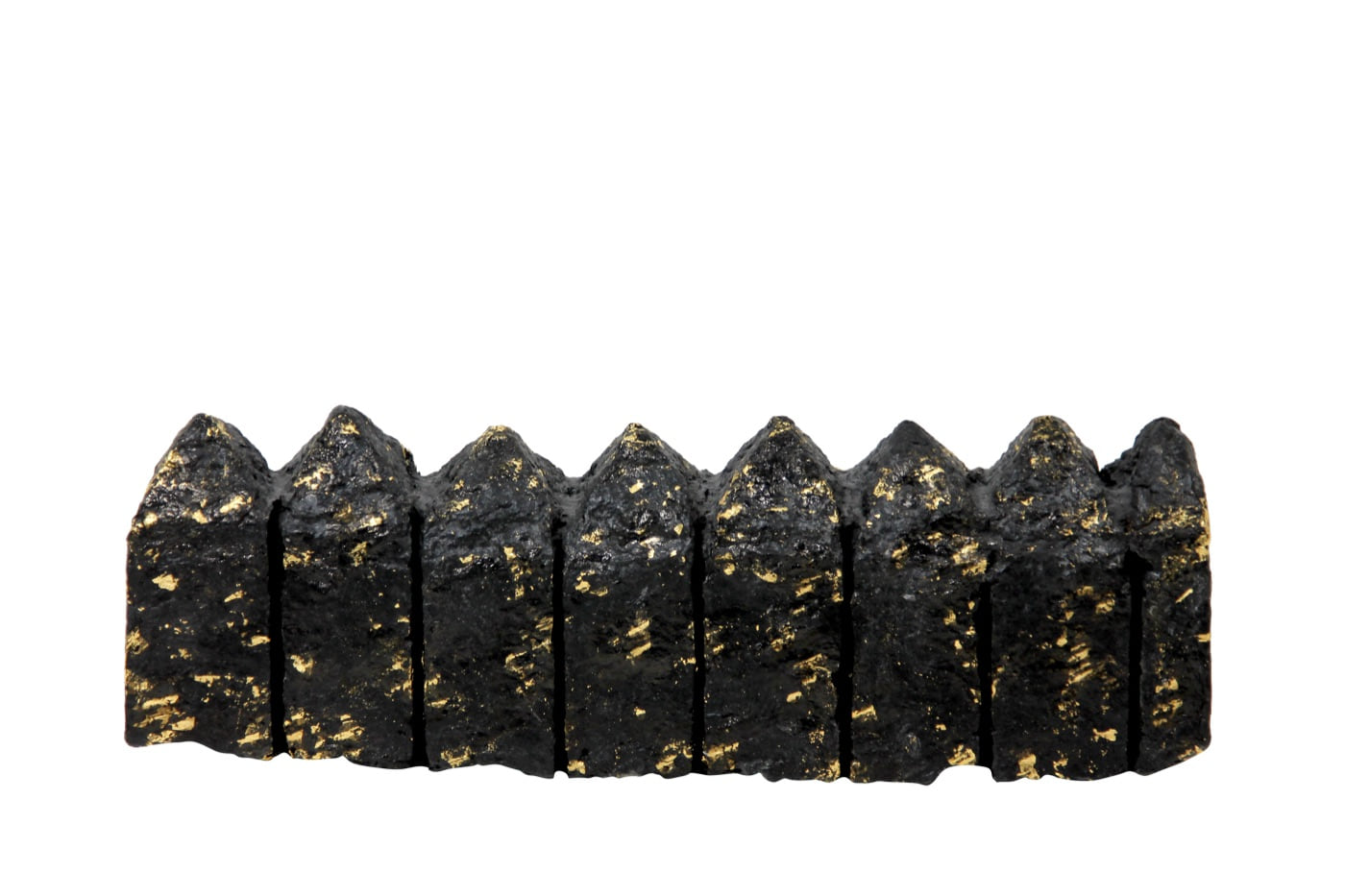
Houses, made that year, provides a closely related lens. Eight small cast-paper dwellings stand in a measured row, similar enough to form a sequence yet different in profile, colour, and surface. Their compact scale makes architecture portable. Home appears not as one recoverable building but as a group of fragments—darkened, gilded, repeated, and held together by memory.
Group exhibition · Making Paper programme · 20 May–3 Oct 1982
Papermaking USA
American Craft Museum · New York
Presented as part of the American Craft Museum’s Making Paper programme, Papermaking USA surveyed a medium undergoing rapid reinvention. Handmade fibre could become print, painting, relief, sculpture, installation, or an object whose surface preserved the gestures of pulping, pressing, and moulding. The exhibition’s breadth made paper visible as a material with its own structure and history rather than a neutral support.
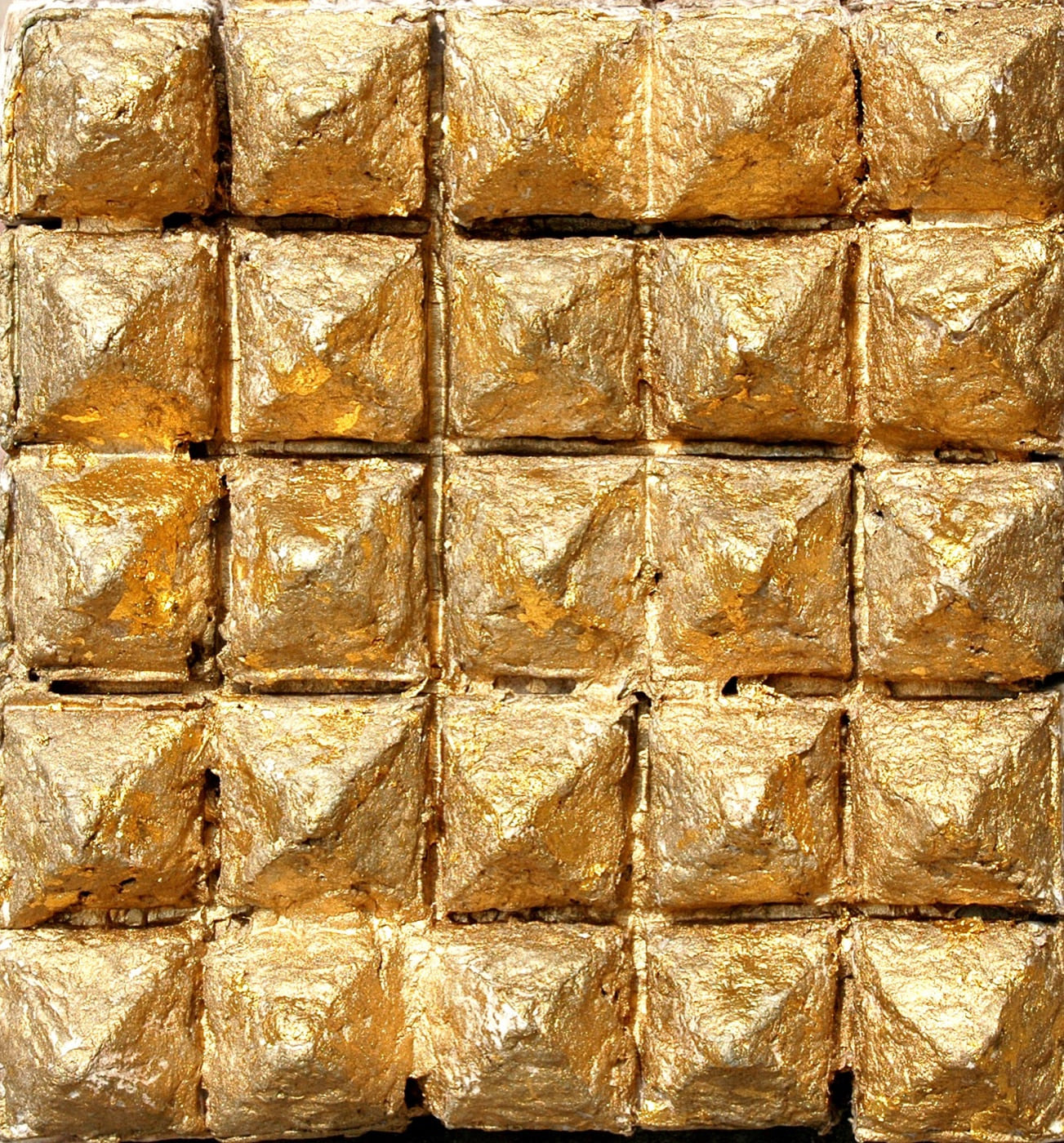
Roofs, made in 1982, gives that transformation architectural force. Repeated raised forms are cast directly into the sheet and covered with gold leaf, so paper appears dense, metallic, and built. The grid suggests an aerial view of closely gathered dwellings, yet changes in height and reflection keep it from becoming uniform. Light moves across the relief like memory across a city—revealing one surface while another recedes.
Group exhibition · traveling paper-art survey · 7 Nov 1982–13 Jan 1983
The New Explosion: Paper Art
Fine Arts Museum of Long Island · Hempstead, New York
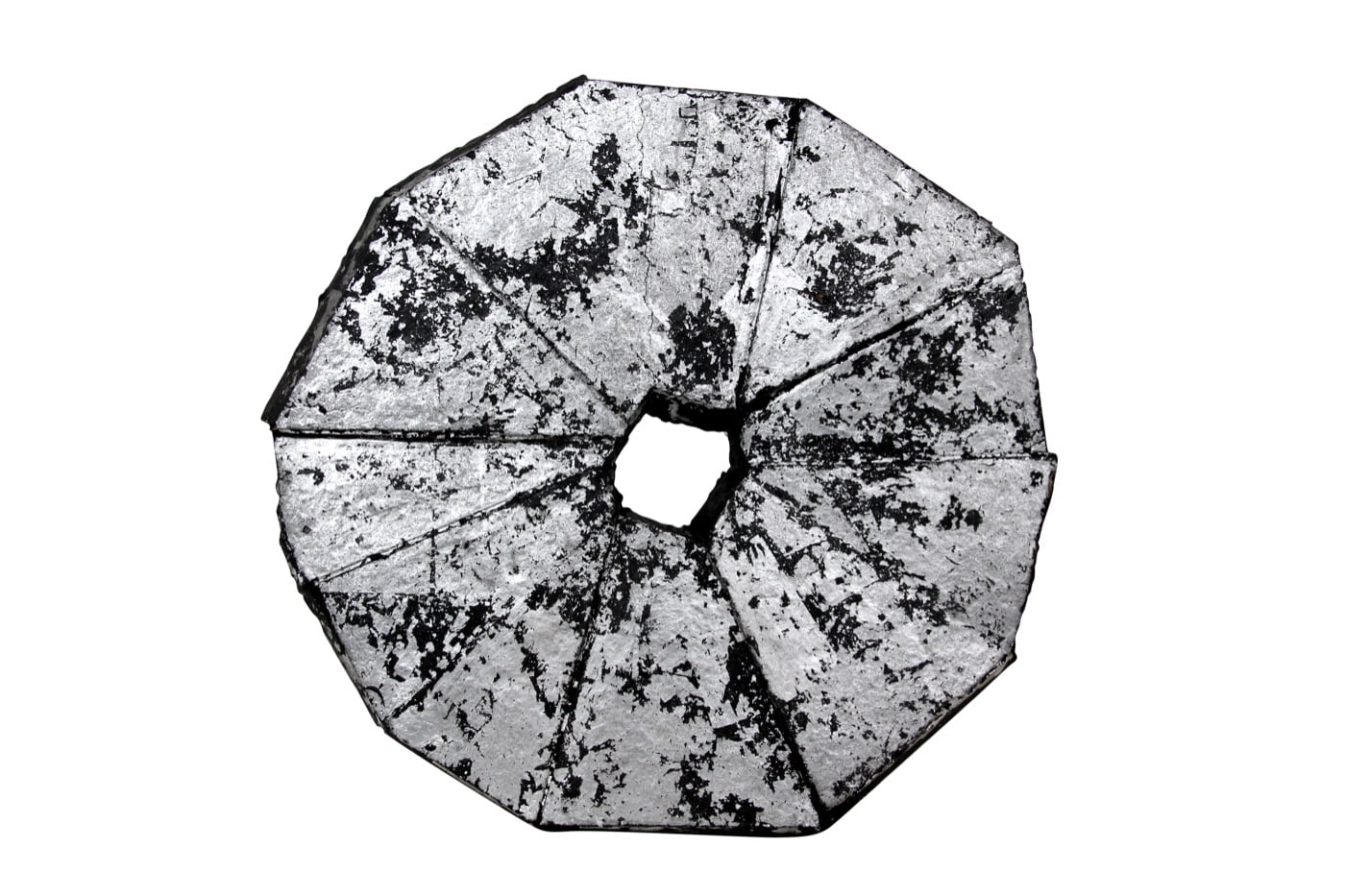
The New Explosion: Paper Art belonged to an international surge of attention to paper as an autonomous medium. The exhibition gathered works that moved beyond the flat sheet into relief, construction, pulp painting, and sculpture, then travelled to CDS Gallery in New York. Its title captured both technical experimentation and the sense that a familiar material had opened into an unexpectedly broad field.
Beirut Summer, made in 1982, offers a period point of reference for Zarina’s place within that field. Pointed cast-paper units gather around an open centre, their damaged, fibrous surfaces holding the pressure of the mould. The form may suggest compass points, roofs, shards, or a city under strain. Paper carries fragility and force at once, allowing political violence to be felt through structure rather than narrated as spectacle.
Group exhibition · works in paper · 23 Nov–17 Dec 1982
Paper Pieces
Freedman Gallery, Albright College · Reading, Pennsylvania
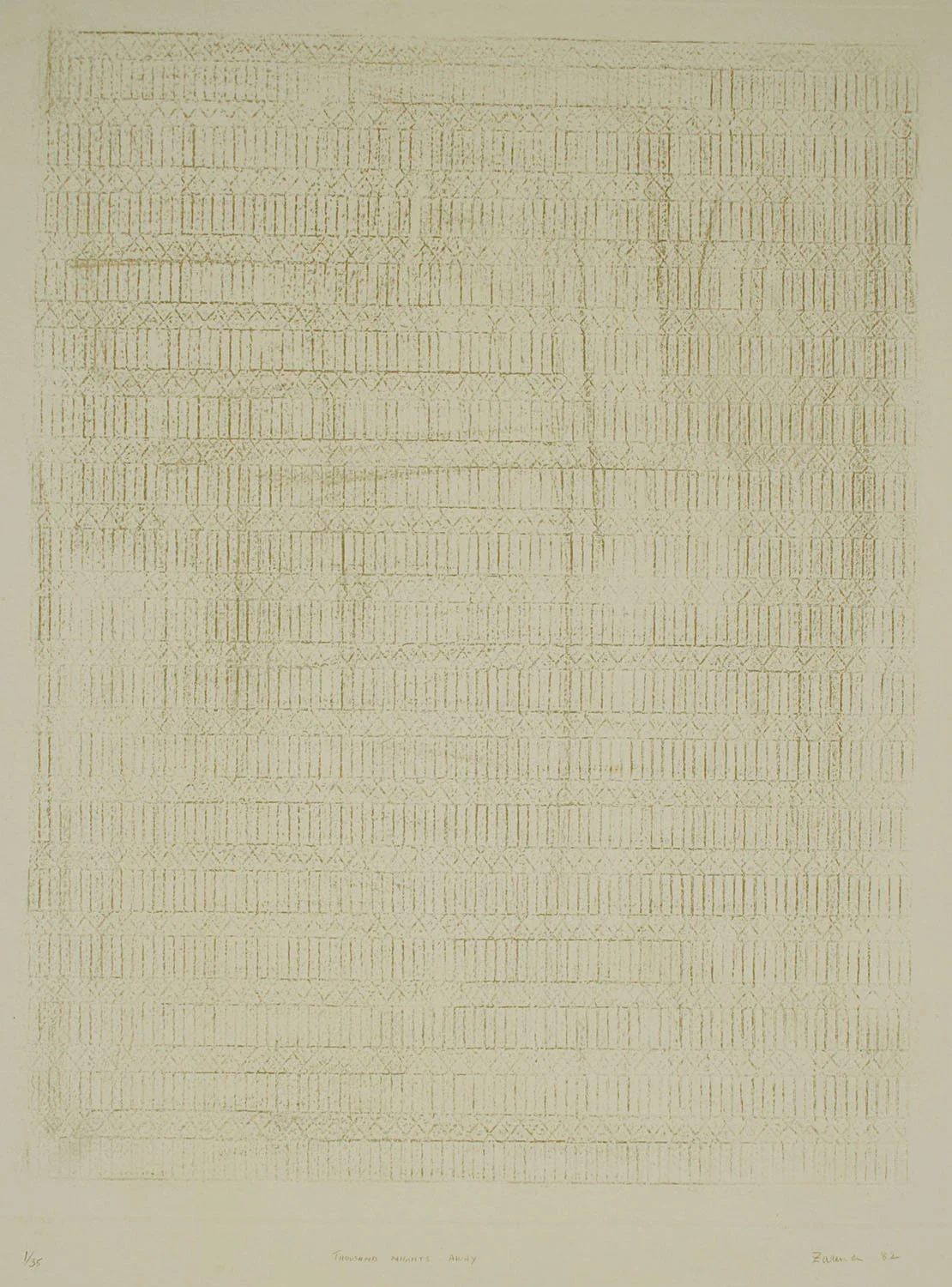
Paper Pieces placed Zarina within a wider reconsideration of what paper could do. The modest word “pieces” is especially apt for a practice in which the sheet could be cut, cast, pressed, joined, or allowed to hold the trace of a repeated action. Paper was not simply a support beneath an image; its fibres, edges, density, and vulnerability were part of the image’s meaning.
Thousand Nights Away, made in 1982, offers a period point of reference. Hundreds of lightly embossed houses gather into a nearly continuous field, visible through pressure and changing light rather than strong contrast. The title measures distance through duration: night follows night, while the remembered sign of home is repeated until private memory becomes an expansive, fragile architecture.
Traveling group exhibition · women artists · 28 Feb 1983–Jun 1984
Exchange of Sources: Expanding Powers
Turlock · Los Angeles · Knoxville · Hartford
Exchange of Sources: Expanding Powers brought together forty women artists through a structure of artistic recognition: ten established participants each selected three other women whose work they wanted to place in view. Traveling from California to Tennessee and Connecticut, the exhibition made influence visible as exchange rather than hierarchy and treated the enlargement of cultural power as something artists could create for one another.
Golden Route, made just before the exhibition opened, provides a period point of reference. Fine gold lines move across a grey handmade sheet, meeting small signs that resemble houses, destinations, or points of departure. The precious line suggests connection without becoming a route that can be followed literally. Its branching paths offer an image of relation shaped by movement, memory, and many possible centres.
Two-artist exhibition · cast paper · 7–28 Dec 1983
Cast Paper: Judith Ingram & Zarina
Delaware Art Museum—Downtown Gallery · Wilmington
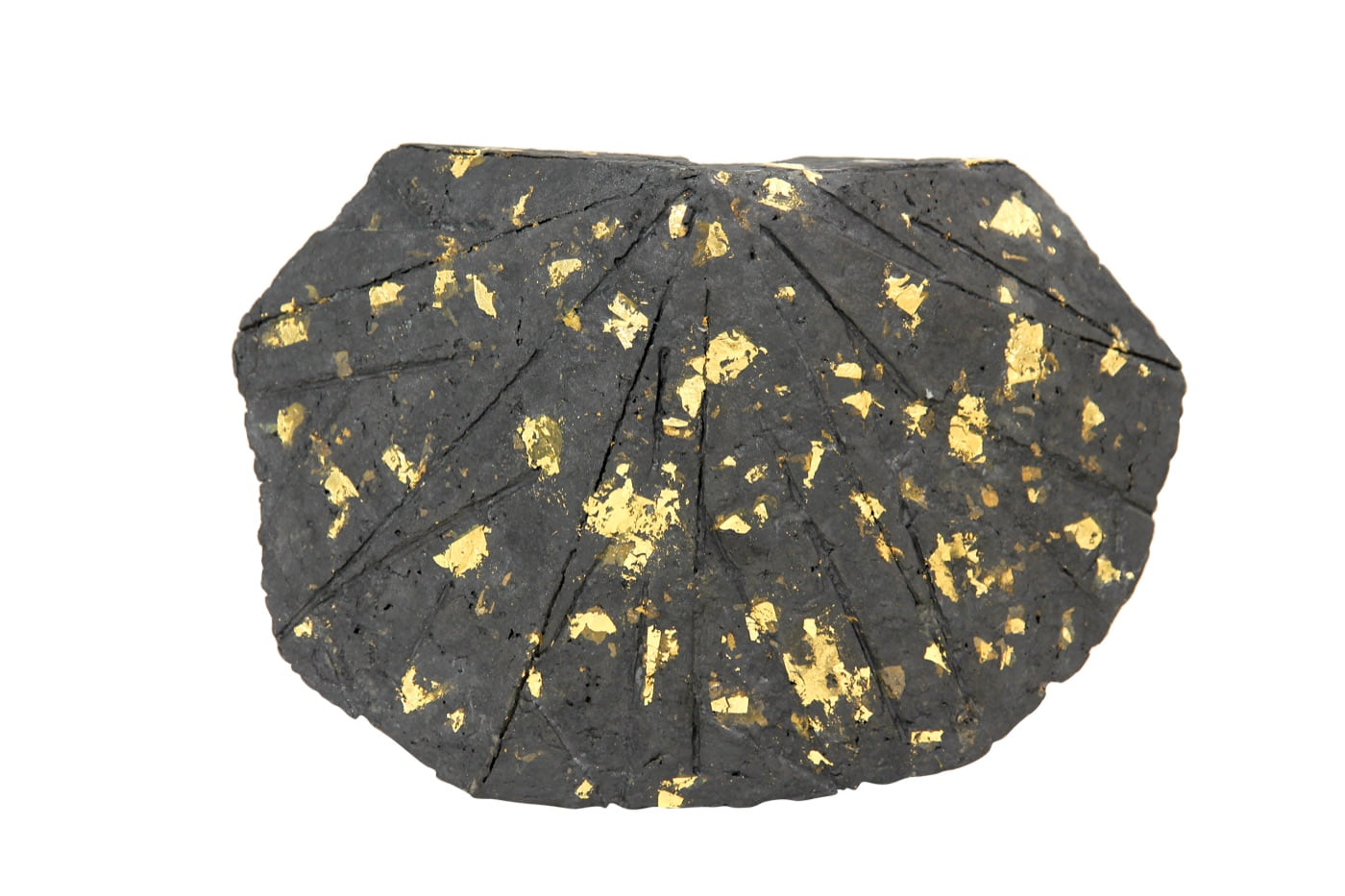
Cast Paper placed Judith Ingram and Zarina in dialogue through a medium that could carry colour, texture, pressure, and three-dimensional form. Their approaches were distinct, but the pairing made visible a shared refusal to treat paper as passive. Pulp could be moulded and built; an edge could become sculptural; a surface could register the labour of making as directly as clay, fibre, or metal.
Zarina’s Shelter, made in 1983, concentrates that material language into a small, low structure. Its charcoal-grey cast-paper body is scored like a roof or folded terrain, while scattered gold leaf catches light across the rough surface. Shelter is both humble and precious, solid and vulnerable—a compact architecture that seems able to be carried, yet still bears the instability of displacement.
Group exhibition · sculptural paper · 1983
Sculptural Paper
Brookfield Craft Center · Brookfield, Connecticut
Sculptural Paper belonged to a period when artists were carrying papermaking decisively into three dimensions. At Brookfield Craft Center, the medium could be understood through the traditions of handcraft while also pressing against the conventional separation of print, drawing, relief, and sculpture. For Zarina, cast pulp made the familiar sheet architectural: it could rise, fold, contain space, and hold the evidence of touch.
Twisted House, made the following year, shows that vocabulary continuing to develop. The compact dwelling turns around an open centre, its walls and roof caught between shelter and collapse. Cast paper gives the object apparent weight while preserving the irregularity of fibre and edge. Home becomes a structure that can be transformed, unsettled, and carried without losing its recognisable form.
Museum solo exhibition · 1981
Zarina: Cast Paper Works
Herbert F. Johnson Museum of Art, Cornell University · Ithaca
Cast Paper Works named a decisive expansion of Zarina’s practice. At Cornell’s museum, paper was no longer only the support for a printed mark: pulp was pressed into moulds, built into relief, and made to hold pigment, fibers, cracks, edges, and depth. The exhibition placed those materially dense works within the language of sculpture while preserving paper’s intimacy and vulnerability.
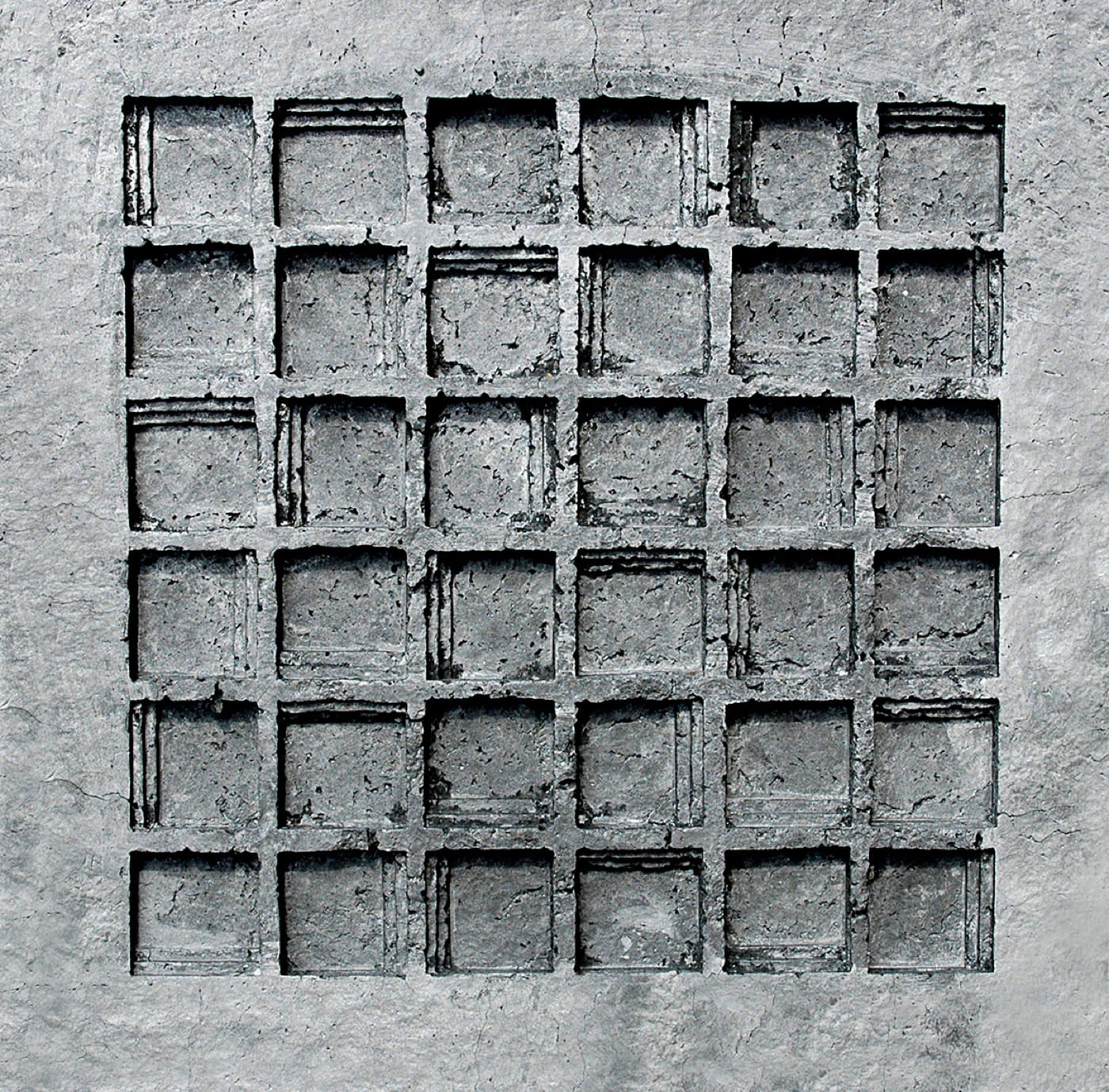
In Steps, thirty-six recessed squares suggest rooms, thresholds, or a sequence counted through space. Black pigment and aluminum powder turn the handmade surface toward stone and metal, even as its fibers remain visible. The grid promises order, but the uneven impressions keep that order human—measured by pressure, repetition, and touch rather than mechanical perfection.
Solo exhibition · 3–31 Mar 1981
Zarina: Recent Cast Paper Works
Orion Editions · New York
At Orion Editions, Zarina’s new cast-paper works met the city in which they had been developed. Their low reliefs retain the serial logic of printmaking—a mould can generate related impressions—but each fibrous surface also records drying, pigment, pressure, and touch. Repetition becomes a way of thinking through difference rather than producing identical objects.
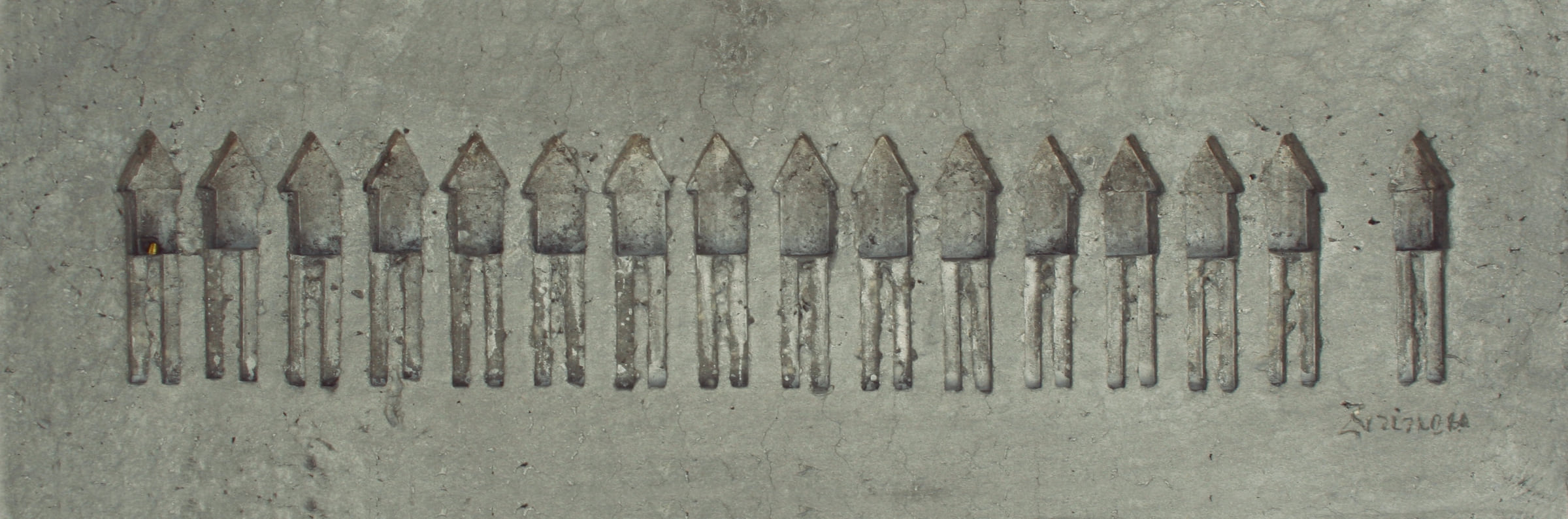
Homes stretches a row of narrow house forms across a horizontal field. The familiar peaked roof appears again and again, yet no two impressions settle in quite the same way. A single glint of gold interrupts the grey procession. Home is imagined as a shared sign and a personal memory: recognizable, repeated, and still impossible to standardize.
Women Artists Series · solo presentation · 1984–85
Women Artists Series at Douglass College
Mabel Smith Douglass Library, Rutgers University · New Brunswick
Zarina’s presentation belonged to the fourteenth year of a series founded in 1971 to make women artists visible within a university where students had few women artists as teachers or models. Installed through the Mabel Smith Douglass Library rather than a conventional museum, the programme joined sustained looking to study, conversation, and the daily life of the campus. It offered recognition not as an exceptional event, but as a continuing institutional practice.
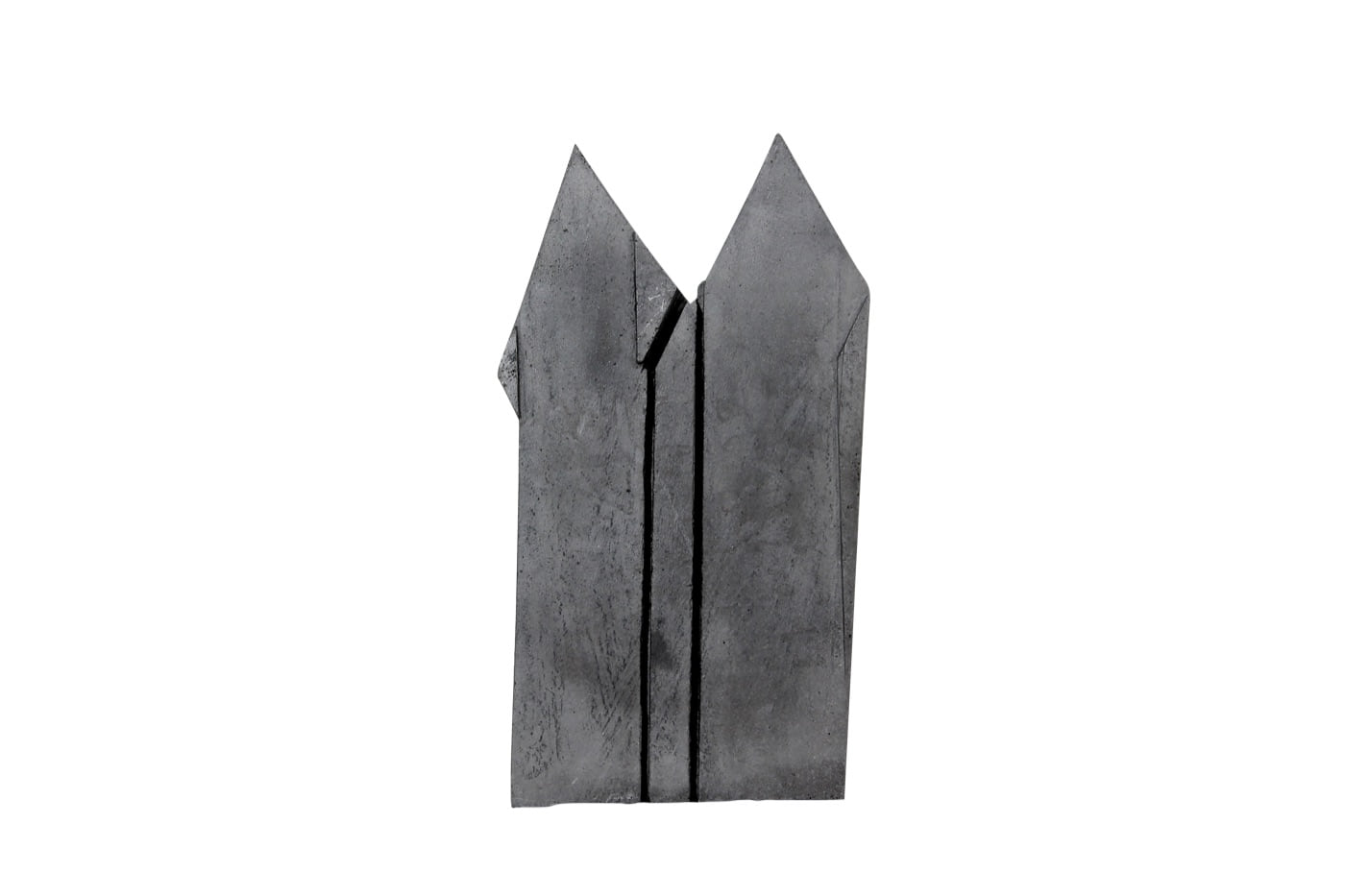
Couple of Houses, made in 1984, gives that context an intimate architectural form. Two cast-aluminium dwellings rise side by side, nearly touching while remaining divided by a deep central seam. Their doubled silhouette can suggest kinship, separation, or homes held together across distance. The work carries Zarina’s recurring house into metal without losing the vulnerability of the remembered structure.
Traveling protest exhibition · five women’s art organizations · 1984
1984: Big Brother Is Watching
Minneapolis · Los Angeles · Washington, DC · New York
Borrowing its title from George Orwell, Big Brother Is Watching brought together five women’s art organizations to address surveillance, political authority, and the pressure of public events on private life. The exhibition travelled through a network built by women in Minneapolis, Los Angeles, Washington, New York, and the Hudson Valley. Its structure made the network itself part of the work: cultural power was answered through cooperation across cities rather than a single institutional centre.
Zarina’s 1978 pin drawing offers a related way of thinking about visibility and control. Hundreds of punctures gather into an uneven grid, readable only as light passes through or catches their edges. The repeated mark may recall a screen, a register, or a field under inspection, yet the handmade irregularity resists perfect order. Absence becomes visible, and a nearly white sheet acquires quiet physical insistence.
National exhibition · paper art · 16 Mar–15 Apr 1984
Paper Transformed
Turman Gallery, Indiana State University · Terre Haute
Paper Transformed surveyed a medium being remade through casting, moulding, layering, folding, and construction. Bringing Zarina into a national field that also included artists working between painting and sculpture, the exhibition treated transformation as both process and proposition. Paper could leave the wall, acquire mass, preserve the pressure of a mould, and make its fibres as consequential as an image printed upon them.
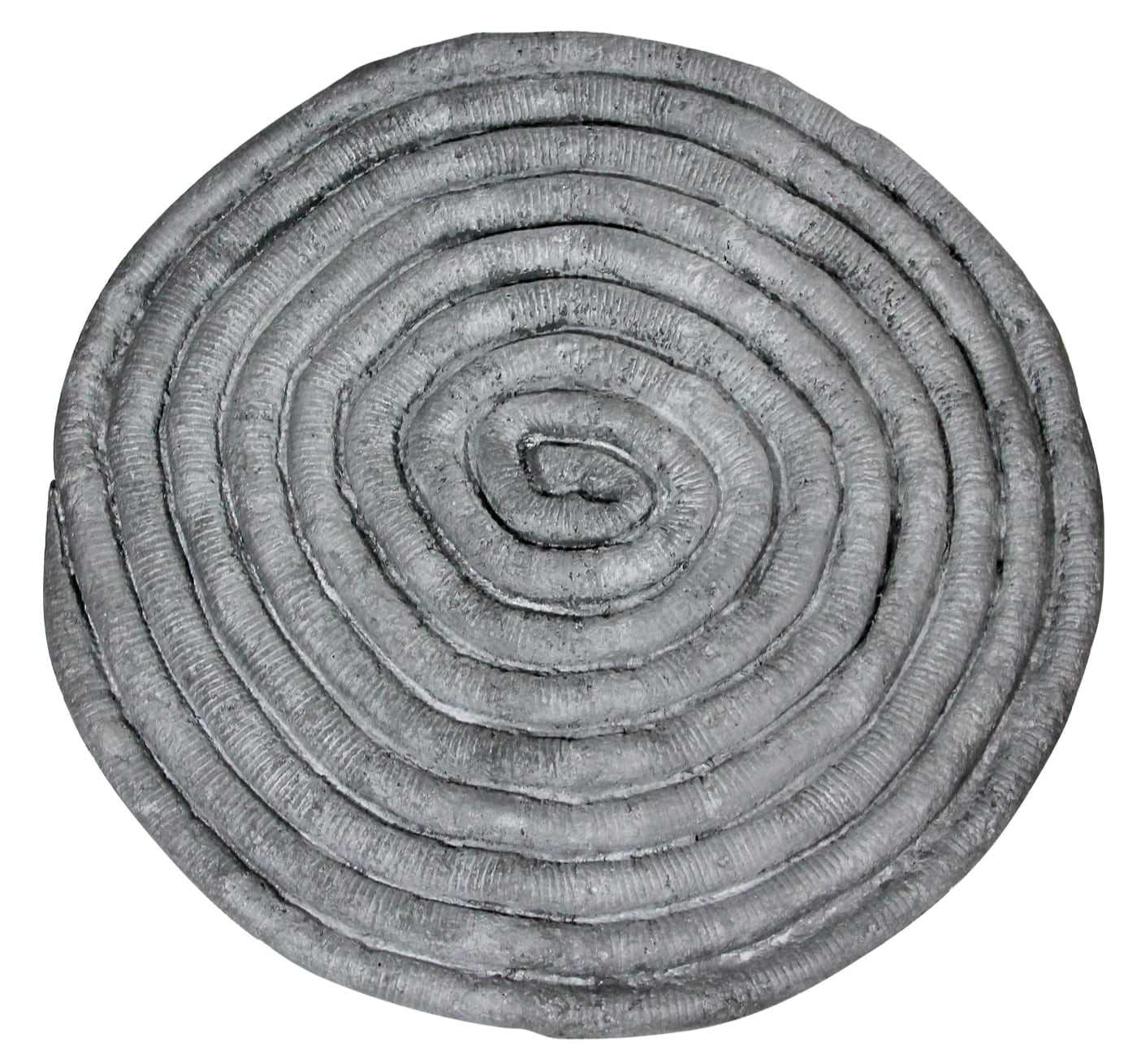
Spiral, made in 1984, turns cast paper into a continuous movement held in place. Its raised coil accumulates through repetition, while the rough grey surface retains the evidence of pulp and handwork. The form can evoke a path, a wound, a line of writing, or time circling inward. Nothing is added as illustration; material, pressure, and duration produce the meaning together.
National invitational · works in paper · 1984
Paperworks: A National Invitational
Cheney Cowles Memorial Museum · Spokane
Paperworks placed Zarina within a national conversation about artists who were giving paper the presence of an object. At the Cheney Cowles Memorial Museum—now the Northwest Museum of Arts and Culture—the invitational joined practices shaped by papermaking, print, relief, and sculpture. The category was deliberately broad: “paperworks” described not one technique but a field of material invention.
Shelter, made the year before, shows how Zarina could compress architecture into fibre, edge, and light. Radiating folds give the low cast-paper form the tension of a roof or a structure opening under pressure. Flecks of gold interrupt its charcoal surface without disguising its roughness. The work holds protection and exposure together, making shelter feel precious precisely because it remains fragile.
University faculty exhibition · 1985
Cornell University Department of Art Faculty Exhibition
Herbert F. Johnson Museum of Art, Cornell University · Ithaca
Cornell’s faculty exhibitions brought studio practice into the museum as part of the university’s intellectual life. Zarina’s participation placed her work among that of fellow teachers while she was leading printmaking at Cornell. The setting joined making, teaching, and sustained looking: processes tested in the studio could be encountered as finished works, and formal restraint could become a way of asking larger questions about material, place, and memory.
Twisted House, made the previous year, offers a close view of the sculptural language Zarina carried into this period. Cast paper rises from the plane of the sheet and turns a familiar dwelling inward around an exposed centre. The work holds construction and instability together. Its small scale invites intimate attention, while its uneven fibres preserve the pressure of making—an apt lens for a faculty exhibition grounded in the exchange between artistic practice and education.
Three-city solo exhibition · 1986
Zarina Hashmi: Paper Works
Art Heritage, New Delhi · Chitrakoot, Calcutta · Cymroza, Bombay
Paper Works travelled through New Delhi, Calcutta, and Bombay at a moment when Zarina had made paper both the ground of an image and a substance with volume, texture, and memory. Prints, embossings, and cast-pulp reliefs could occupy the same field of inquiry: pressure leaves a mark, repetition measures duration, and a modest sheet can carry the force of architecture.
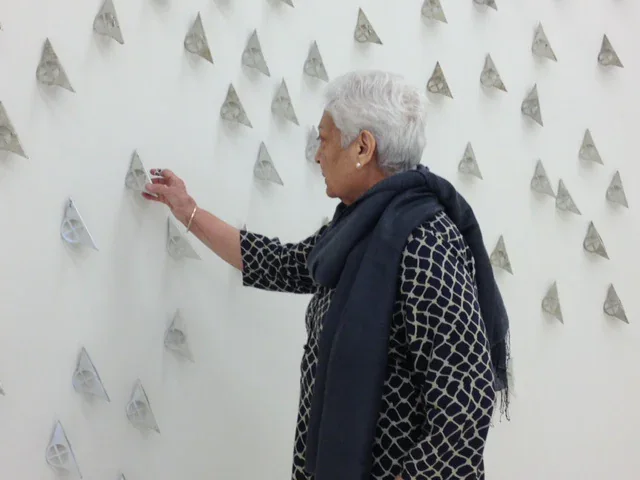
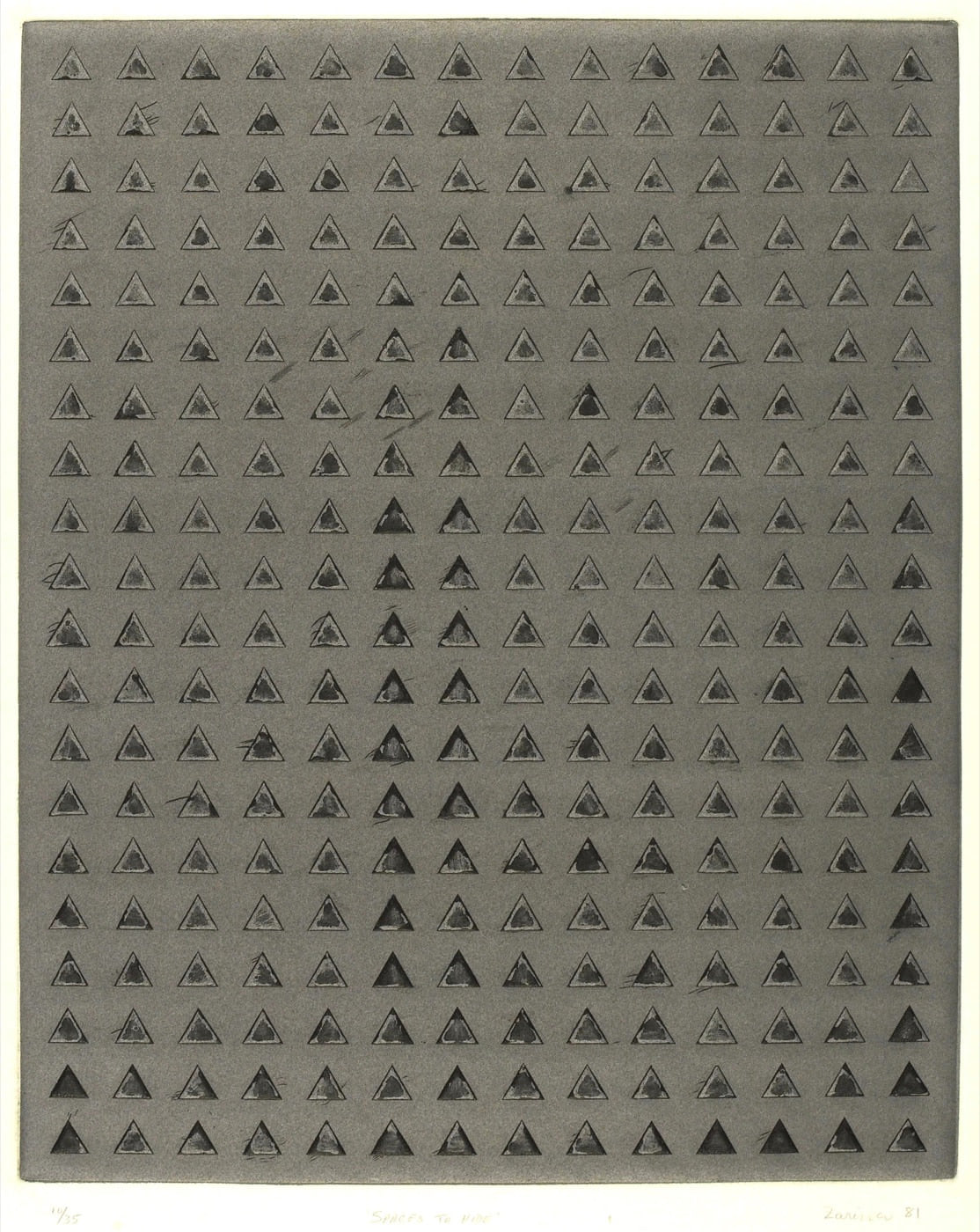
Spaces to Hide, preserved with the exhibition archive, builds a shifting field from hundreds of small triangular enclosures. No single form dominates. Instead, accumulation turns geometry into a social and emotional space—one in which shelter is imagined repeatedly but never guaranteed. The work shows how Zarina could move between the intimacy of a handmade surface and the larger experience of vulnerability, movement, and belonging.
Group exhibition · filial memory · 1986
Fathers
Asian Arts Institute · New York
Fathers gathered artists around inheritance, authority, remembrance, and the intimate distance between parent and child. For Zarina, those questions were inseparable from language and place. Her father’s presence endured through the remembered house in Aligarh, through the Urdu she continued to carry, and through forms that could condense a relationship into a few deliberate marks.
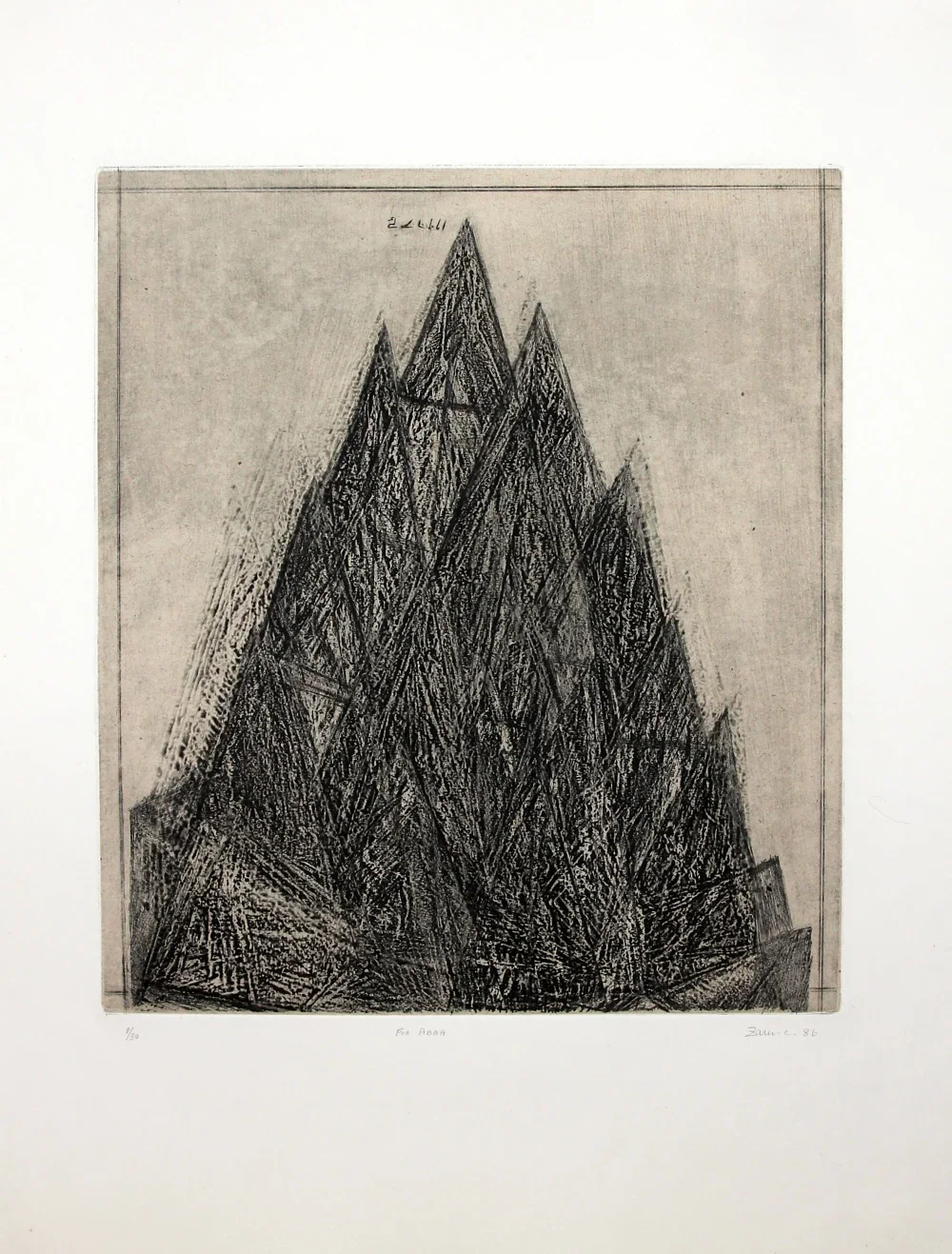
For Abba, made in 1986, gives that remembrance the gravity of a monument without becoming grandiose. A dark, mountain-like form rises from the pale sheet beneath a handwritten dedication in Urdu. The carved image is dense and nearly immovable; the script remains personal and direct. Together they make memory both public and private—a structure of devotion held in the grain of wood, the pressure of ink, and a daughter’s address to her father.
Feminist group exhibition · 1986
The Heroic Female: Images of Power
Ceres Gallery · New York
The Heroic Female asked how power might be pictured outside inherited heroic conventions. Presented at Ceres Gallery, founded within the New York Feminist Art Institute’s orbit, the exhibition belonged to a feminist culture that made space for women to define strength through their own forms and histories. Zarina’s work offered a language of power grounded not in spectacle, but in endurance, memory, and the ability to carry a place after leaving it.
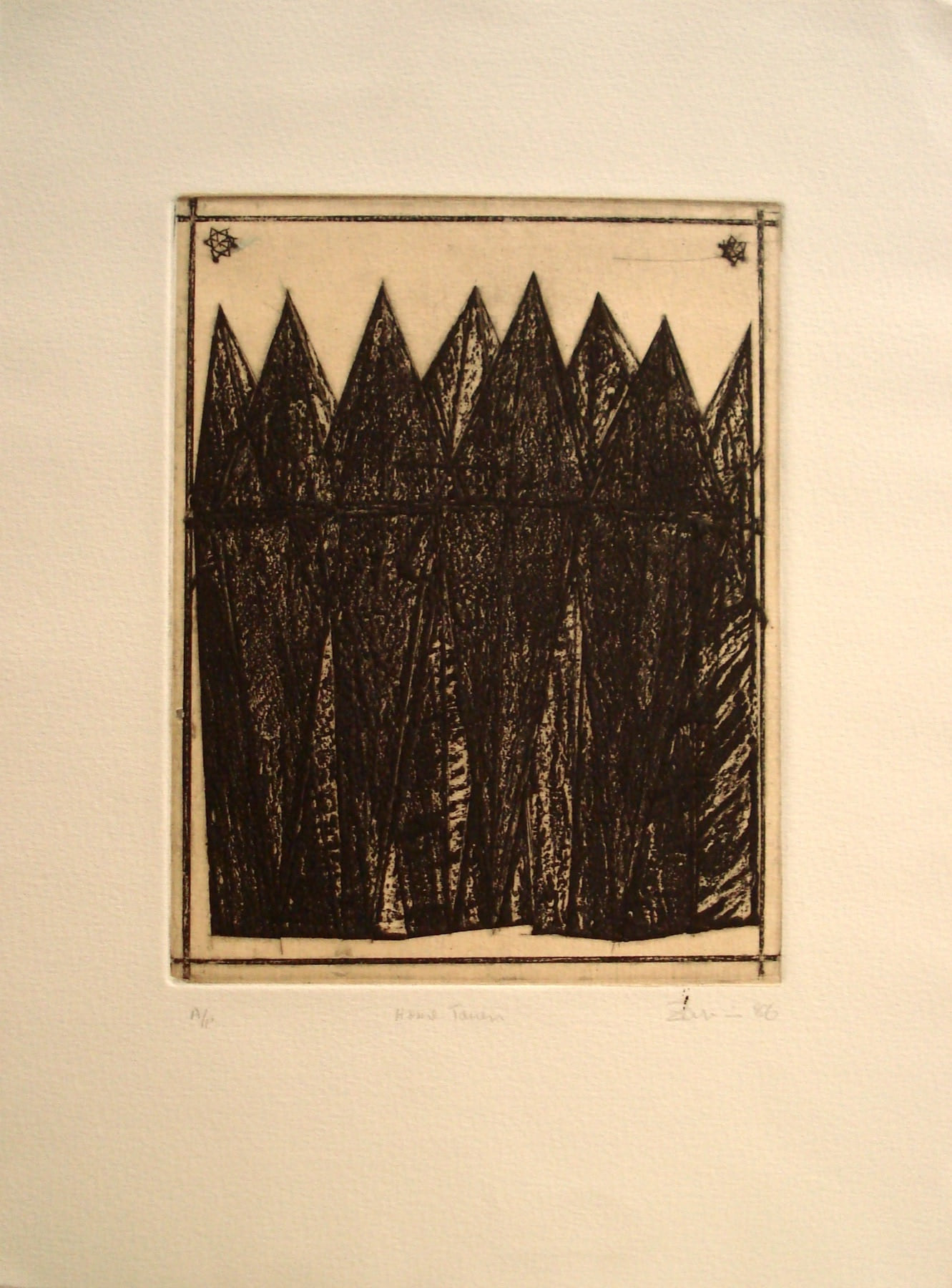
Home Town, made in 1986, reduces architecture to a dark enclosure and a small interior opening. Its apparent simplicity is charged with the experience of distance: home is protected, withheld, and illuminated from within. Read in this context, heroism can reside in preservation rather than conquest—in keeping language, memory, and belonging alive across migration, and in giving those private continuities a durable public form.
Traveling print exhibition · 1986
Through a Master Printer: Robert Blackburn and the Printmaking Workshop
Bronx Museum of the Arts · New York; Columbia Museum of Art · South Carolina
Through a Master Printer considered Robert Blackburn’s Printmaking Workshop as both a place of technical exchange and a community. Blackburn created an unusually open studio in New York, where artists from many backgrounds could work through the demands of a plate, press, ink, and paper while retaining their own visual languages. Zarina’s presence in the exhibition situated her spare, exacting prints within that collaborative history.
Letter, made a decade earlier, reveals what such printmaking knowledge could make possible. Fine diagonal lines converge across an almost colourless field, meeting at a small central impression like the folds and seal of an envelope. The image is quiet but materially precise: meaning emerges through what the print barely reveals, what it withholds, and how completely the surface records the disciplined acts that brought it into being.
National touring exhibition · 1988–1990
Coast to Coast: A Women of Color National Artists’ Book Project
DiverseWorks, Houston · Center for Book Arts, New York · Flossie Martin Gallery, Radford University · and touring venues
Coast to Coast gathered artists’ books by women of colour from across the United States and carried them through a national network of galleries, universities, and cultural centres. Organized by Faith Ringgold, Clarissa Sligh, and Margaret Gallegos, the project treated the book as both an intimate object and a means of connection: a form that could move between communities while holding distinct histories, languages, and ways of making.
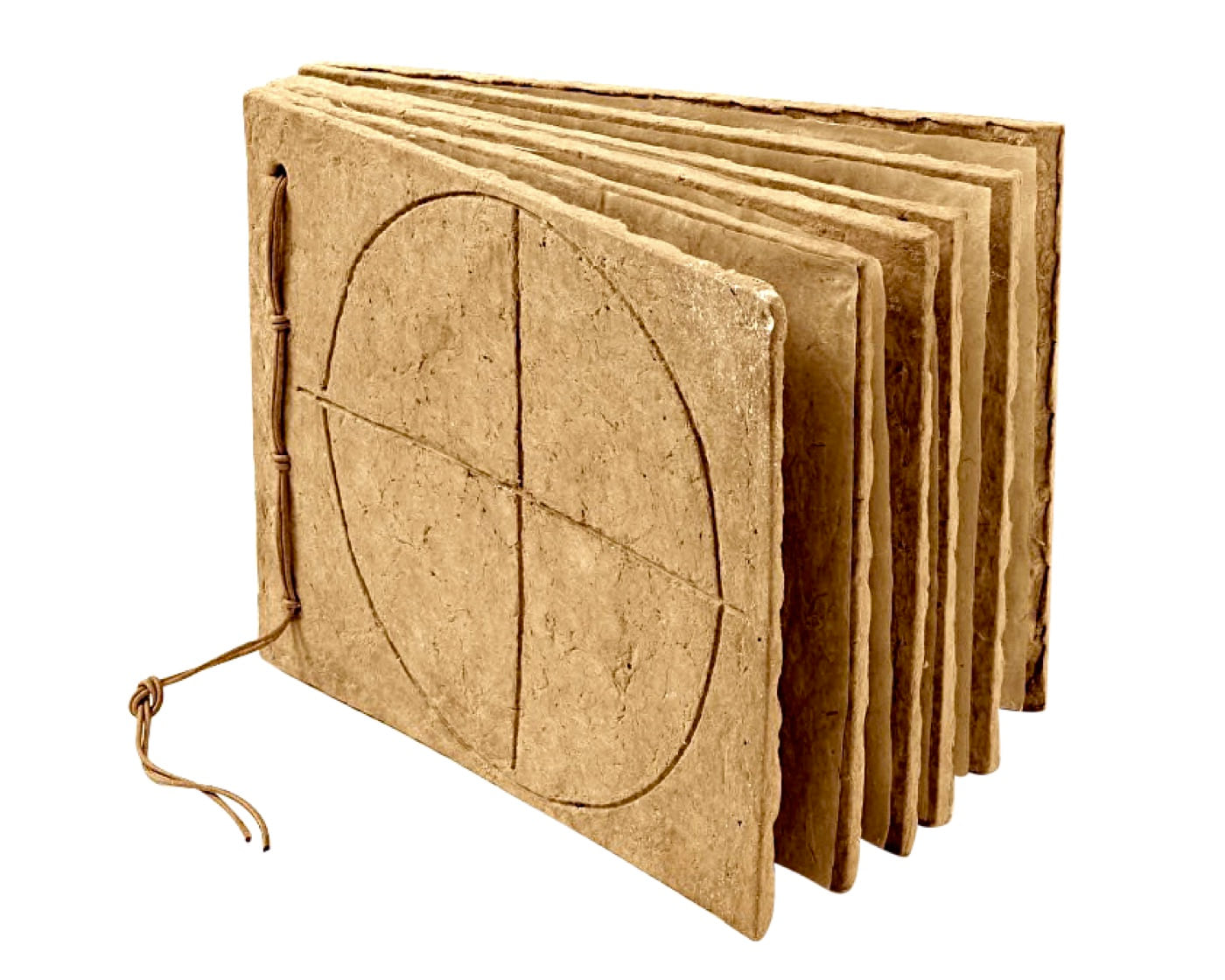
Flight Log belongs to Zarina’s work with the book as a structure for memory and passage. Its cast-paper form, handmade leaves, printed text, and silk binding ask to be read through sequence, weight, and touch as much as through words. Within Coast to Coast, such an object joined an expansive conversation in which autobiography and cultural memory could travel without being reduced to a single shared image or experience.
Group exhibition · 1988
The Language of Form: The Form of Language
Rosa Esman Gallery · New York
The Language of Form: The Form of Language proposed that visual structure and linguistic meaning need not occupy separate worlds. For Zarina, this exchange ran through the grain of wood, the pressure of a printed line, the architecture of a shape, and the words she carried across places. Form could behave like a vocabulary—repeated, revised, and made legible through relation—while language could become spatial and material.
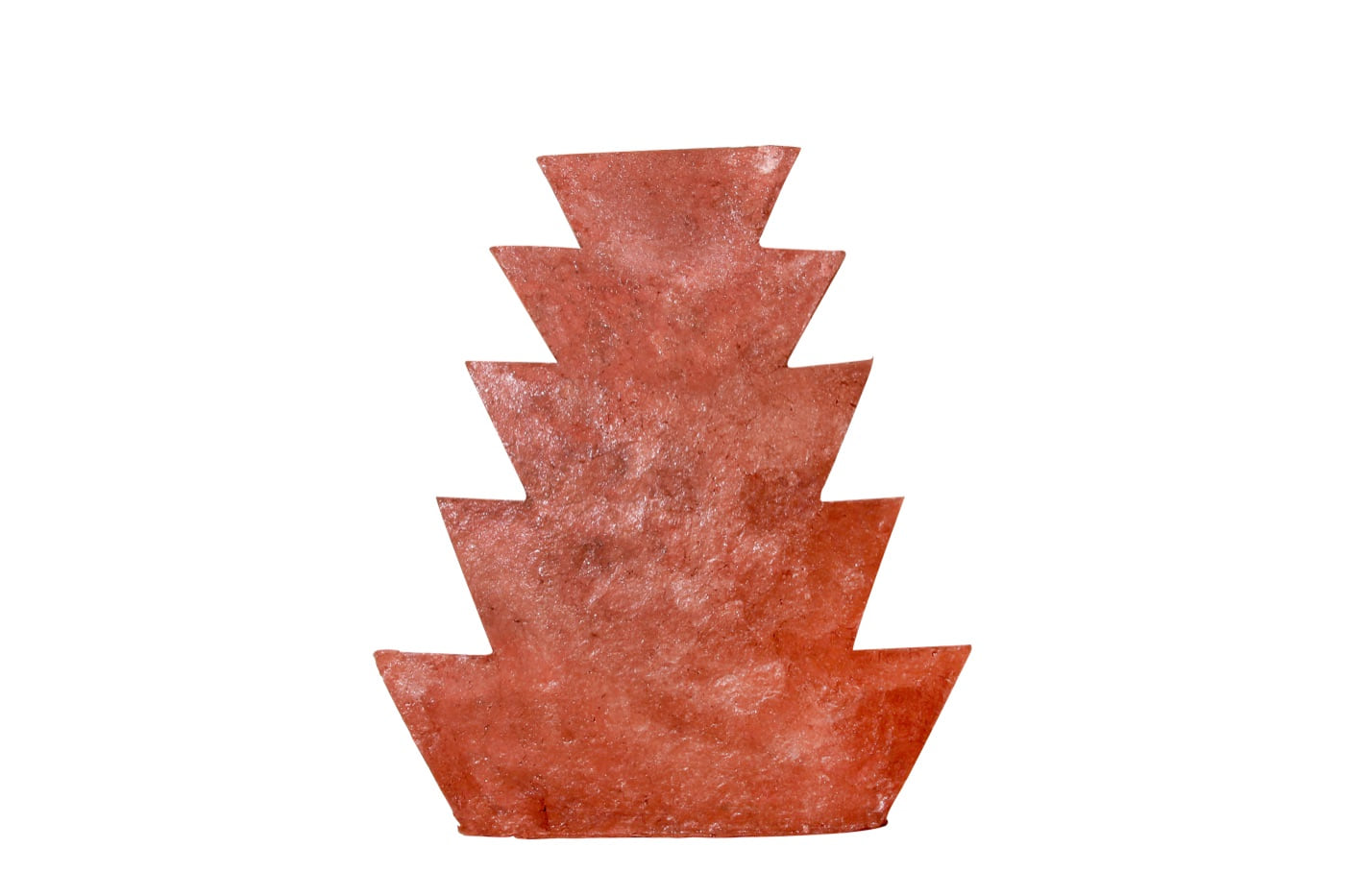
Marrakesh gives that reciprocity a sculptural presence. Its cast-paper surface holds a warm, fibrous density, while its stepped outline turns a compact object into something that can be read as wall, plan, threshold, or remembered place. The title brings a city into the work without illustrating it. Instead, name and form meet as parallel ways of carrying experience: one spoken, the other pressed into matter.
Printmaking survey · 1988
Forty Years, Robert Blackburn and the Printmaking Workshop
Metro-Dade Cultural Center · Miami
Forty Years brought the travelling projects In a Stream of Ink and Through a Master Printer into one presentation of Robert Blackburn’s Printmaking Workshop as an artistic community as well as a place of technical exchange. The Miami exhibition extended that history through public programmes and teaching, emphasizing how the workshop enabled artists from different generations and backgrounds to experiment while retaining their own visual languages.
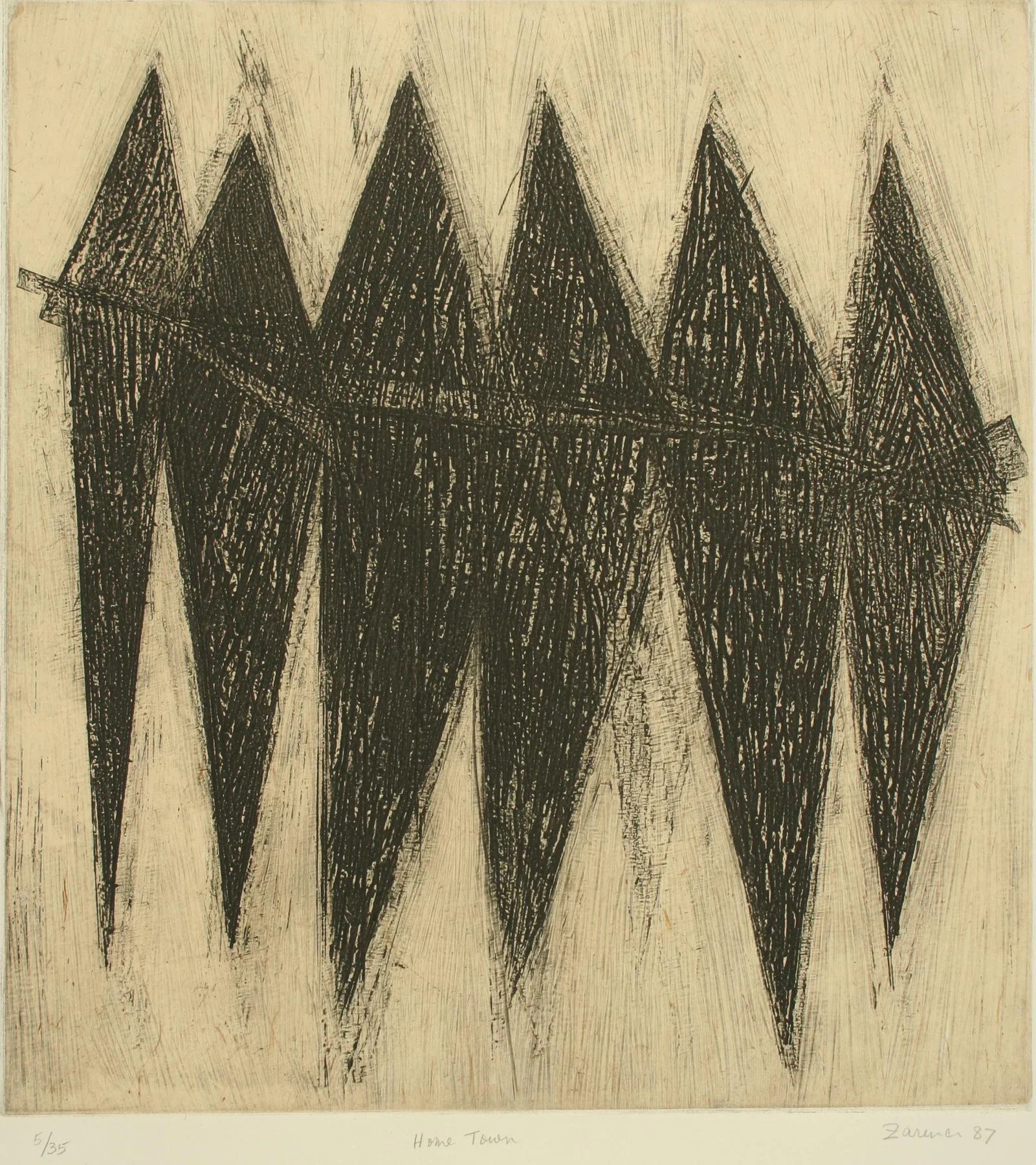
Zarina’s Home Town shows what that freedom could hold. An irregular dark field sits within a fine linear boundary, compressed between map, enclosure, and memory. The etched surface is spare but not empty: subtle shifts of tone and pressure make the image feel inhabited. Printmaking becomes a way to give an unstable place a durable form without pretending that its borders can be fixed.
International print biennial · 13 Feb–13 Mar 1989
1st Bharat Bhavan International Biennial of Prints
Roopankar Museum of Fine Arts, Bharat Bhavan · Bhopal
The first Bharat Bhavan International Biennial of Prints placed printmaking in India within an explicitly international field. Held at Roopankar in Bhopal, the biennial made the printed image a meeting point for different workshops, traditions, and approaches to the multiple—an especially resonant context for an artist whose practice had been shaped across print studios in several countries.
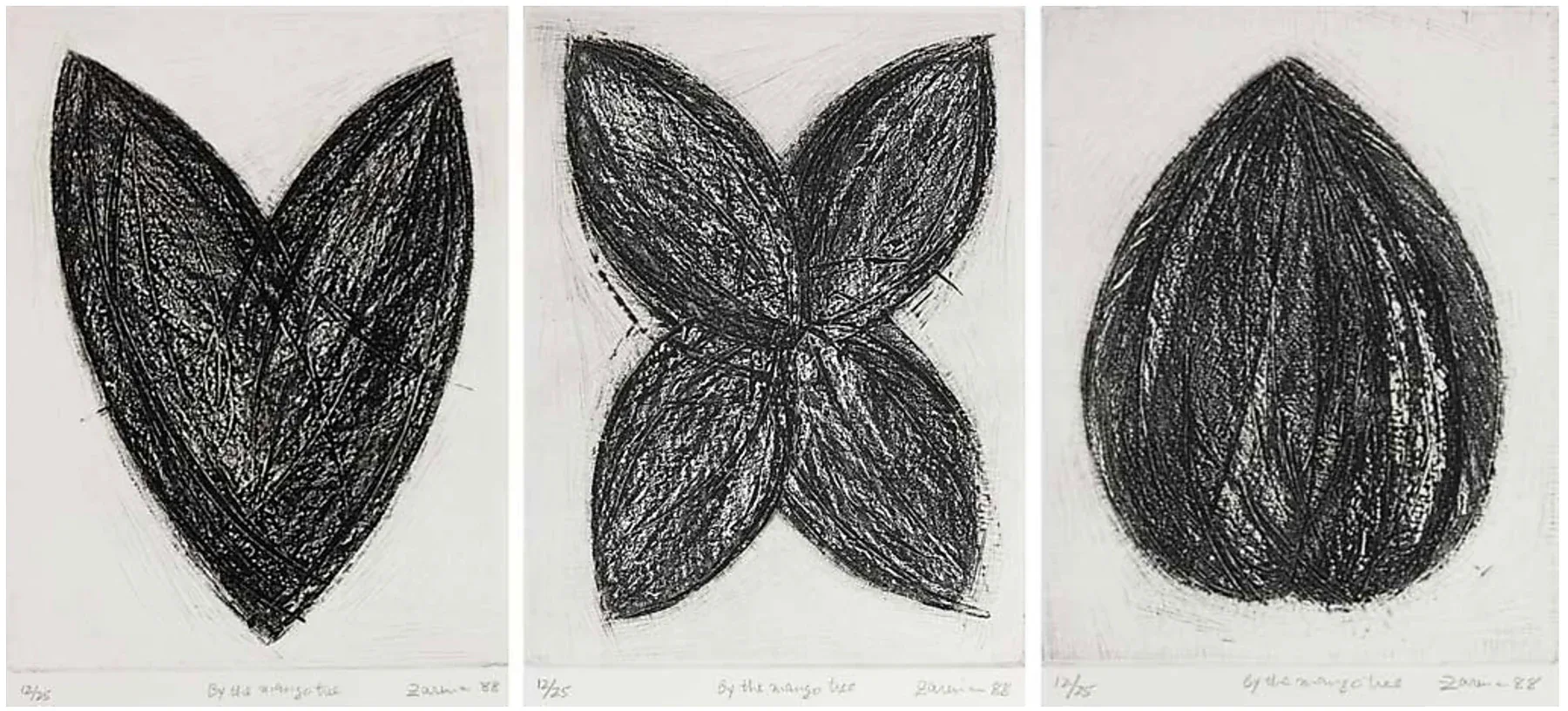
By the Mango Tree, made the previous year, unfolds as a sequence of leaf, flower, and seed. The images move between observation and recollection: botanical forms are simplified until they become signs, yet they retain the intimacy of something seen and remembered. Their progression also makes time visible, allowing a small natural cycle to carry ideas of origin, transformation, and return.
Group exhibition · 27 Feb–24 Mar 1990
Memory/Reality
Ceres Gallery · New York
Memory/Reality brought Zarina’s work into Ceres Gallery, a feminist alternative space founded to expand the public presence of women artists. The exhibition title names a tension central to her practice: memory is not the opposite of reality, but one of the ways a place continues to exist after distance, migration, and time have changed the conditions of return.
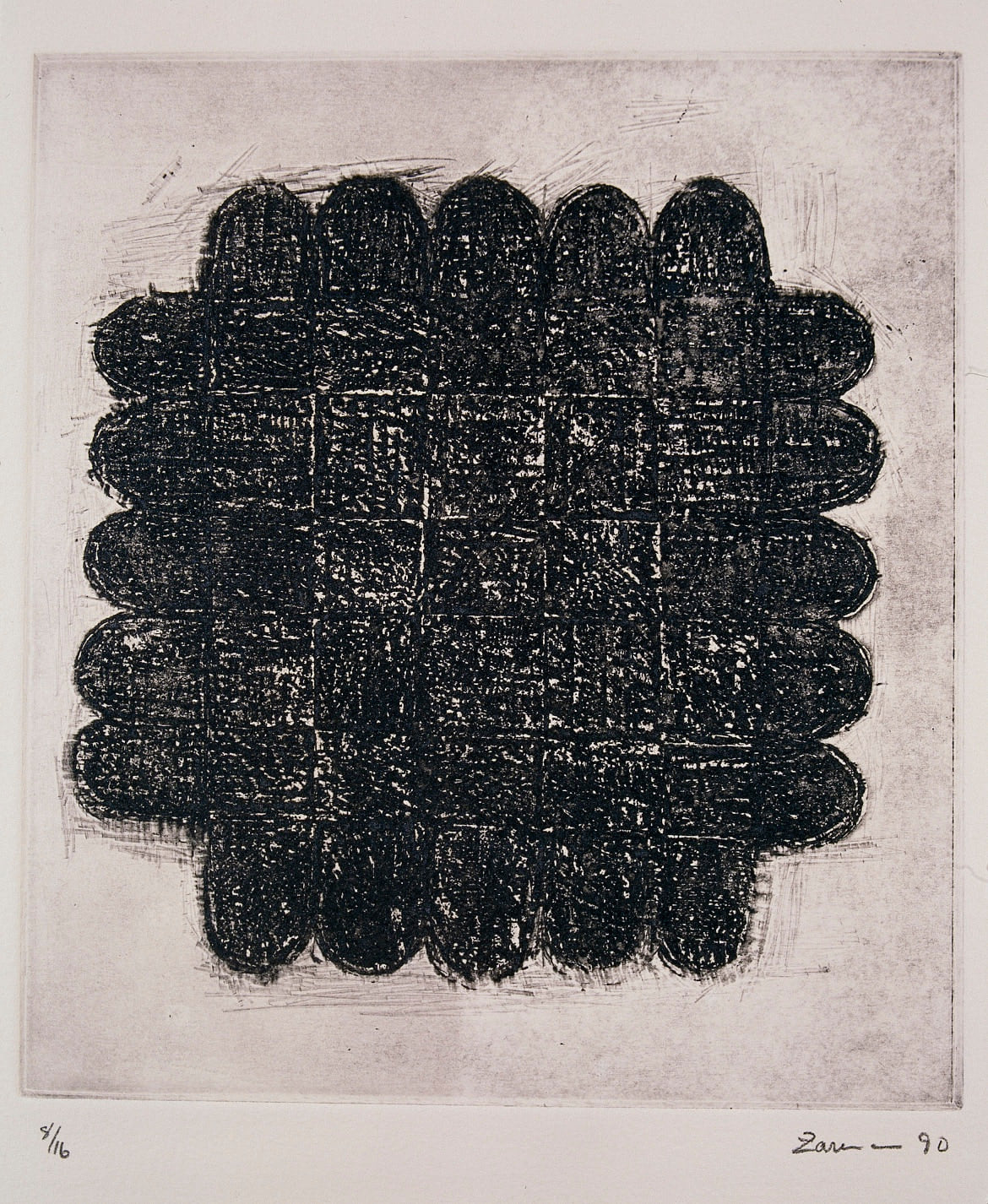
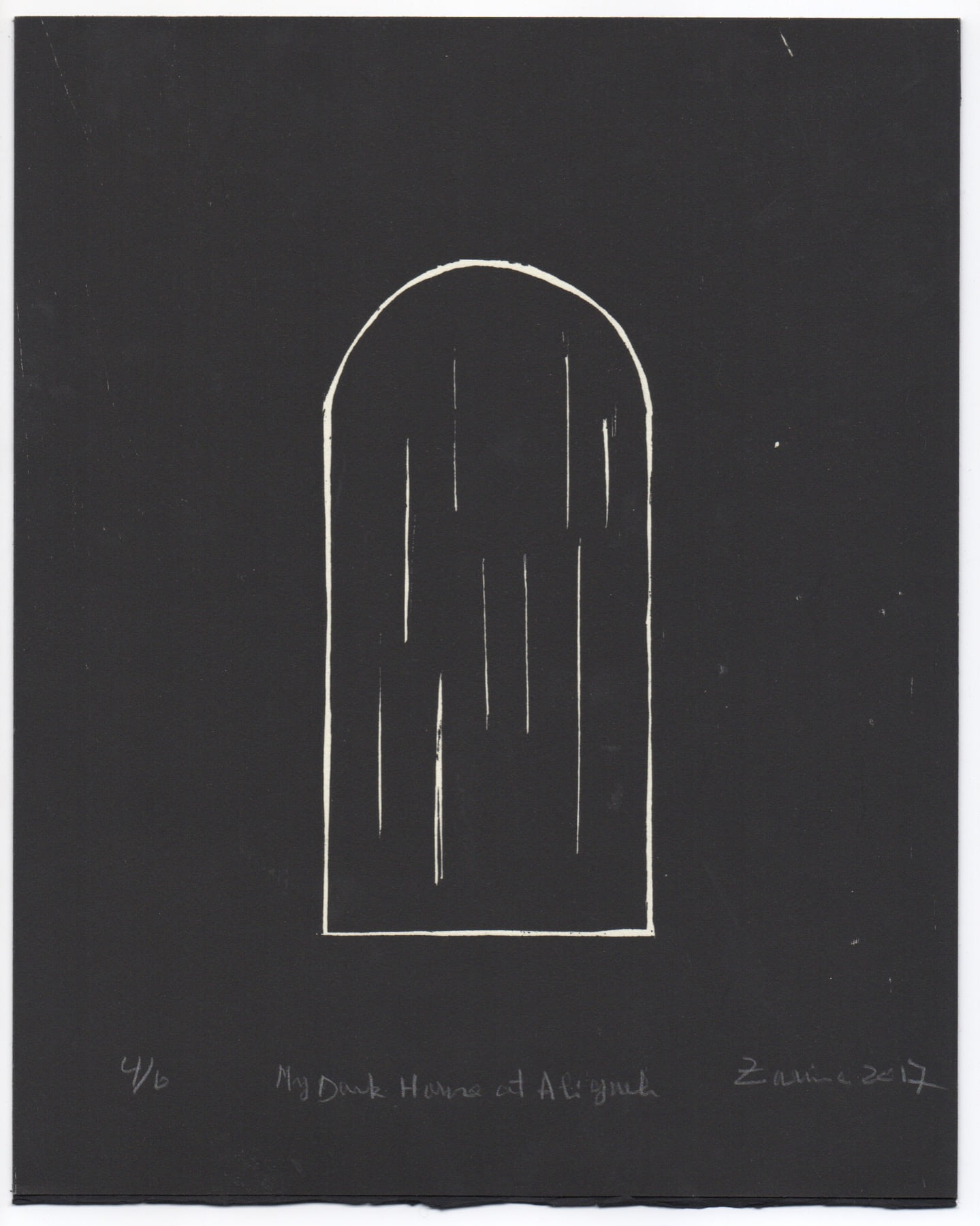
At Night I Go to the House at Aligarh, made that year, gives this tension an architectural form. A dense black enclosure is crossed by a faint internal grid, turning the remembered house into both refuge and obstruction. The image does not reconstruct Aligarh room by room. It allows pressure, repetition, and a nearly buried structure to hold the emotional reality of returning in thought to a place that can no longer be entered in the same way.
Solo exhibition · 1990
Zarina: Recent Work, Bronze, Cast Paper, Etchings
Roberta English Gallery · San Francisco
Recent Work brought bronze, cast paper, and etching into one presentation rather than treating printmaking and sculpture as separate practices. Across those materials, Zarina returned to the physical acts that shaped her work: pressing, cutting, casting, incising, and repeating. A line could be bitten into a plate, a surface built from pulp, or a compact form given the density of metal.
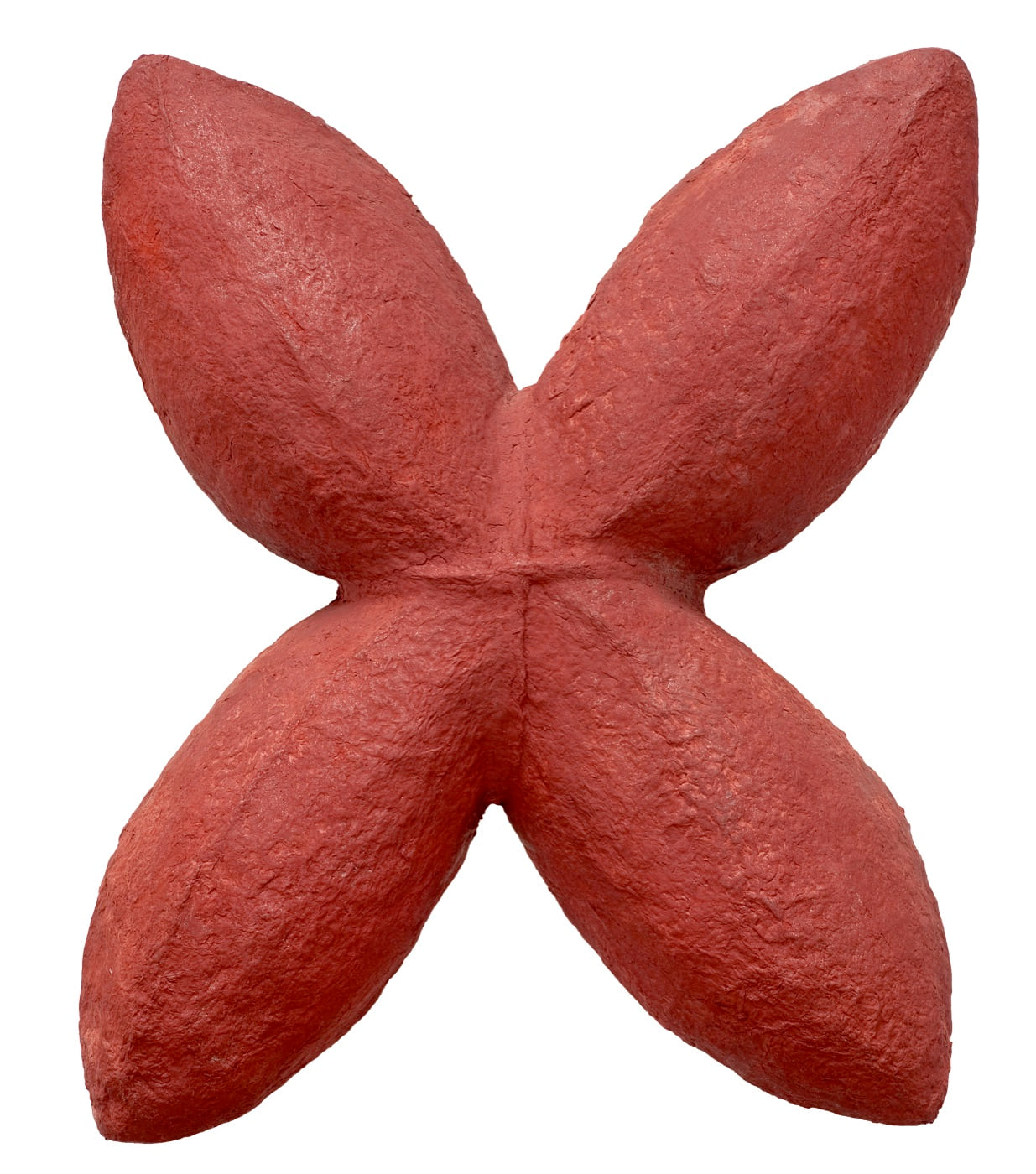
Phool belongs to this late-1980s passage through cast paper. Four joined lobes make a flower that feels simultaneously organic and architectural, while terra-rosa pigment gives the pulp the colour and gravity of earth. The work does not imitate a botanical specimen; it gives sensory memory—especially the remembered presence of a garden—weight, texture, and an object-like body.
Print and artist-book exhibition · 8 Jul–13 Sep 1992
De Bonnard à Baselitz: estampes et livres d’artistes
Bibliothèque nationale · Paris
De Bonnard à Baselitz presented prints and artists’ books acquired by the Bibliothèque nationale over the preceding decade. Zarina’s presence within that collection history placed her work in a broad account of the contemporary print—one in which the medium could move beyond a single sheet toward sequence, text, tactile paper, and the intimate scale of the book.
For Abba, 1986, offers a period lens onto that expanded language. A steep dark form rises through layered, visibly worked lines, while etching and chine collé make the image inseparable from the joined paper that carries it. The dedication makes the geometry personal without making it illustrative. Structure becomes remembrance: an austere field in which material, address, and loss remain inseparable.
Solo exhibition · 1992
House with Four Walls
Bronx Museum of the Arts · New York
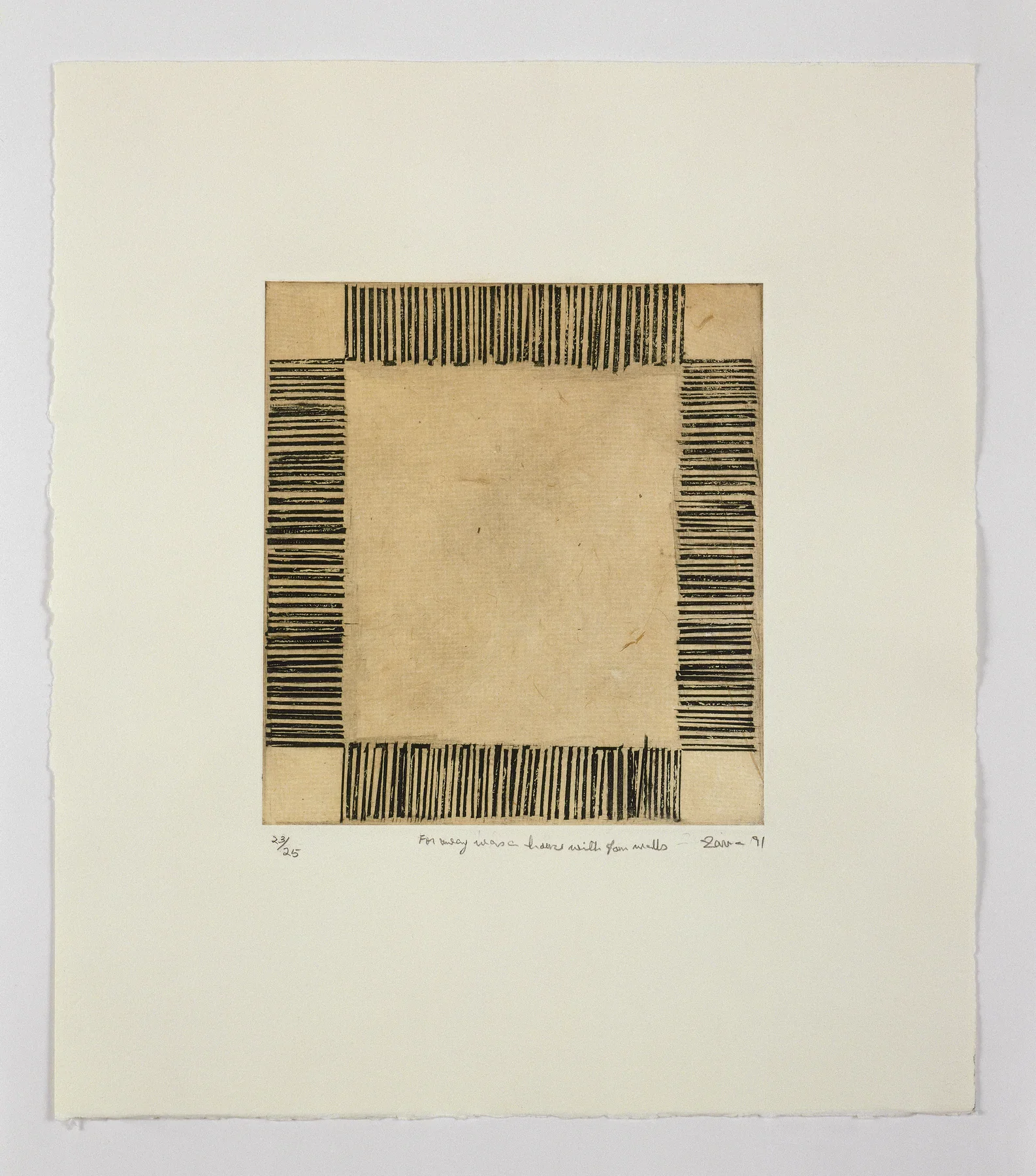
House with Four Walls brought Zarina’s 1991 portfolio to the Bronx Museum as a sequence of etched images and texts. Its long titles return to the remembered house through fragments of childhood: the ghost by a pillar, the black snake that entered the rooms, bare feet burned by summer ground, an owl heard at night, and the warning that the household would one day have to leave.
The images do not illustrate those memories literally. Bars, openings, dark masses, and repeated marks turn the house into an emotional architecture in which enclosure can mean intimacy, fear, protection, or impending departure. Handmade Nepalese paper enters each sheet through chine collé, making memory visible as something joined to another surface—held in place, but never made seamless.
Artists’ books survey · 1993
Artists’ Books 1979–1993: A Selection
Women’s Studio Workshop at HarperCollins · New York
Artists’ Books 1979–1993: A Selection gathered work published through Women’s Studio Workshop across a formative period for the contemporary artist’s book. The exhibition framed the book not simply as a container for images, but as a paced encounter with paper, sequence, binding, touch, and the movement between word and form.
Zarina’s Urdu Proverbs, published by the workshop in 1991, belongs fully to that language. Kishwar “Rani” Chishti selected proverbs remembered by the sisters from childhood and youth, and Zarina answered them with woodcuts. The project does not make image subordinate to text or text a caption for image. Each proverb and each carved form carries its own density, and their meeting turns shared memory into a collaboration across language, family experience, and the physical structure of the book.
Solo exhibition · 1993
Zarina at Chawkandi Gallery
Chawkandi Gallery · Karachi
Zarina’s 1993 exhibition at Chawkandi placed the house and the journey before a Karachi audience. Contemporary reviews called the presentation “Diary of a Traveller,” “Breaking Journey,” and “The House That Zarina Built”—phrases that locate the work between movement and architecture, and between the places one inhabits and the home one continues to reconstruct in memory.
An artist who encountered the exhibition remembered being drawn to a house on wheels: a minimal form made emotionally charged by its possibility of motion. In Zarina’s hands, wheels do not make the house carefree or easily portable. They unsettle the promise of permanence, turning shelter into something carried, repeated, and exposed to departure. The Karachi exhibition also began a long relationship with Chawkandi, which became an important setting for Zarina’s work in Pakistan.
International touring exhibition · 1994–1996
Asia/America: Identities in Contemporary Asian American Art
Asia Society Galleries, New York · Walker Art Center, Minneapolis · MIT List Visual Arts Center, Cambridge · and touring venues
Asia/America examined identity as something formed across histories, languages, racial categories, and lived movement rather than inherited as a fixed label. As the exhibition travelled through the United States, it brought together artists whose work complicated the idea that “Asian American” could describe a single origin or experience. Zarina’s presence gave that discussion the perspective of a life shaped by Partition, repeated migration, and an attachment to Urdu that distance did not diminish.
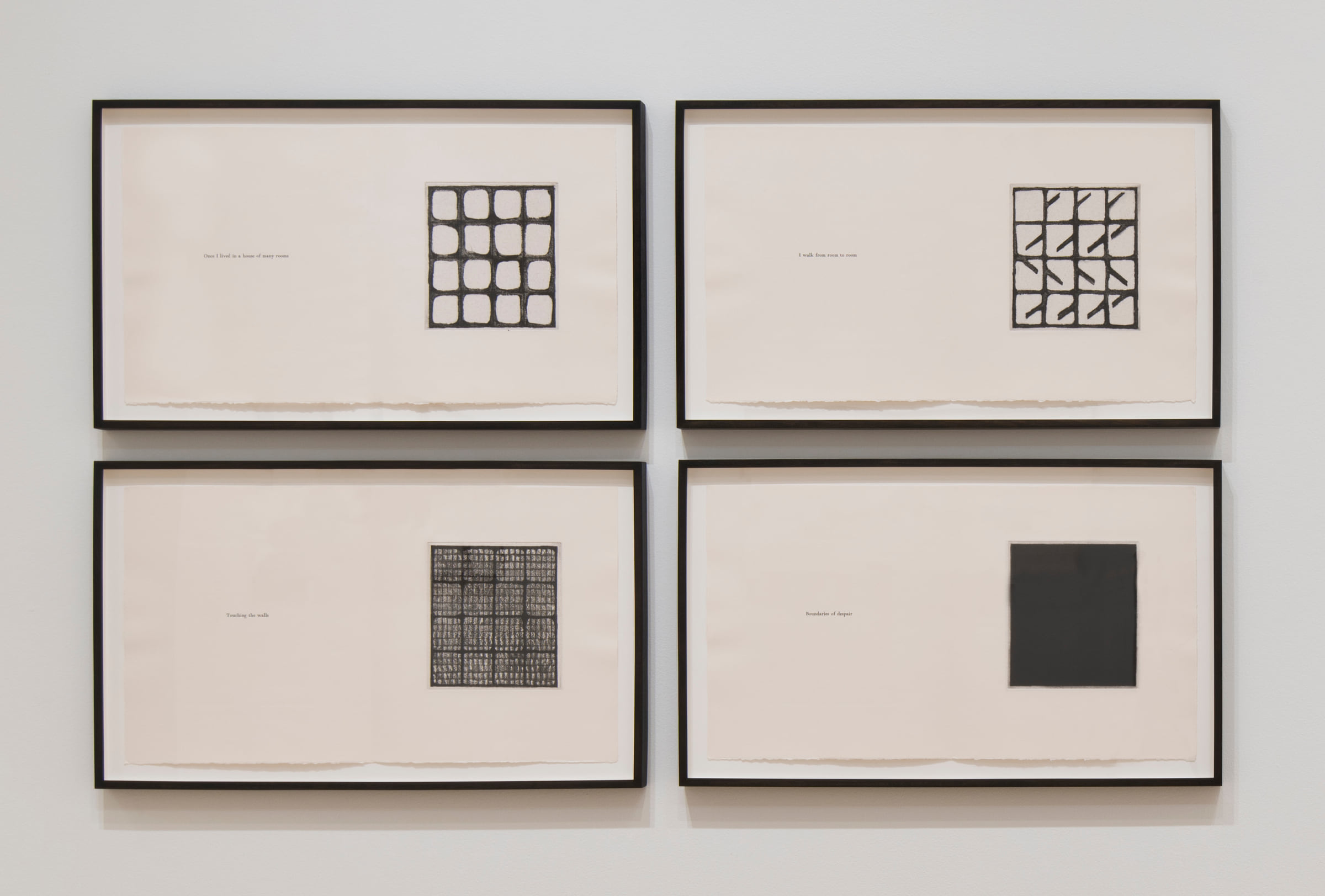
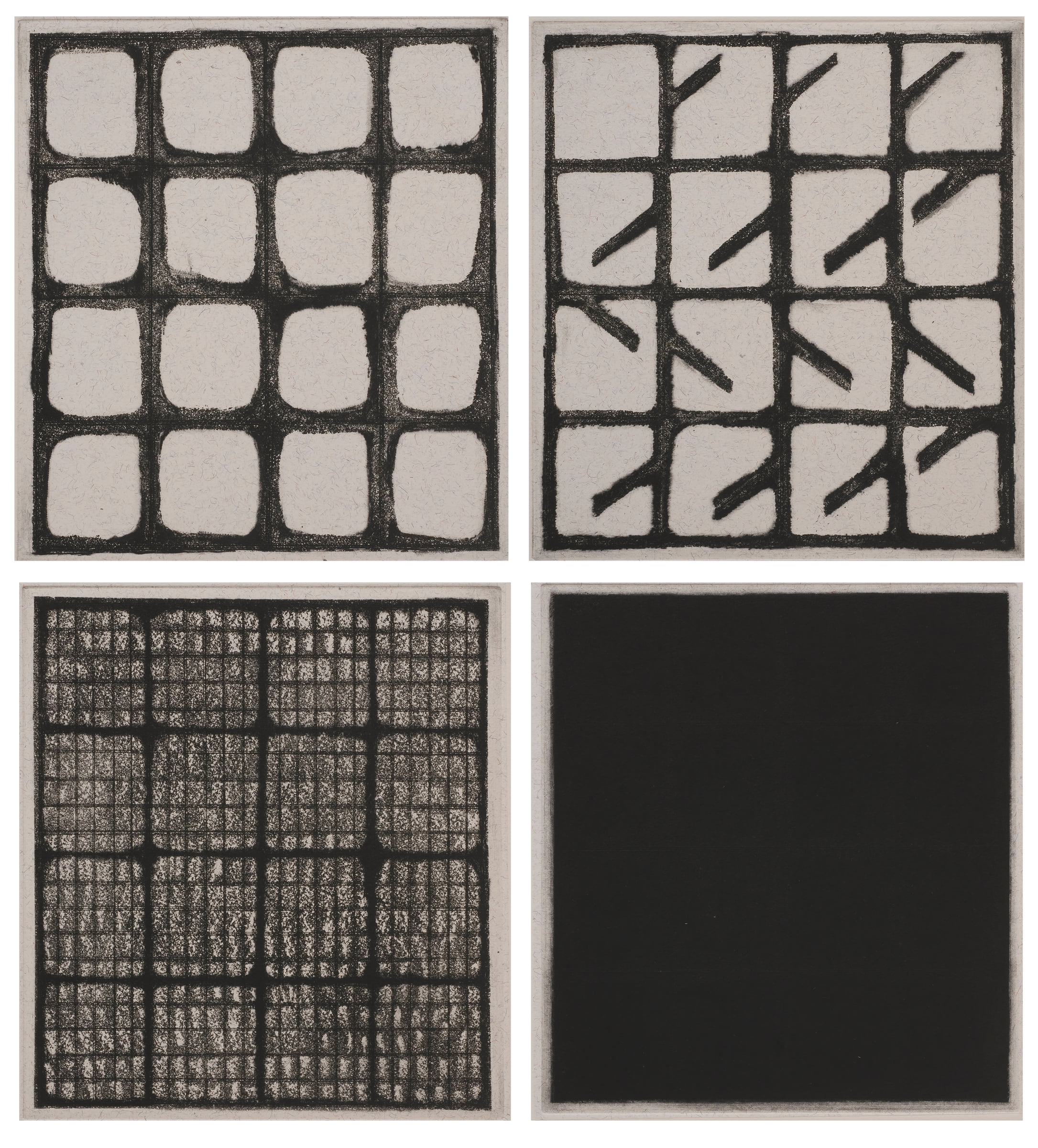
House of Many Rooms, made in 1993, approaches belonging through an architecture that cannot be occupied literally. Window, diagonal, grid, and dark field move across separate sheets, turning the house into a sequence of partial views. No panel completes the others, yet together they create a place held through rhythm and relation. Identity likewise appears not as a stable enclosure, but as a structure assembled from memory, language, separation, and the rooms one continues to carry.
Solo exhibition · 1994
Homes I Made
Faculty Gallery, University of California · Santa Cruz
Presented while Zarina was working in Santa Cruz, Homes I Made placed the house within a life defined by movement rather than a single permanent address. The exhibition title already held the tension that would shape much of her work: homes could be plural and carefully remembered, yet none could claim to contain the whole of a life lived across cities.
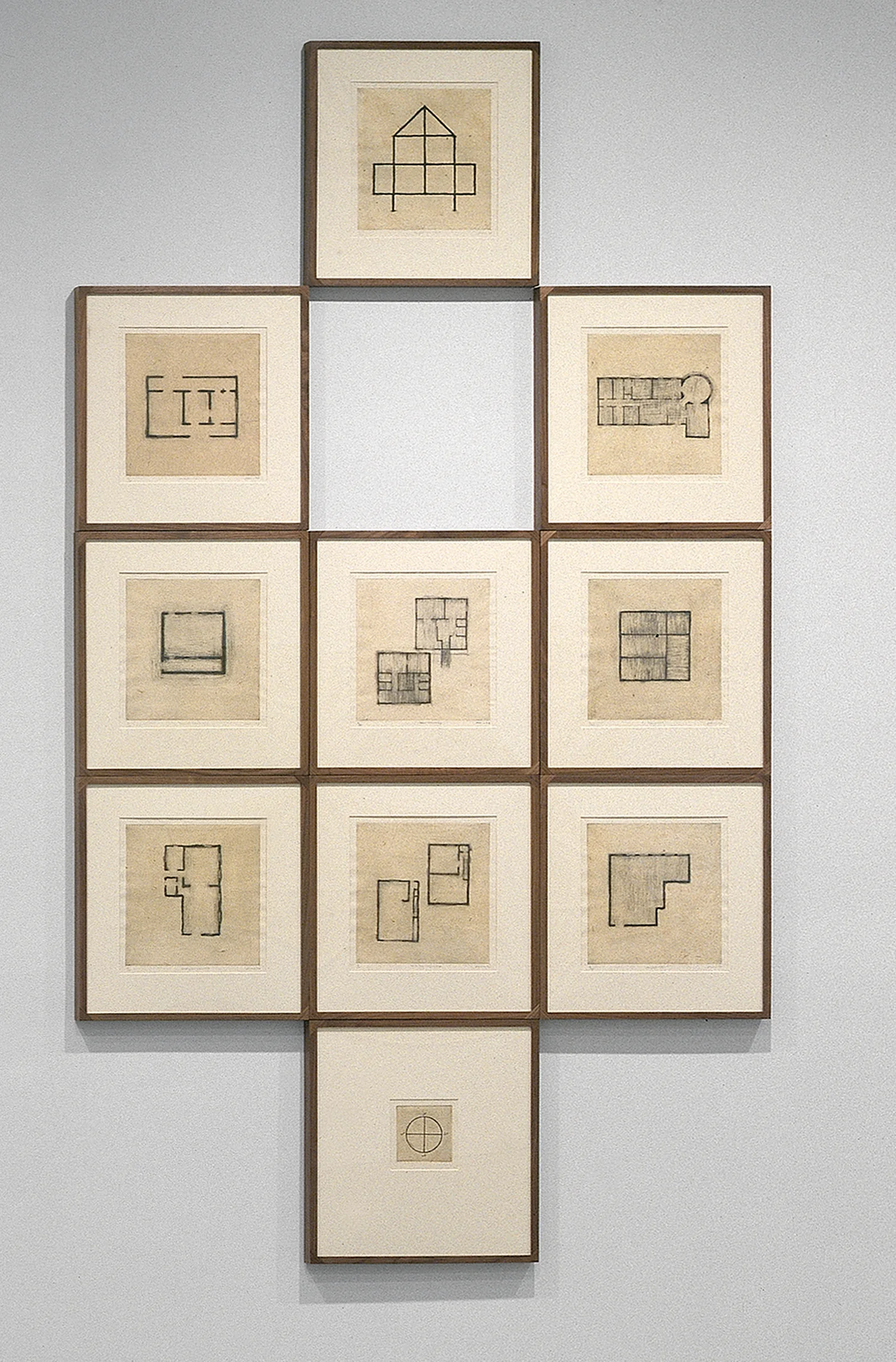
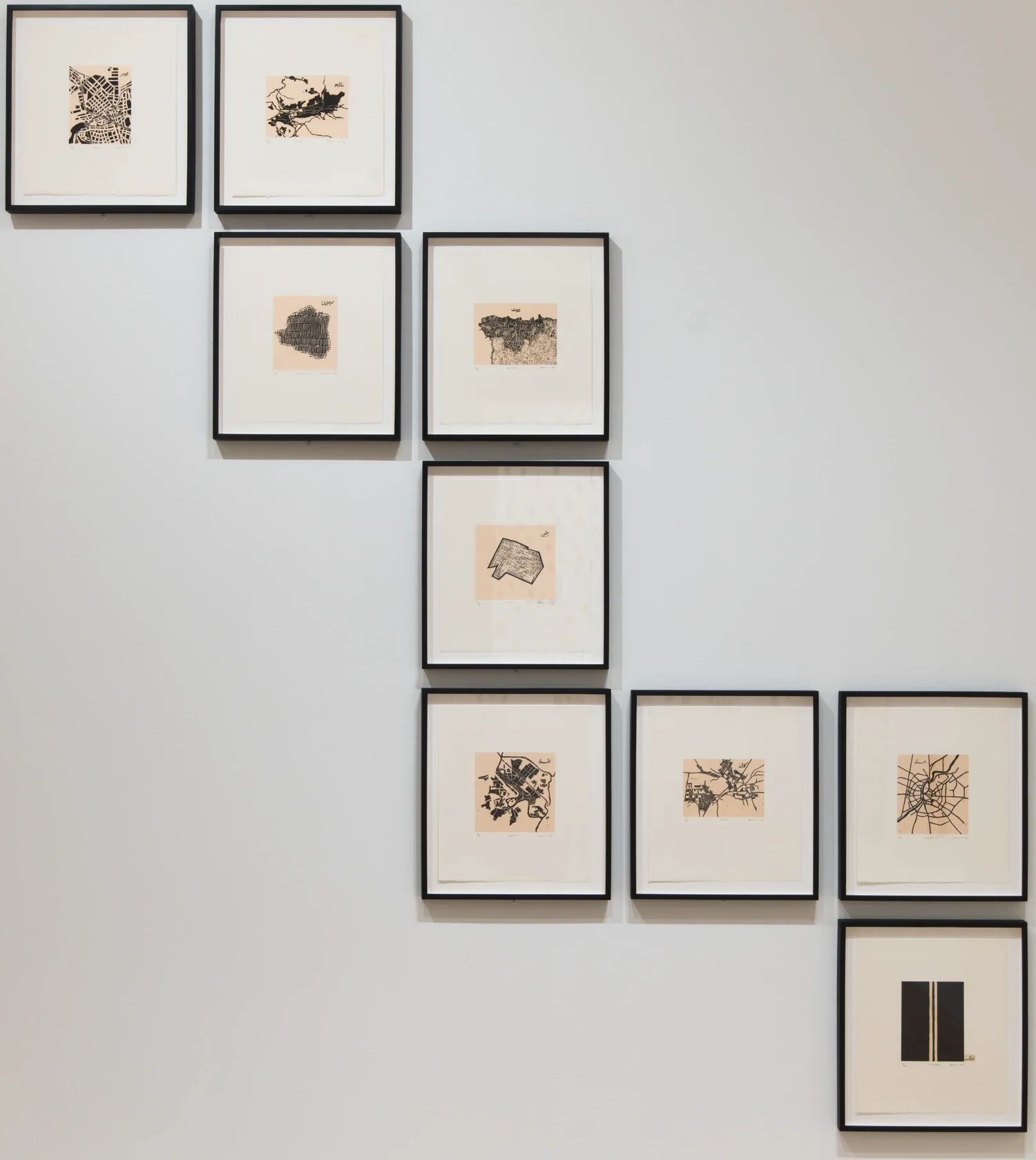
That inquiry continued in the later portfolio Homes I Made / A Life in Nine Lines, where the cities become spare plans, fragments, and names. Architecture is reduced until it can travel, while each place retains its own emotional temperature. Santa Cruz was both a working environment and one of those lived lines—a place where printmaking, teaching, the Pacific landscape, and the idea of home entered the work together.
Feminist retrospective · 1996
25 Years of Feminism / 25 Years of Women’s Art
Mason Gross School of the Arts, Rutgers University · New Brunswick
The twenty-fifth-anniversary retrospective of the Mary H. Dana Women Artists Series gathered a broad field of artists at Rutgers. It formed part of a larger program of exhibitions, archives, public events, and writing devoted to the conditions under which women made and presented art from 1971 onward. Zarina’s inclusion placed her practice within a feminist institutional history built through sustained visibility rather than a single shared style.
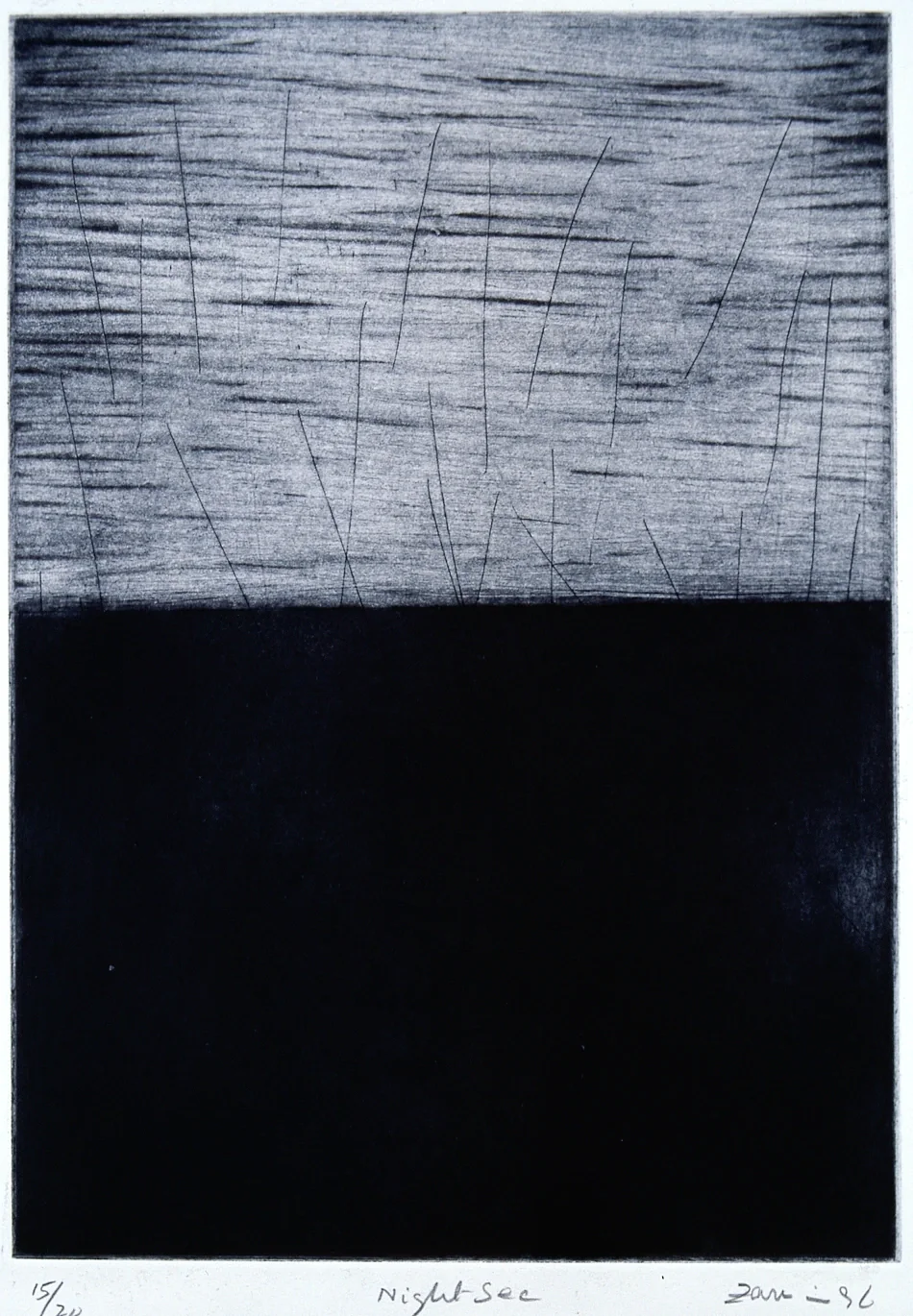
Night Sea, made in 1996, offers a period lens onto that independence. A dark lower field meets an agitated blue-gray surface crossed by fine vertical marks, making a horizon without turning the image into conventional landscape. The work joins the discipline of printmaking to the experience of distance and solitude. Its authority comes from Zarina’s decision to let material, memory, and a personal sense of place determine the form.
Print survey · 23 Apr–21 Sep 1997
India and Pakistan: Contemporary Prints
Victoria and Albert Museum · London
India and Pakistan: Contemporary Prints brought recent printmaking from the two countries into the Victoria and Albert Museum. Curated by Rosemary Miles and Divia Patel, the exhibition gave the medium its own field of attention: not as a lesser form beside painting, but as a place where paper, pressure, edition, language, and exchange could register the region’s changing artistic histories.
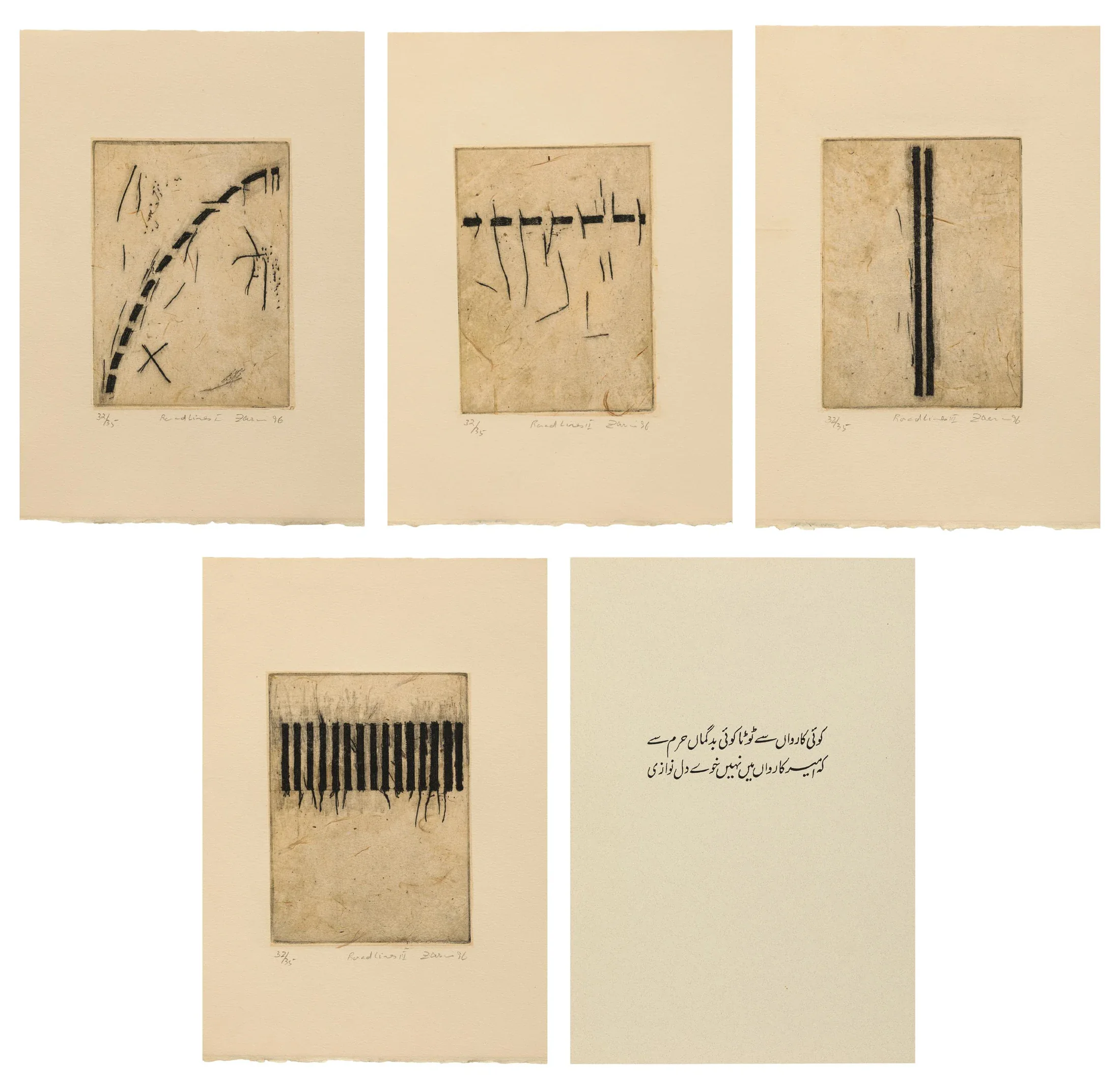
Road Lines, made the previous year at the University of California, Santa Cruz, offers a period lens onto Zarina’s contribution to that expanded field. Across the portfolio, marks bend, gather, narrow into parallel lines, and repeat like a barrier or procession. A couplet by Allama Iqbal follows the images. Word and line do not translate one another; together they make travel feel interrupted, collective, and emotionally charged.
Diaspora exhibition · 1997
Out of India: Contemporary Art of the South Asian Diaspora
Queens Museum of Art · New York
Out of India was one of the Queens Museum exhibitions that brought contemporary art into conversation with the diasporic communities of its borough. Rather than treating departure from South Asia as a single condition, the exhibition made room for practices shaped by different routes, generations, languages, and negotiations of belonging. Zarina’s work brought to that conversation a biography spanning India, Southeast Asia, Europe, Japan, and the United States without allowing those movements to dissolve the specificity of memory.
Homes I Made / A Life in Nine Lines, also made in 1997, turns that movement into an irregular constellation of plans. Each etched sheet names a city and a period of Zarina’s life, while the open arrangement refuses a single center. Home becomes plural: made through residence, work, relationship, and recollection. The portfolio does not resolve diaspora into arrival. It gives form to the continuing labor of locating oneself among places carried at different distances.
Group exhibition · 17 Nov–12 Dec 1998
Asian American Artists: Cross-Cultural Voices
University Art Gallery, Stony Brook University · New York
Asian American Artists: Cross-Cultural Voices brought Zarina together with Kip Fulbeck, Wenda Gu, Do Ho Suh, and Lynne Yamamoto. The exhibition treated culture as lived across languages, locations, and inherited histories rather than as a stable category. Zarina’s work resists the expectation that an artist moving between South Asia and the United States must choose one cultural position or turn biography into explanation.
Somewhere the flotilla of sorrow will come to rest, made in 1997, spreads a vast field of cast-and-painted aluminum elements across the wall. The repeated forms can suggest boats, houses, or travelers in passage, yet no single reading fixes them. Their changing directions and dispersed spacing transform migration from a route with a clear destination into a field of vulnerability, persistence, and hoped-for rest. Repetition makes each small form part of a collective without erasing its difference.
Group exhibition · Jan 1998
Ada or Ardor
Nature Morte at India Habitat Centre · New Delhi
Ada or Ardor belonged to the first program mounted by Nature Morte after the gallery was re-established in New Delhi. The exhibition brought together women artists whose practices approached seriality through different subjects and materials. In that setting, repetition was not sameness: it could mark duration, variation, attention, and the pressure of returning to a form until its meaning shifted.
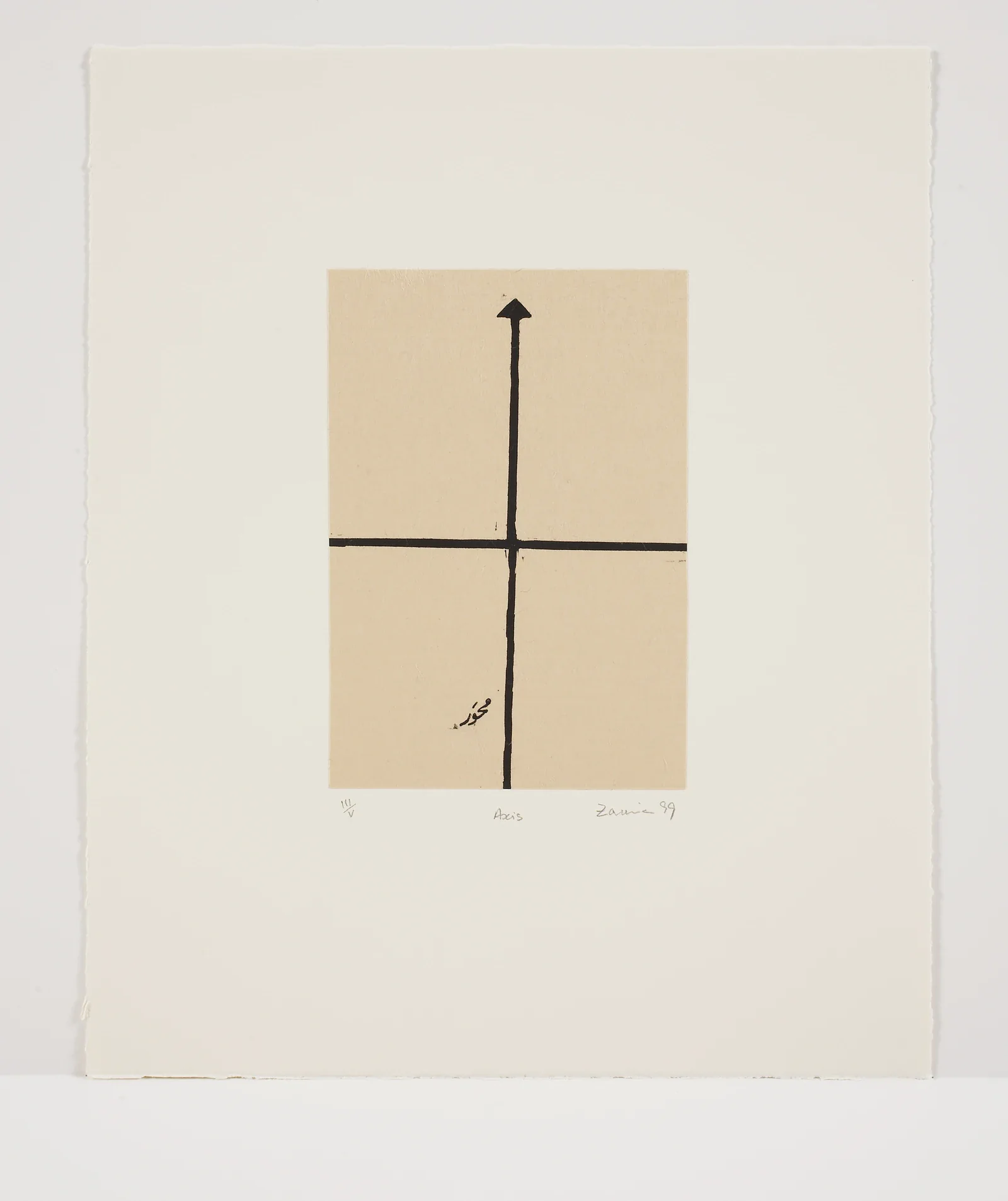
Axis, made the following year for Home Is a Foreign Place, offers a period lens onto Zarina’s use of serial structure. A vertical line rises through a horizontal crossing and ends in an arrow, while the Urdu word sits close to the lower edge. The image is both exact and unsettled: a coordinate that promises orientation, but also a path that continues beyond the sheet. Across Zarina’s portfolios, sequence gives such spare signs time to accumulate as memory and movement.
Group exhibition · 6 Jan–12 Feb 1998
Connections
Euphrat Museum of Art, De Anza College · Cupertino
Connections joined two inquiries into community and place. The section Under One Roof brought together South Asian artists working in the Bay Area across painting, sculpture, furniture, and installation. Its title made belonging both architectural and social: a shared roof could name shelter, proximity, conversation, or the effort of creating cultural space among artists whose work had rarely been seen together.
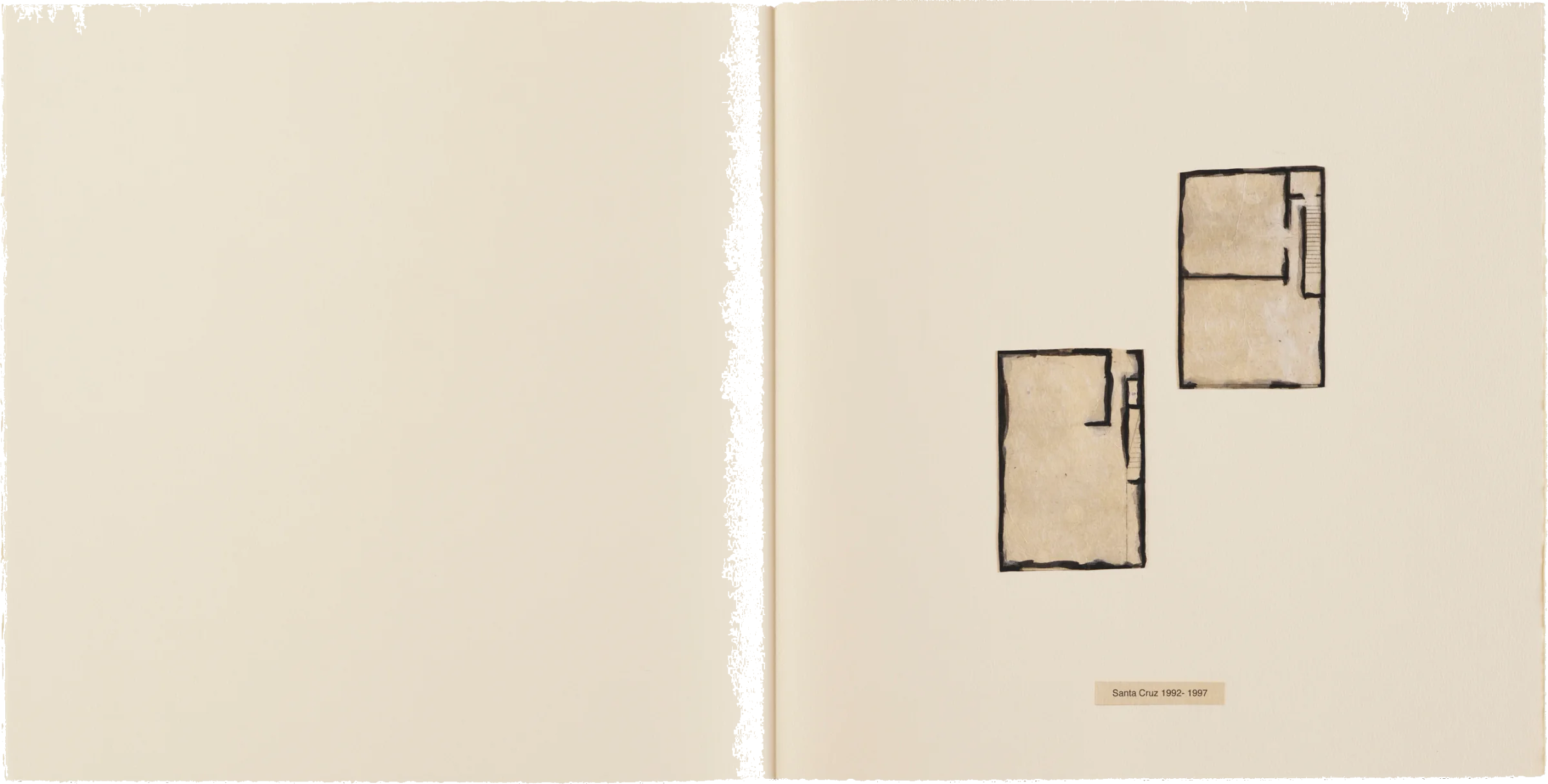
Zarina’s Santa Cruz sheet from Homes I Made / A Life in Nine Lines gives that context a quiet spatial form. Two reduced plans occupy one side of an open spread, leaving most of the paper unmarked. The emptiness keeps the structures from becoming fixed houses; they remain traces of rooms lived in and later recalled. Made while Zarina divided her life between California and New York, the portfolio turns connection into something carried across distance rather than guaranteed by location.
Group exhibition · 1999
Icons of the Millennium
Lakeeren at Nehru Centre · Mumbai
Icons of the Millennium placed Zarina within a Mumbai exhibition shaped by the symbolic weight of a historical threshold. Her work approaches an icon without monumentality. A house, a border, a line, or a word becomes memorable through reduction and repetition, asking how a compact sign can carry histories larger than itself.
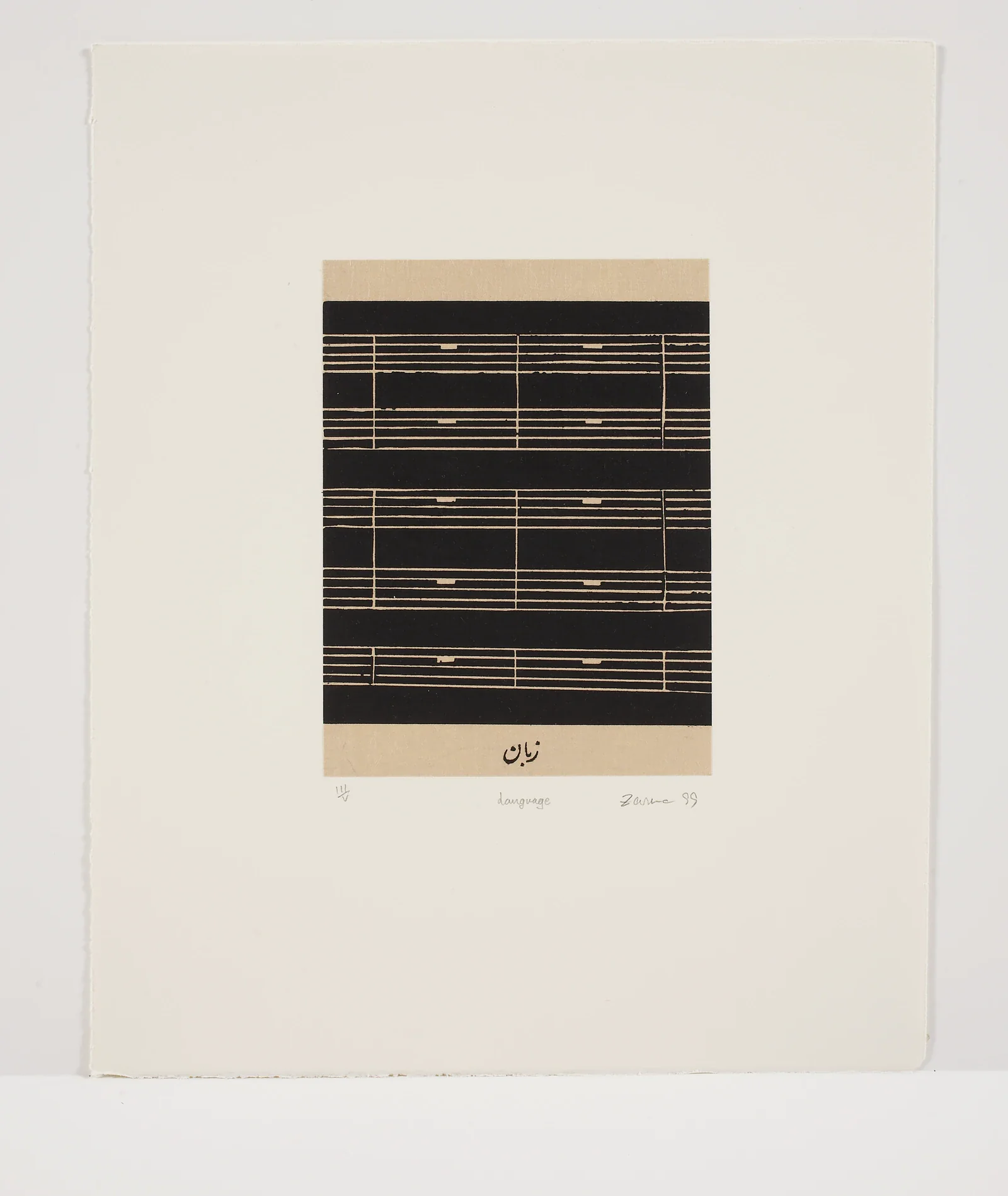
Language, made in 1999 for Home Is a Foreign Place, is a fitting lens onto that moment. Fine pale lines interrupt a dense black field above the Urdu word zabaan. The image joins sound, script, and structure without turning language into decoration. At the turn of the millennium, Zarina’s most resonant signs remained deliberately intimate: formed from a remembered vocabulary, yet open enough to speak across places and generations.
Three-city solo exhibition · 2000
Home Is a Foreign Place
New York · New Delhi · Karachi
Home Is a Foreign Place travelled from Admit One in New York to Gallery Espace in New Delhi and Chawkandi Art in Karachi. Its movement across those cities sharpened the portfolio’s central proposition: home is not secured by physical proximity. It is recognized through distance, language, recollection, and the repeated act of departure.
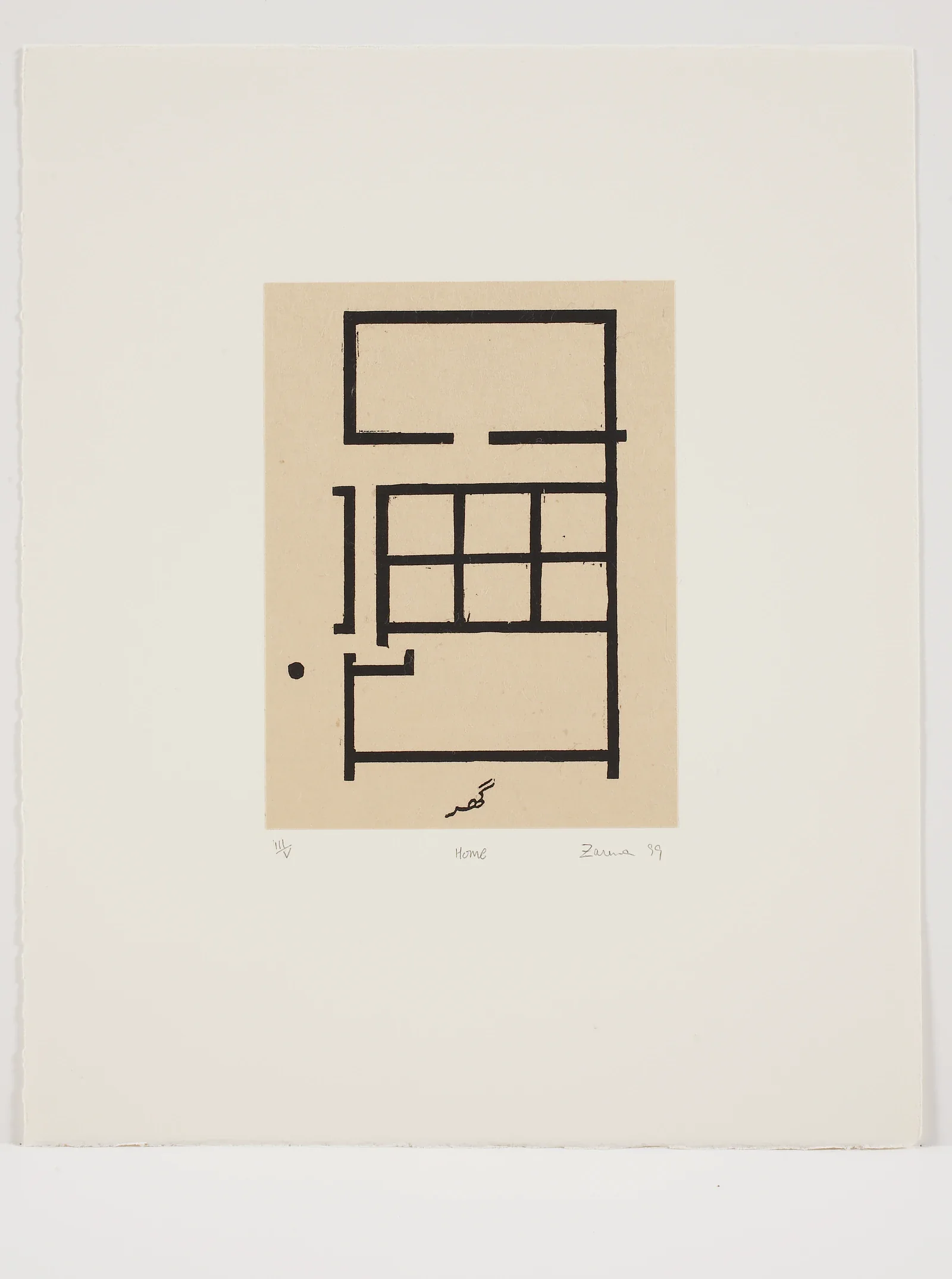
The woodcut sequence unfolds from Home, Threshold, Door, Entrance, and Courtyard toward weather, darkness, country, language, journey, road, distance, time, and border. Each Urdu word is paired with a carved image rather than translated by it. The sequence carries the plan of Zarina’s childhood house outward into a larger meditation on belonging, allowing a private architecture to hold the pressures of migration and Partition without reducing either to illustration.
International print biennial · 13 Feb–13 Mar 2001
Fifth Bharat Bhavan International Biennial of Print Art
Roopankar Museum of Fine Arts, Bharat Bhavan · Bhopal
The Bharat Bhavan biennial placed contemporary printmaking within an international exchange centered on the medium itself. Hosted by Roopankar, whose workshops joined exhibition, collection, and artistic production, the biennial gave printed paper a field broad enough to hold technical experiment, cultural memory, and distinct regional traditions without making one answer for another.
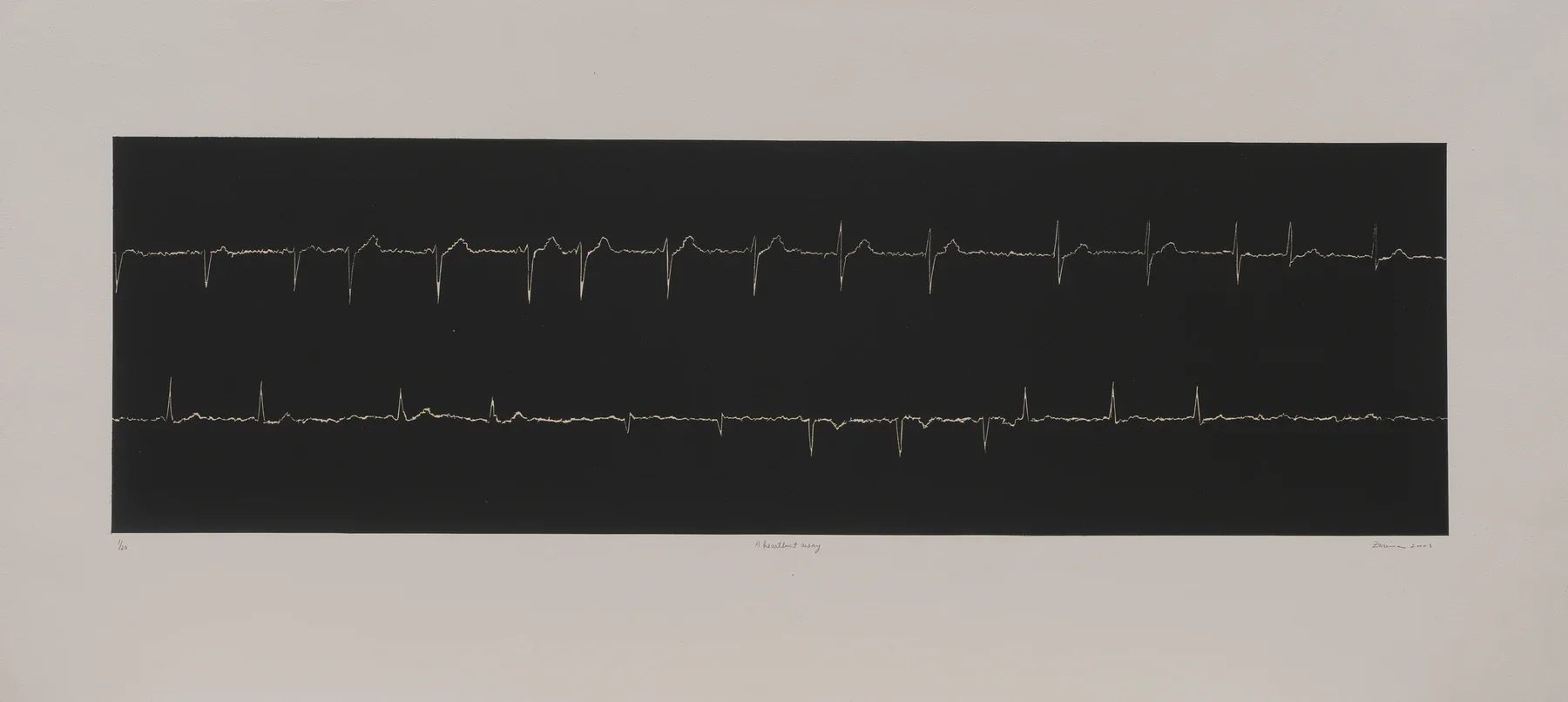
A Heartbeat Away, made in 2001, offers a period lens onto Zarina’s command of the woodcut. Two pale, pulse-like lines cross a long black field. Minute changes in height and rhythm keep the image alive, while the surrounding darkness turns measurement into emotional distance. The print joins repeatable process to an irreducibly human sign: the fragile evidence of a life continuing across an expanse.
Solo survey · 4 Nov–21 Dec 2001
Mapping a Life: 1991–2001
Mills College Art Museum · Oakland
Mapping a Life brought together a decade in which Zarina transformed the remembered house, the journey, and the map into an increasingly expansive language. Portfolios including The House at Aligarh, Atlas of My World, and Home Is a Foreign Place appeared alongside sculptural works whose houses could crawl, move on wheels, hang, or break into displaced fragments.
The exhibition’s title makes biography spatial. A life is not narrated as a continuous story but traced through rooms, routes, countries, and repeated departures. Across print and sculpture, the house remains recognizable even when it is reduced to a plan or made mobile; memory becomes something built from intervals, recurrence, and the material pressure of the hand.
Historical and contemporary exhibition · 2002
From the Two Pens: Line and Color in Islamic Art
Williams College Museum of Art · Williamstown
From the Two Pens placed Zarina’s prints in conversation with works spanning the history of Islamic calligraphy, including manuscript pages and calligraphic exercises. The exhibition’s title joined line and color through the idea of the pen, allowing script to appear not only as text to be read but as movement, proportion, discipline, and visual form.
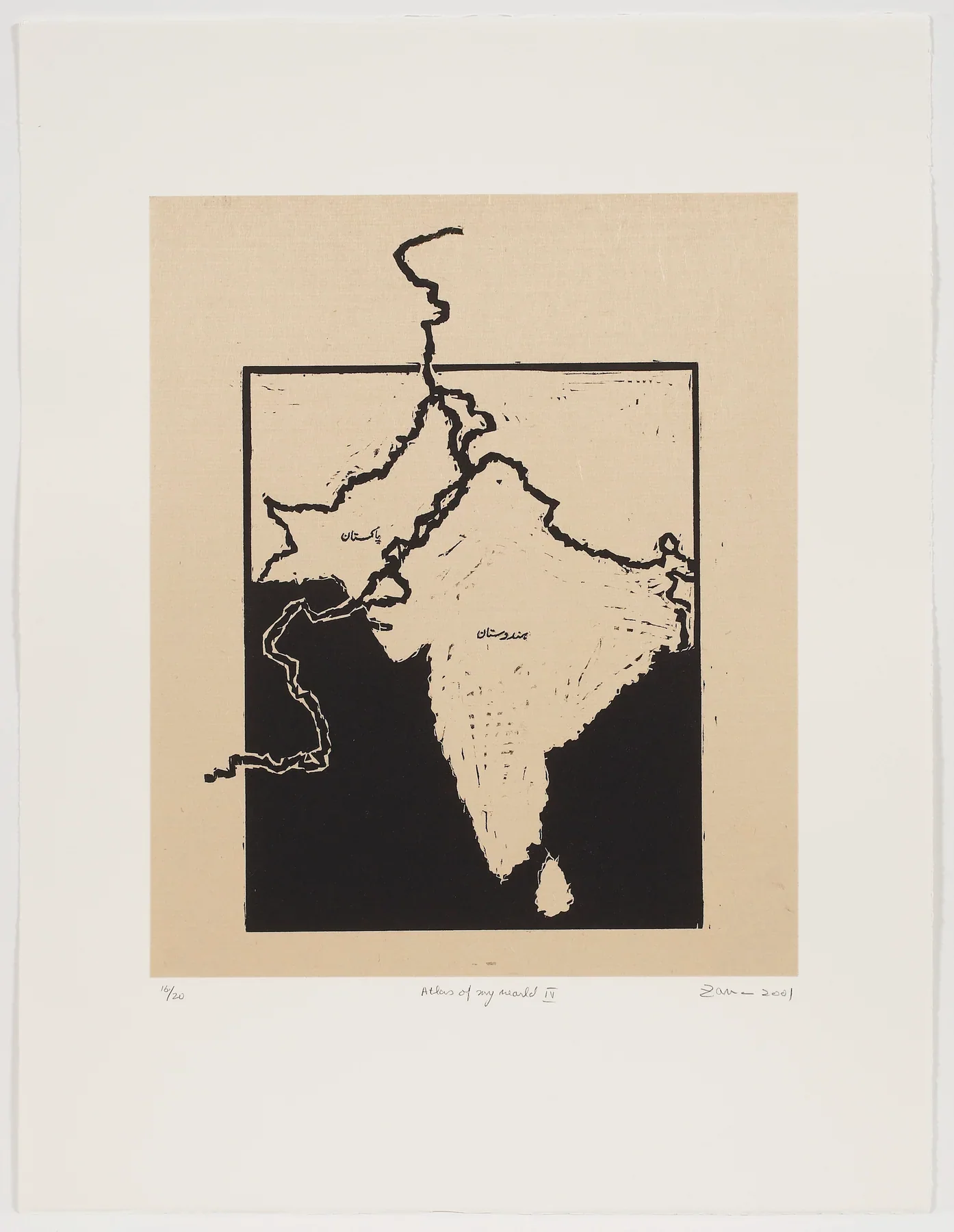
Atlas of My World IV, made the previous year, brings those possibilities into Zarina’s political geography. The outline of the subcontinent is cut, darkened, and crossed by borders, while Urdu names locate Pakistan and India within a map shaped by Partition. Script does not sit outside the image as explanation. It belongs to the remembered terrain, carrying sound, history, and cultural intimacy into the carved line.
Artistic response and public gathering · 19 Jan 2002
Reflections at a Time of Transformation
Cathedral Church of Saint John the Divine · New York
Created in the wake of September 2001, Reflections at a Time of Transformation brought American Muslim visual artists, writers, and performers into a public space of mourning and exchange. The gathering answered fear and suspicion through culture rather than spectacle, making room for grief, spiritual reflection, and the varied voices of a community refusing to be reduced to a single public image.
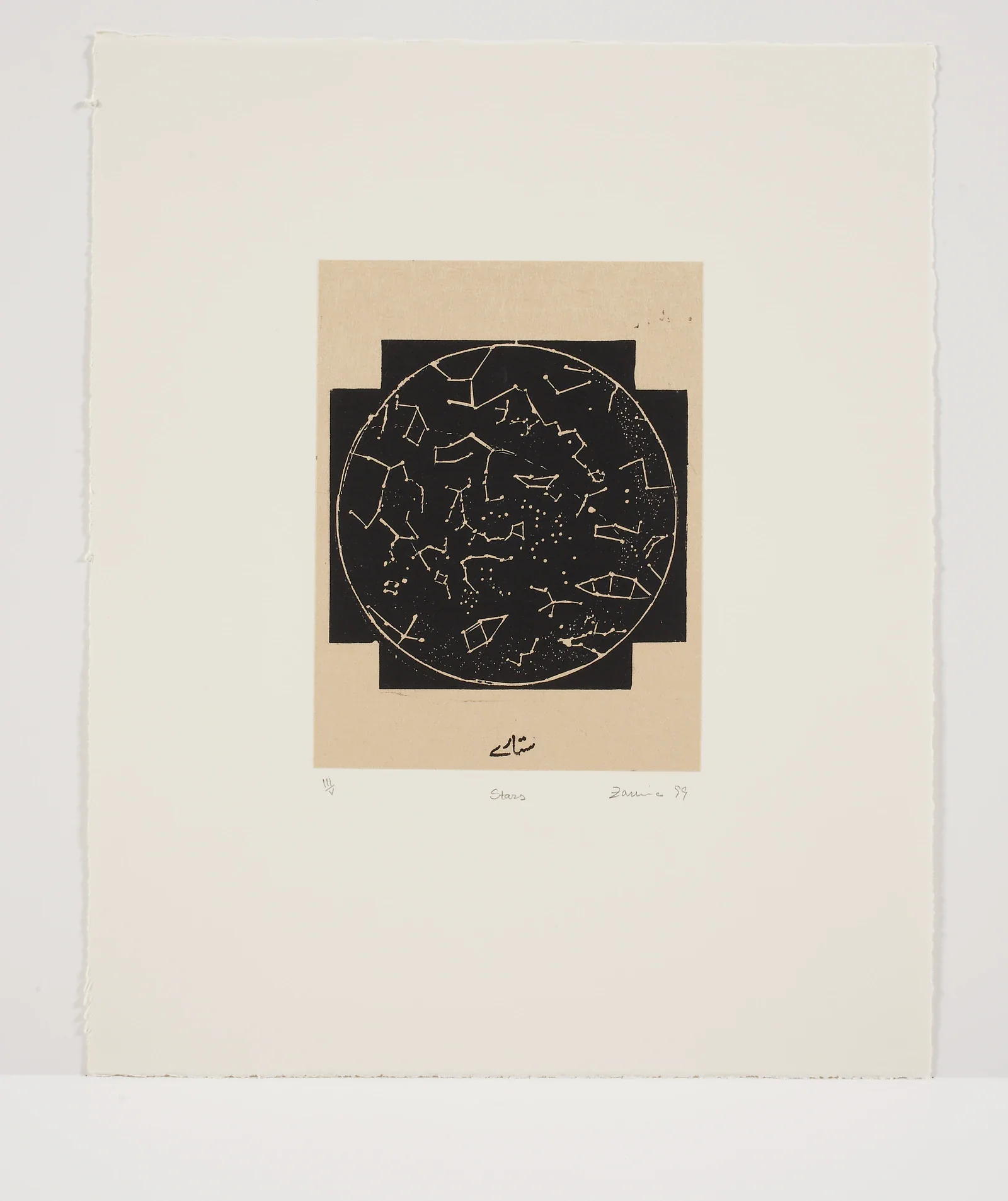
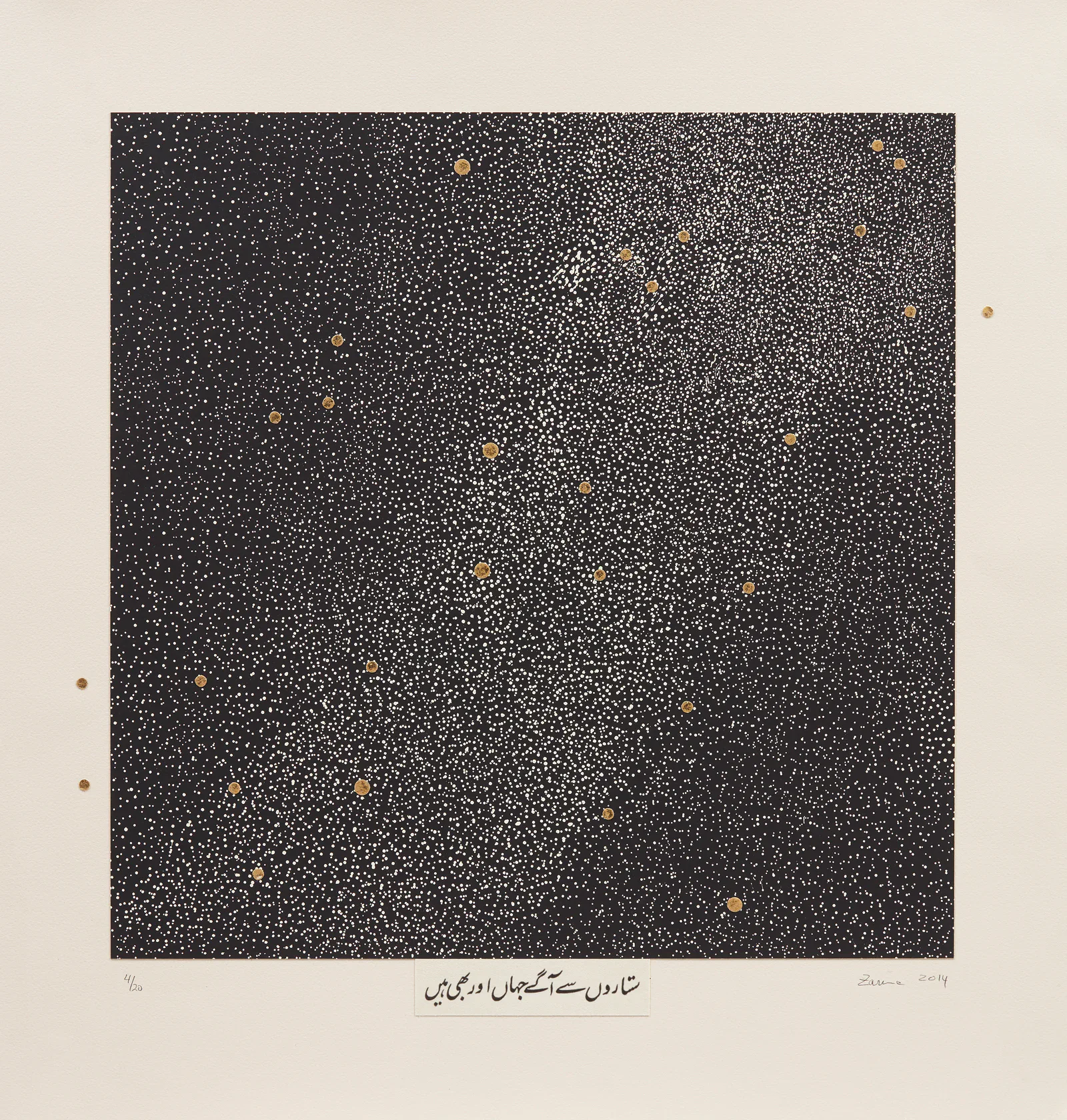
The program described Zarina’s contribution as prints of the cosmos. Stars, made in 1999 for Home Is a Foreign Place, gives that idea an intimate scale. Constellations and scattered points gather inside a dark circular field above the Urdu word sitaray. The image looks outward toward immeasurable space while remaining anchored in a language carried from childhood—a quiet union of distance, memory, and belonging.
Book-linked group exhibition · 2003–9 Jan 2004
Fresh Talk Revisited: New York Artists from Fresh Talk/Daring Gazes
Asian/Pacific/American Studies at NYU · New York
Fresh Talk Revisited returned to artists featured in the book Fresh Talk/Daring Gazes, which paired twenty-four Asian American artists with writers, artists, and activists. Curated by Margo Machida, the New York exhibition extended those conversations into the gallery, where identity could be approached through movement, memory, history, and the loss or remaking of home rather than treated as a fixed category.
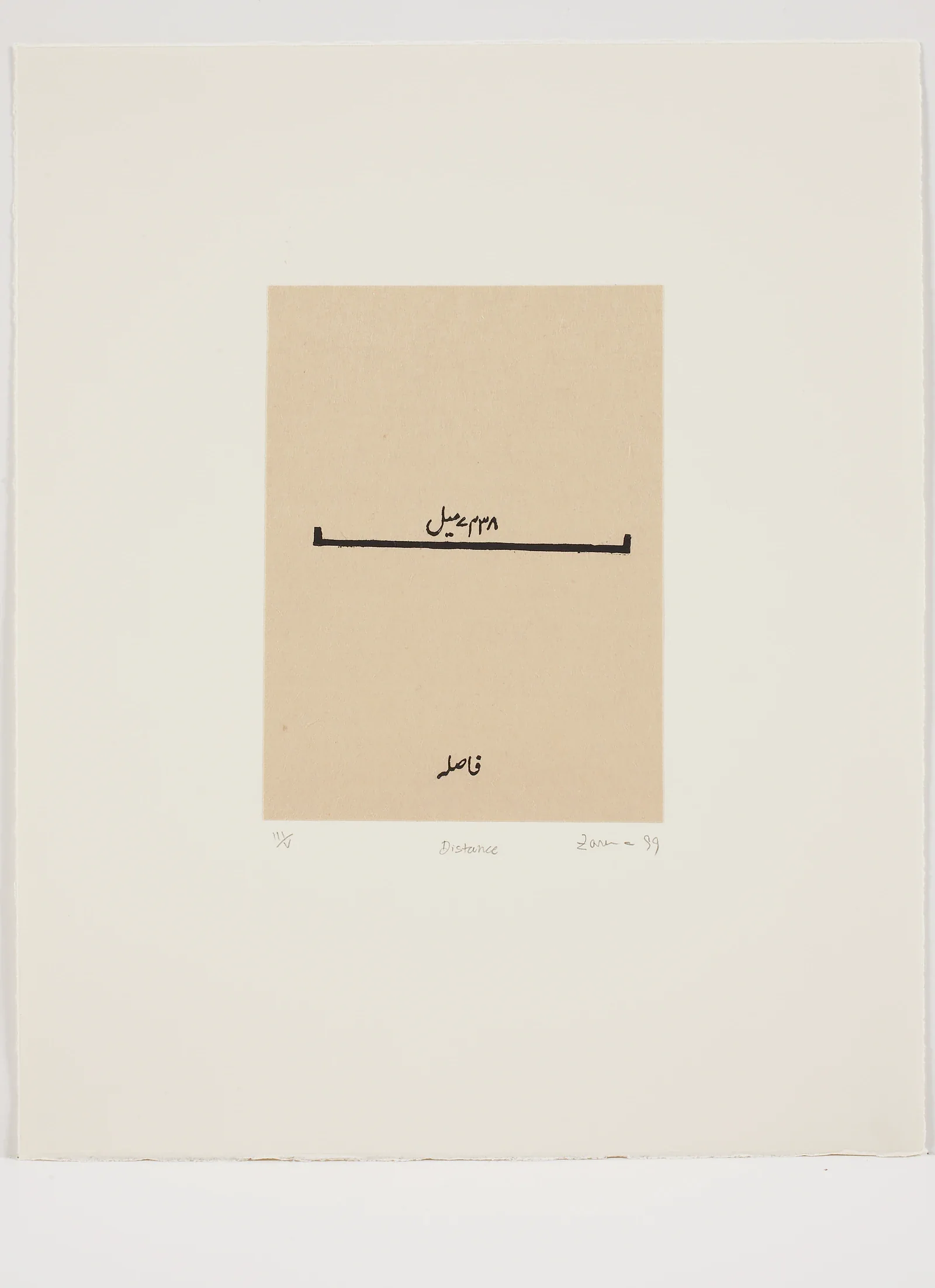
Distance from Home Is a Foreign Place offers a period lens onto that exchange. A single line stretches between two Urdu words: faasla, distance, and darmiyaan, the space between. The image makes separation measurable but not empty. Language, memory, and the physical span of the sheet hold two places in relation, turning diaspora into an interval that is lived rather than merely crossed.
Solo exhibition · 2003
Maps, Homes and Itineraries
Gallery Lux · San Francisco
Maps, Homes and Itineraries brought Zarina’s cartographic prints into conversation with houses and route-based sculptures. Across the installation, a framed city could face a line pinned directly to the wall, while works including Itinerary with 98 Steps, House on Four Wheels, The Frailest House, Unsafe Havens, and Peregrinations made travel feel measured, precarious, and physical.
The exhibition’s three nouns describe competing ways of locating a life. A map offers an overview, a home fixes a place, and an itinerary records movement between points. Zarina unsettled each category: maps became personal, houses could travel or fail, and journeys survived as fragile sequences of pins, thread, wood, and repeated marks.
Four-city solo exhibition · 2004
Cities, Countries and Borders
Mumbai · New Delhi · Karachi · Lahore
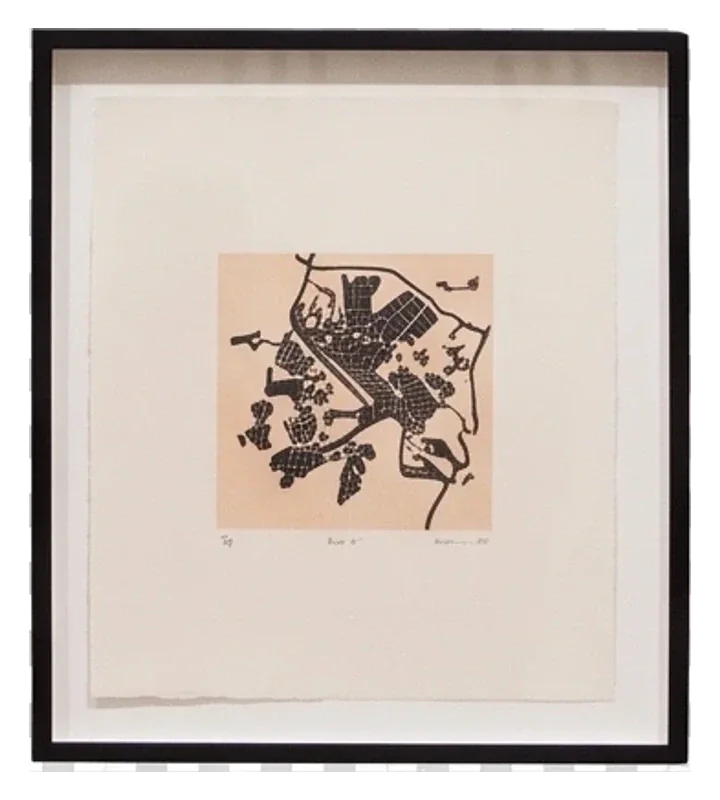
Cities, Countries and Borders travelled through Mumbai, New Delhi, Karachi, and Lahore, carrying Zarina’s maps across the very national boundaries her work examined. The exhibition joined images of countries to the places named in These Cities Blotted into the Wilderness—cities marked by war, siege, communal violence, and the unstable distance between lived experience and news.
Zarina’s cartographies refuse the apparent neutrality of the conventional map. Streets become dense scars, borders split land, and the Urdu name of each city makes language part of its geography. By moving the exhibition between India and Pakistan, the work placed Partition within a wider history of destroyed and divided places while insisting that a city persists through memory as well as territory.
World Social Forum exhibition · 2005
Crossovers and Rewrites: Borders over Asia
Museum of Contemporary Art · Porto Alegre
Presented during the 2005 World Social Forum, Crossovers and Rewrites approached Asia through borders made by colonial history, nation states, and everyday social life. Its field extended from India and Pakistan to divisions shaped by gender, community, caste, race, city and village, home and street. Culture appeared here as a political language in motion: a way to test inherited boundaries and imagine other relations across them.
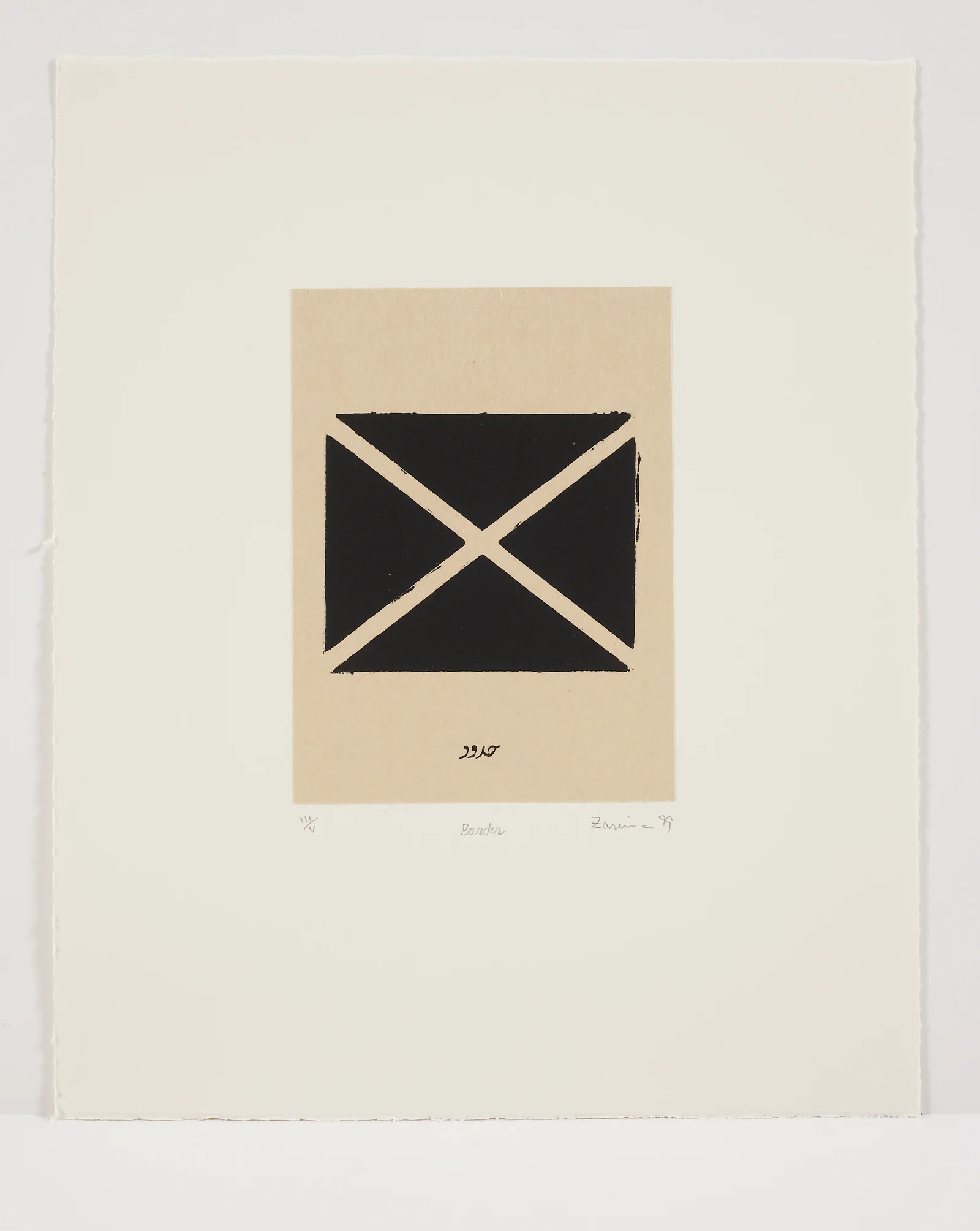
Border from Home Is a Foreign Place provides a closely related period lens. Two pale diagonals cut through a dense black field, turning the simple geometry of an X into closure, crossing, and refusal. As a woodcut, the image also belongs to the exhibition’s interest in reproducible forms—works able to circulate beyond the singular art object while carrying the pressure of partition and exclusion into a direct, economical sign.
Touring group exhibition · 2005–08
Figures of Thinking: Convergences in Contemporary Cultures
Richard E. Peeler Art Center and five touring venues · United States
Figures of Thinking brought together fourteen women artists whose works connected contemporary ideas across cultures without flattening their differences. Co-curated by Vicky A. Clark and Sandhini Poddar, the exhibition travelled across the United States from 2005 to 2008. Its artists used materials metaphorically and drew intimate experience into wider questions of representation, cultural encounter, and the assumptions attached to identity.
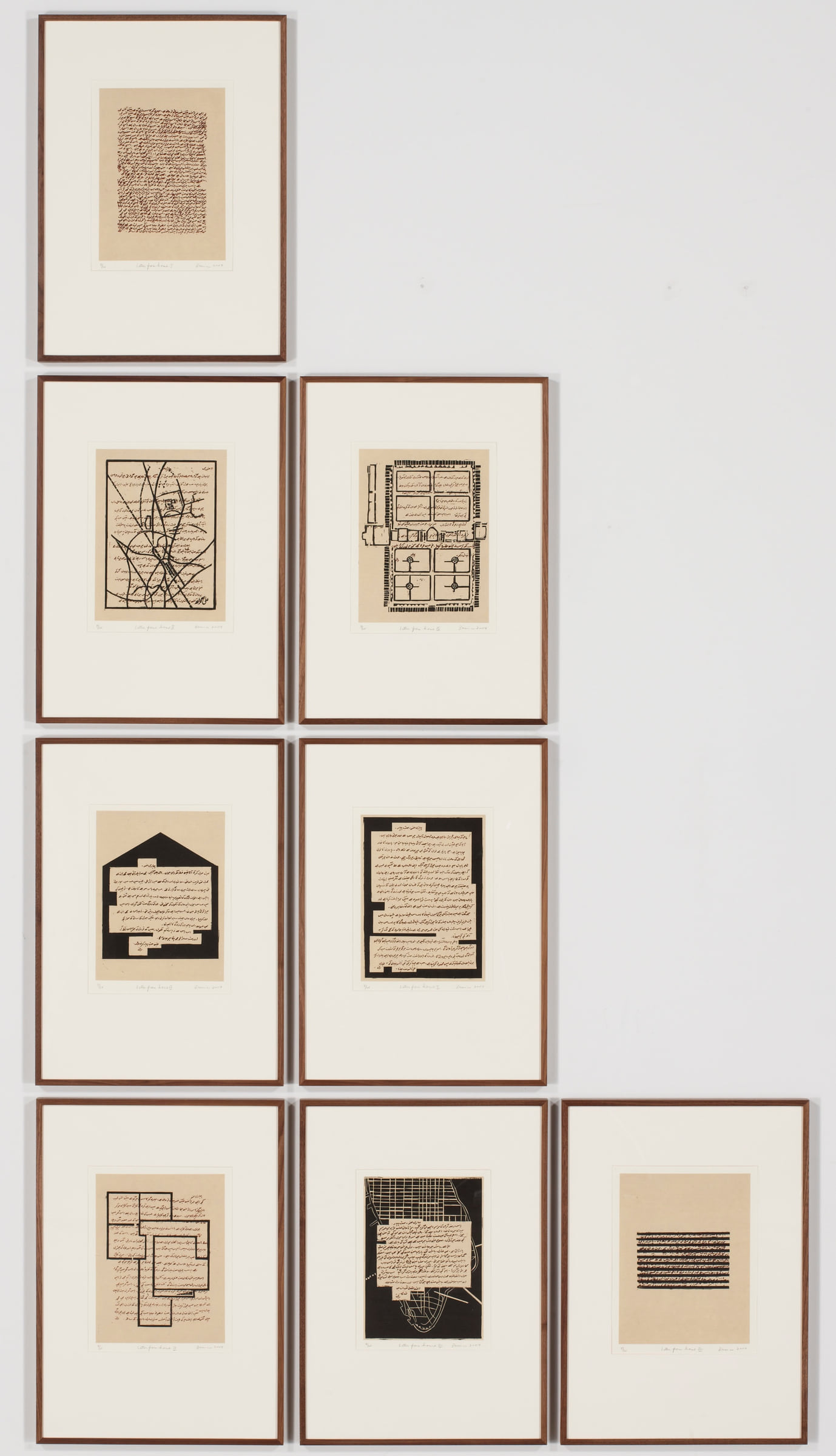
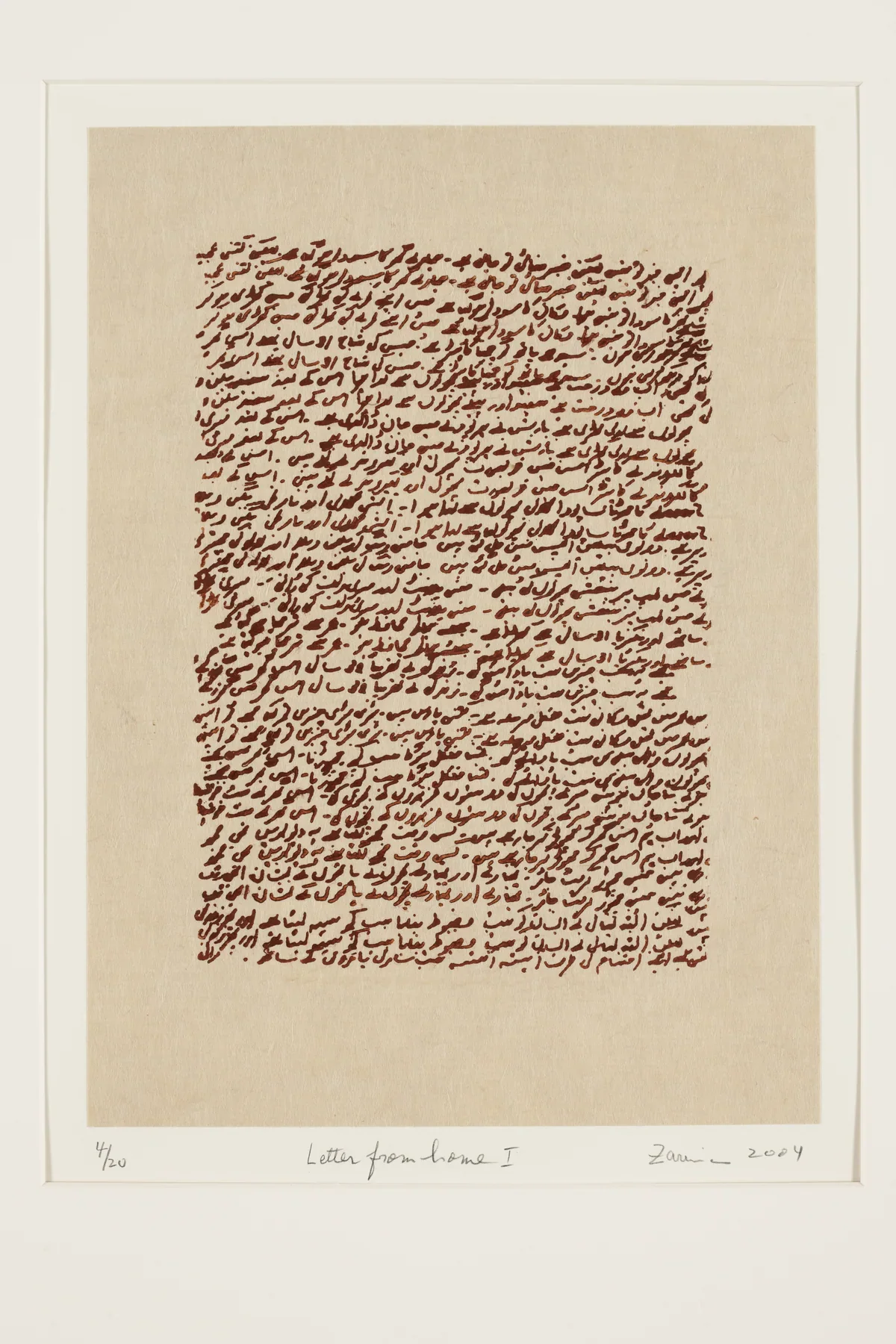
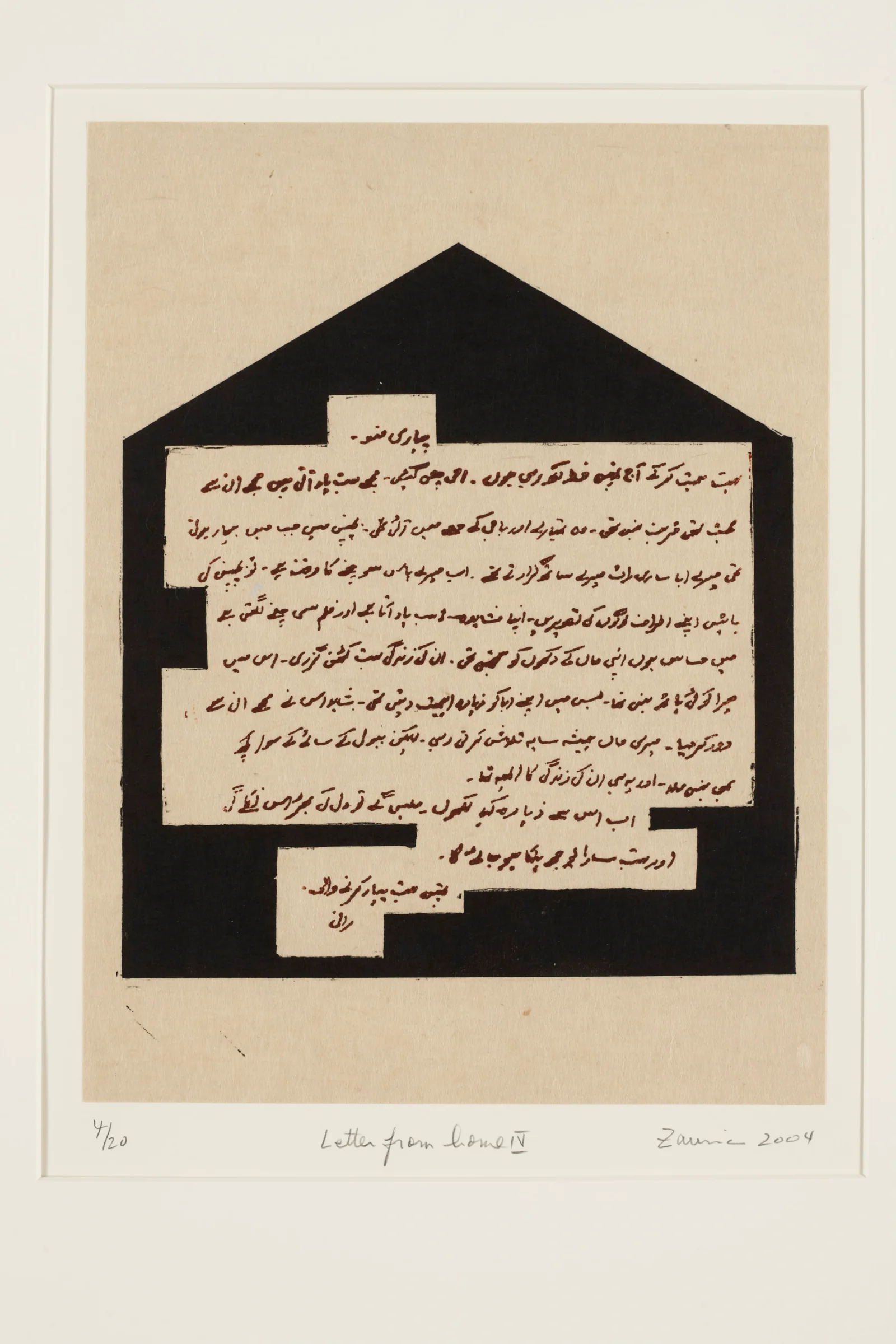
Letters from Home, made in 2004, offers a period lens on that convergence. Zarina enlarged passages from letters written by her sister Rani and layered handwriting with maps, plans, and dark geometric fields. The private letter becomes image, architecture, and evidence of distance at once. Thought is not illustrated from outside; it takes material form through ink, paper, repetition, and the charged gaps between what can be read and what can only be felt.
Solo survey · 10 Nov–22 Dec 2005
Counting: 1977–2005
Bose Pacia · New York
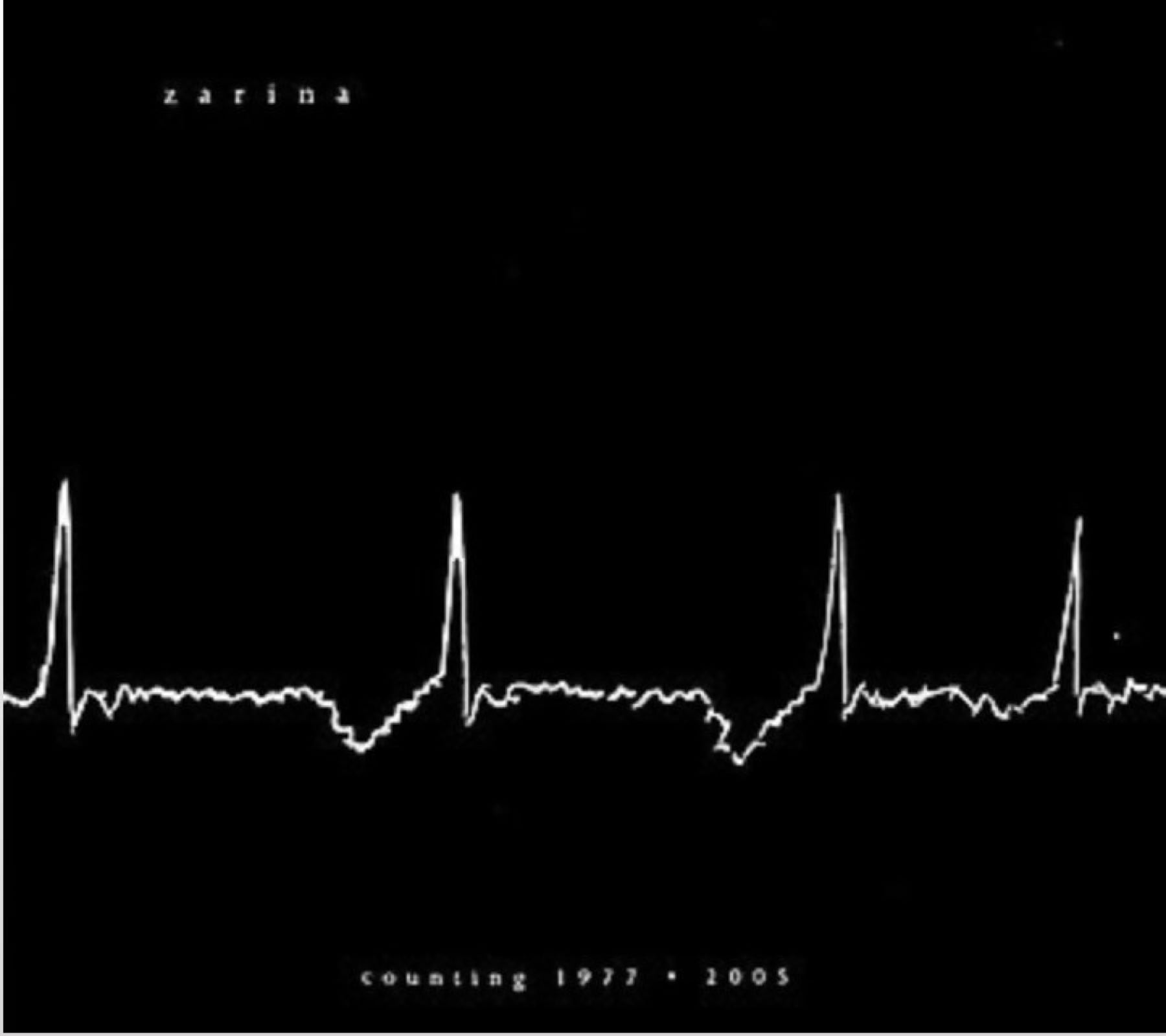
Counting brought nearly three decades of Zarina’s work into one sustained view. Cast-paper objects, floor plans, maps, letters, and portfolios revealed how consistently she returned to a small vocabulary of line, house, border, route, and measure. The title suggests more than chronology: repetition becomes a way of marking duration, and every return to a familiar form records what time and distance have changed.
The exhibition also placed intimate signs beside public history. Handwriting, remembered rooms, and named cities make displacement legible without turning it into spectacle. In works including Letters from Home and These Cities Blotted into the Wilderness, personal memory becomes a structure through which war, Partition, exile, and the destruction of place can be encountered at human scale.
Retrospective exhibition · 2006
Silent Soliloquy
Bodhi Art · Singapore
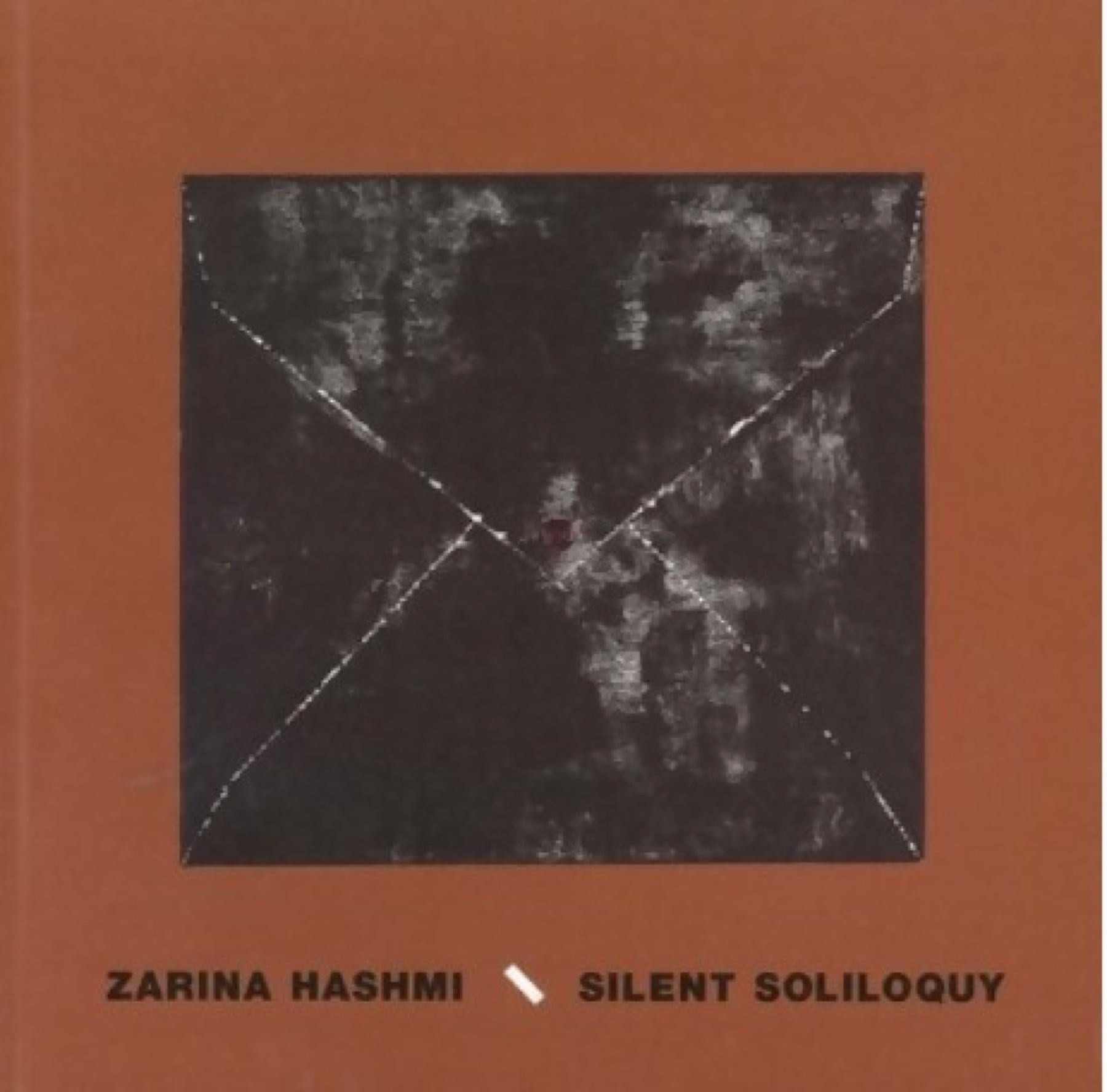
Silent Soliloquy returned to Zarina’s earlier printmaking, bringing the relief prints, serigraphs, embossings, and paper constructions of the 1970s into view as the foundations of her later practice. Even before maps and houses became recurring subjects, line, pressure, geometric enclosure, and the physical character of paper already carried emotional weight.
The title names a productive tension in the work. A soliloquy is spoken inwardly, yet a print moves that private address into shared space. Zarina’s quiet forms do not withhold meaning; they concentrate it. The grain of a surface, the pull of a thread, or the edge of a dark shape becomes a record of touch through which memory, distance, and belonging can be felt without illustration.
Group exhibition · Gallery Espace reopening · 2006
Back to the Future
Gallery Espace · New Delhi
Gallery Espace reopened after renovation with Back to the Future, bringing more than fifty artists into a deliberately double-facing frame. The exhibition looked back through the relationships that had shaped the gallery while asking how established practices continued to change. Zarina’s work belongs naturally within that movement between memory and renewal: her recurring forms are never static emblems, but structures remade through different materials, scales, and historical pressures.
Shadow House VI, made in 2006, offers a period lens. Cut Nepalese paper gives the house a fragile, porous body, while a narrow passage of gold leaf catches light against its dark interior. The familiar outline survives, yet it has become shadow, threshold, and absence. Looking backward does not restore a lost dwelling; it allows an old form to carry a changed understanding of shelter and distance.
Traveling group exhibition · thirty women printmakers · 2006
Footprints—Women in Printmaking
Vadodara · Hyderabad · Mumbai · Bangalore
Curated by printmaker Kavita Shah, Footprints gathered thirty women working in India, Pakistan, Hong Kong, the United Kingdom, and the United States, then travelled through four Indian cities. The exhibition treated printmaking as both a demanding material discipline and a network of exchange. Its catalogue invited the artists to reflect on the conditions of working as women printmakers, placing technique beside access, professional life, and artistic community.
A sheet from Letters from Home offers a close period lens on Zarina’s place within that conversation. Enlarged handwriting meets a dense printed field, so private correspondence becomes something impressed, repeated, and made public. The image depends on the physical transfer at the heart of printmaking, but it also carries a woman’s voice across distance. Memory is neither illustration nor confession here; it is rebuilt through pressure, scale, ink, and paper.
Three-artist exhibition · 2006
Works by Mehlli Gobhai, Nasreen Mohamedi & Zarina Hashmi
Bombay Art Gallery · Mumbai
This focused presentation brought Zarina into dialogue with Mehlli Gobhai and Nasreen Mohamedi, three artists for whom abstraction was inseparable from material attention. Mohamedi’s measured lines and graph-paper structures, Gobhai’s rubbed and scoured surfaces, and Zarina’s carved, cut, and assembled paper share a disciplined economy without becoming one language. Each practice asks how line, interval, and touch can hold experience without narrating it literally.
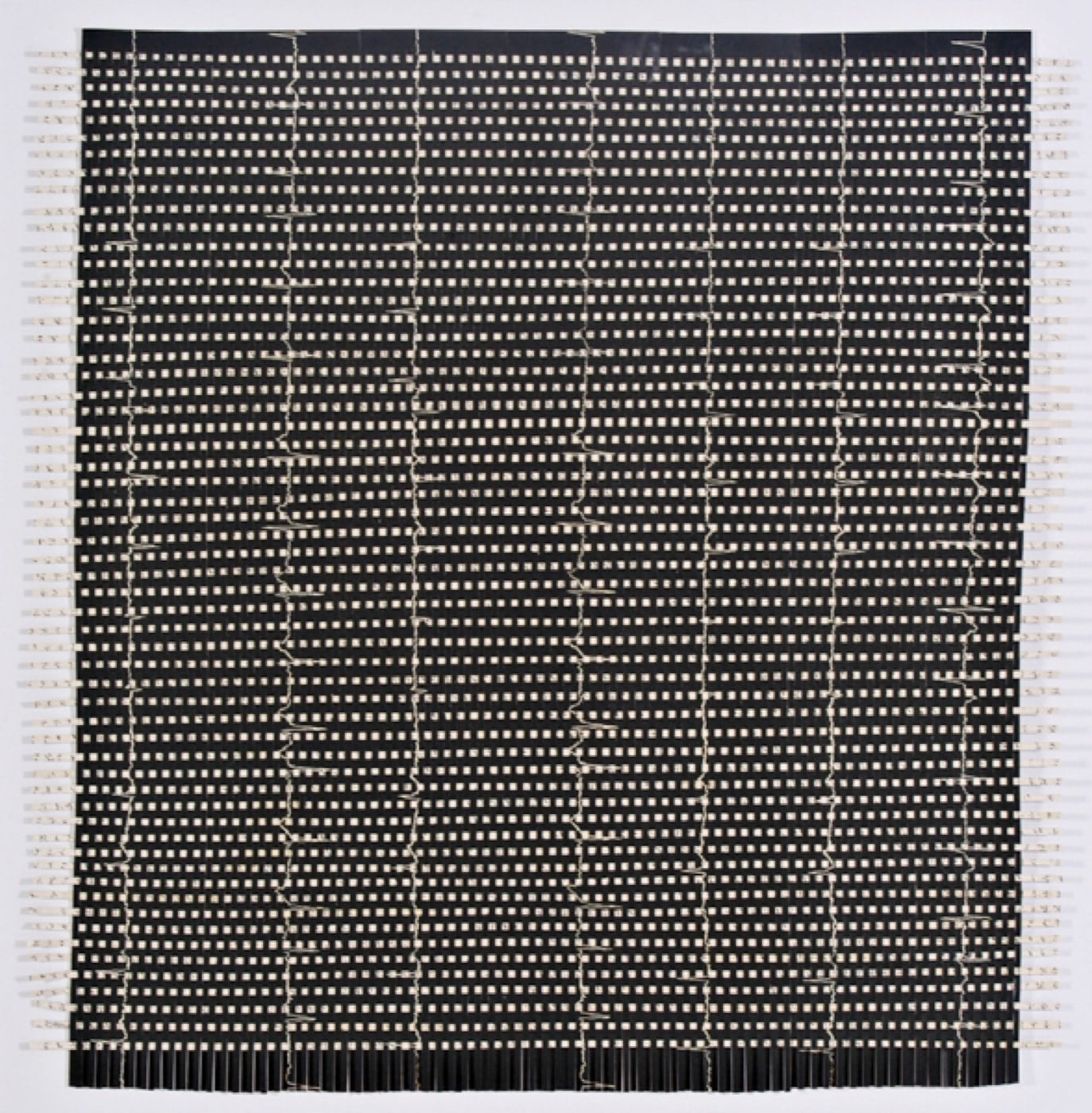
Weaving Memory, made that year, clarifies Zarina’s distinct position within the conversation. Strips of woodcut and computer-generated text are woven into a square whose broken sentences and dark marks remain present but resist complete reading. Geometry becomes a way of binding fragments rather than purifying them. The work joins hand and machine, word and image, order and interruption, making memory visible as an active construction.
Group exhibition · curated by Ina Puri · 18 May–2 Jun 2006
Making of Divinity
Sakshi Gallery · Mumbai
Curated by Ina Puri, Making of Divinity brought Zarina into a group exhibition whose title treated the sacred as something made and encountered rather than simply illustrated. That question runs through Zarina’s practice in an exacting, nonfigurative form. Repetition can resemble recitation; geometry can suggest an order larger than the self; darkness and reflected light can open a space for inward attention.
Stars, from Home Is a Foreign Place, offers a lens on that spiritual register. A dark circular field is punctuated by small points of light, while the Urdu word beneath the image binds the celestial to a remembered language. The sheet does not prescribe a single religious image. It allows word, void, and constellation to hold distance, wonder, and the possibility of orientation together.
Solo exhibition · 13 Jan–3 Feb 2007
Paper Houses
Gallery Espace · New Delhi
Paper Houses returned Zarina’s work to New Delhi through an exhibition that joined early cast-paper sculpture to the house forms, floor plans, and displaced dwellings that recur across her practice. Works such as Corner, Corners, and Displaced People / Displaced Homes made paper architectural without pretending that it could become permanent: pulp could carry weight and volume, yet remain vulnerable to pressure, damage, and time.
The exhibition title also named Zarina’s way of turning biography into form. A house might be reduced to an outline, a corner, or a dark enclosure, while still holding the memory of rooms once inhabited. In the statement published with the exhibition, she described retracing the places of her life through symbols and words—not to recover an untouched past, but to understand the route by which she had arrived in the present.
Solo exhibition · 19 Jan–10 Feb 2007
Weaving Memory: 1990–2006
Bodhi Art · Mumbai
Weaving Memory gathered eighteen portfolios made over sixteen years, allowing memory to unfold as sequence rather than a single image. Across the gallery, repeated sheets, restrained geometries, and shifts between Urdu and English gave recollection a physical rhythm. The exhibition joined the private architecture of House at Aligarh, Home Is a Foreign Place, and Letters from Home to the public geographies of Atlas of My World, Countries, and These Cities Blotted into the Wilderness.
The title describes Zarina’s method precisely. A woven memory is assembled from separate strands: a floor plan, a handwritten letter, a map, the name of a city, the pressure of a carved block. These fragments do not restore the past as something whole or untouched. Their intervals and repetitions keep absence visible, while allowing lived experience and political history to remain inseparable.
Solo presentation · Best of Artists · 6–9 Sep 2007
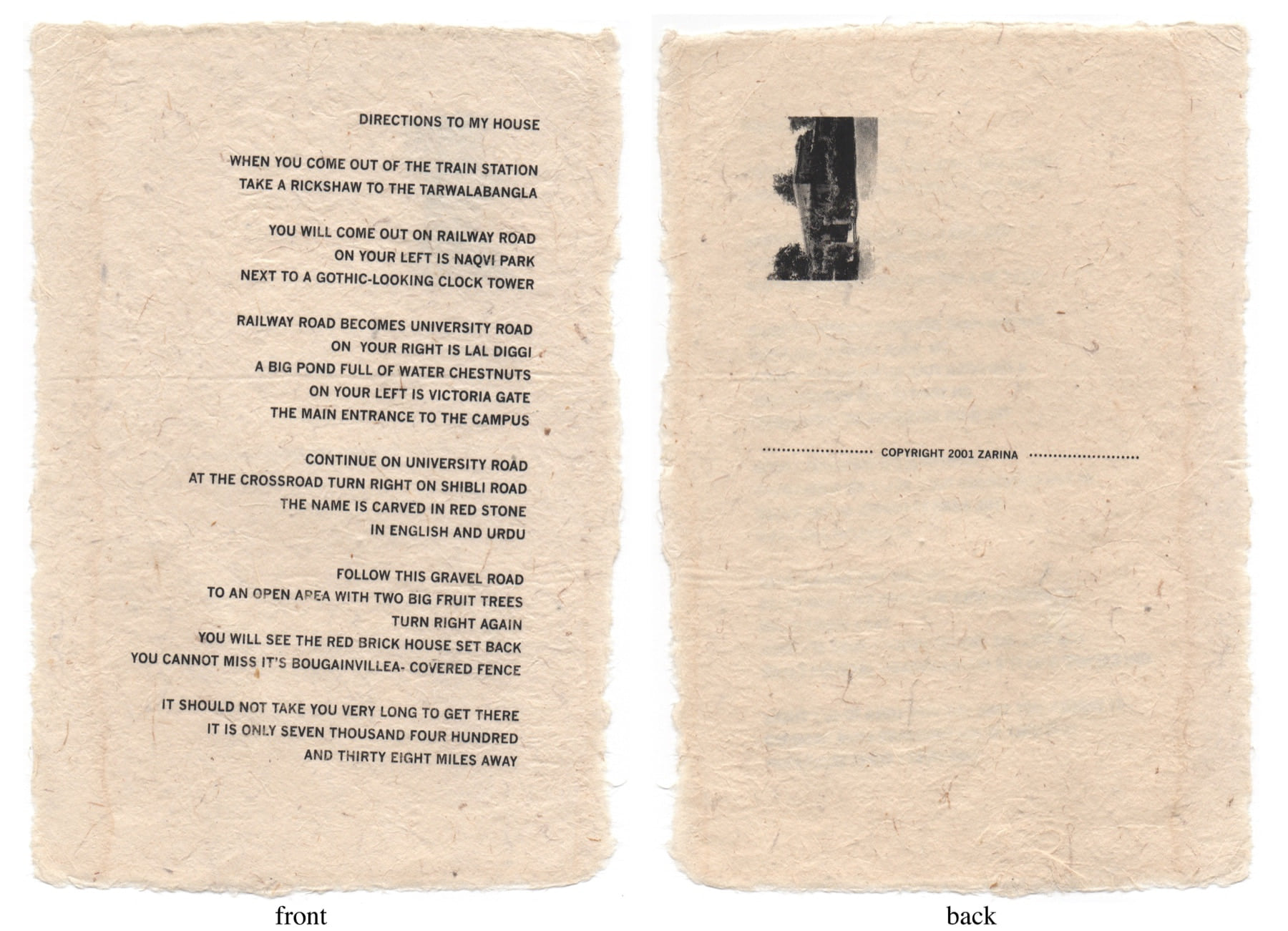
Directions to My House
ShContemporary 07 · Shanghai
Presented within ShContemporary’s Best of Artists programme, Directions to My House brought Zarina’s remembered architecture to the first edition of the international fair in Shanghai. Her exhibition checklist moved from cast-paper works of the early 1980s—including Steps, Shelter, and Claw House—to the bronze House That Flew Away, allowing more than fifteen years of work to read as one sustained meditation on shelter, movement, and loss.
These houses do not behave as stable buildings. A stair can lead nowhere, a shelter can remain exposed, and a house can take flight. Paper pulp gives the forms density while preserving their vulnerability; bronze grants weight to an image of departure. The title turns navigation toward an emotional destination, asking how one finds a home that survives most vividly through memory and form.
Traveling museum survey · curated by Connie Butler · 2007–09
WACK! Art and the Feminist Revolution
MOCA Los Angeles · National Museum of Women in the Arts · MoMA PS1 · Vancouver Art Gallery
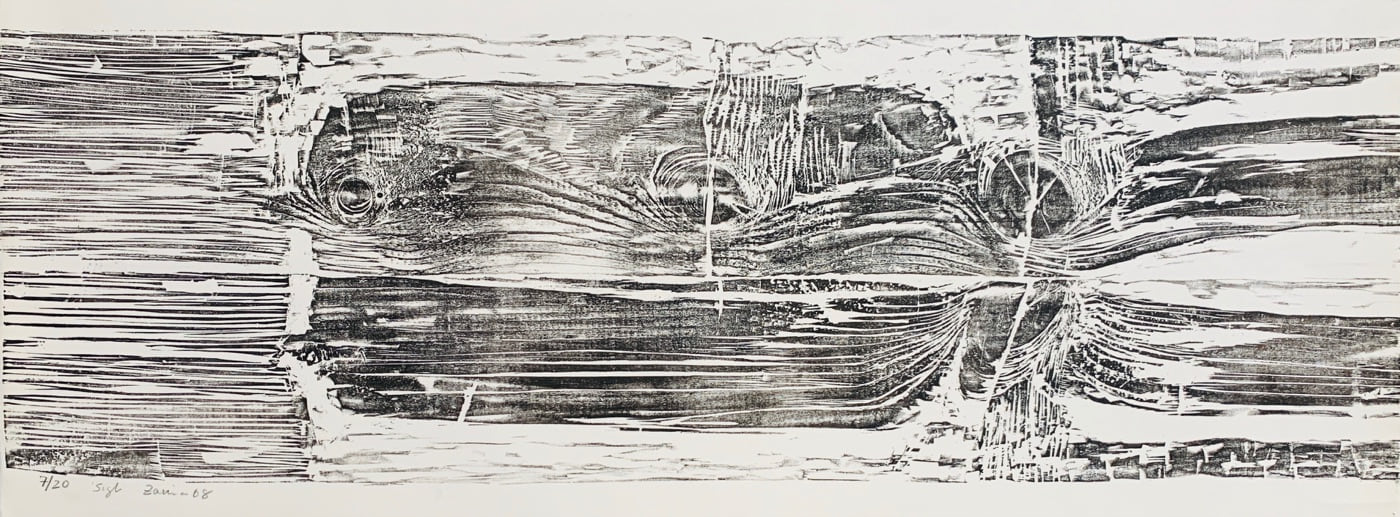
WACK! was the first institutional exhibition to examine the international foundations and legacy of art made under the influence of feminism. Bringing approximately 120 artists from twenty-one countries into a survey of work from 1965 to 1980, it moved feminist art history beyond a single national story or medium. Zarina’s inclusion placed her early practice within that transnational field while preserving the independence with which she approached identity and artistic work.
A Sigh, made in 1968, offers a contemporaneous view of that independence. The woodcut’s marks gather and disperse across a long horizontal field, allowing the resistance of the block and the movement of the hand to remain visible. The image is neither narrative nor decorative. Its physical intelligence helps explain why Zarina’s work could enter feminist history without being reduced to an illustration of gender: material, labor, mobility, and self-determination are already embedded in the act of making.
Group exhibition · curated by Vidya Shivadas with Sonal Khullar · Apr–May 2008
Fluid Structures: Gender and Abstraction in India, 1973–2008
Vadehra Art Gallery · New Delhi
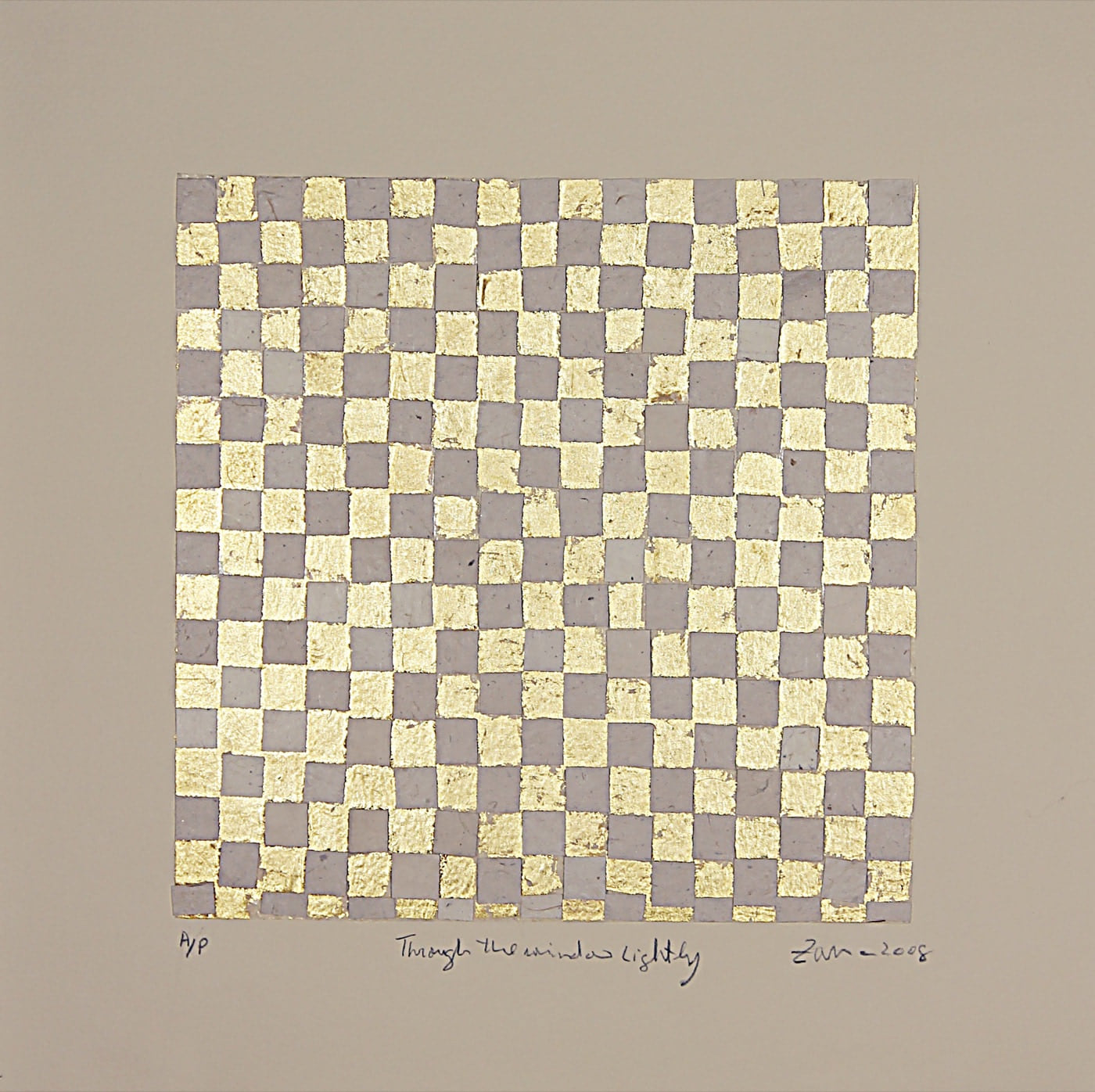
Fluid Structures brought together Arpita Singh, Nasreen Mohamedi, Sheila Makhijani, Manisha Parekh, Gargi Raina, and Zarina across two generations of women artists working in India. Rather than treating abstraction as a retreat from social experience, the exhibition asked how gender, history, material, and artistic labor could inhabit line, surface, and structure. Its dialogue across generations also resisted the idea that feminist art had one geography or one recognizable visual language.
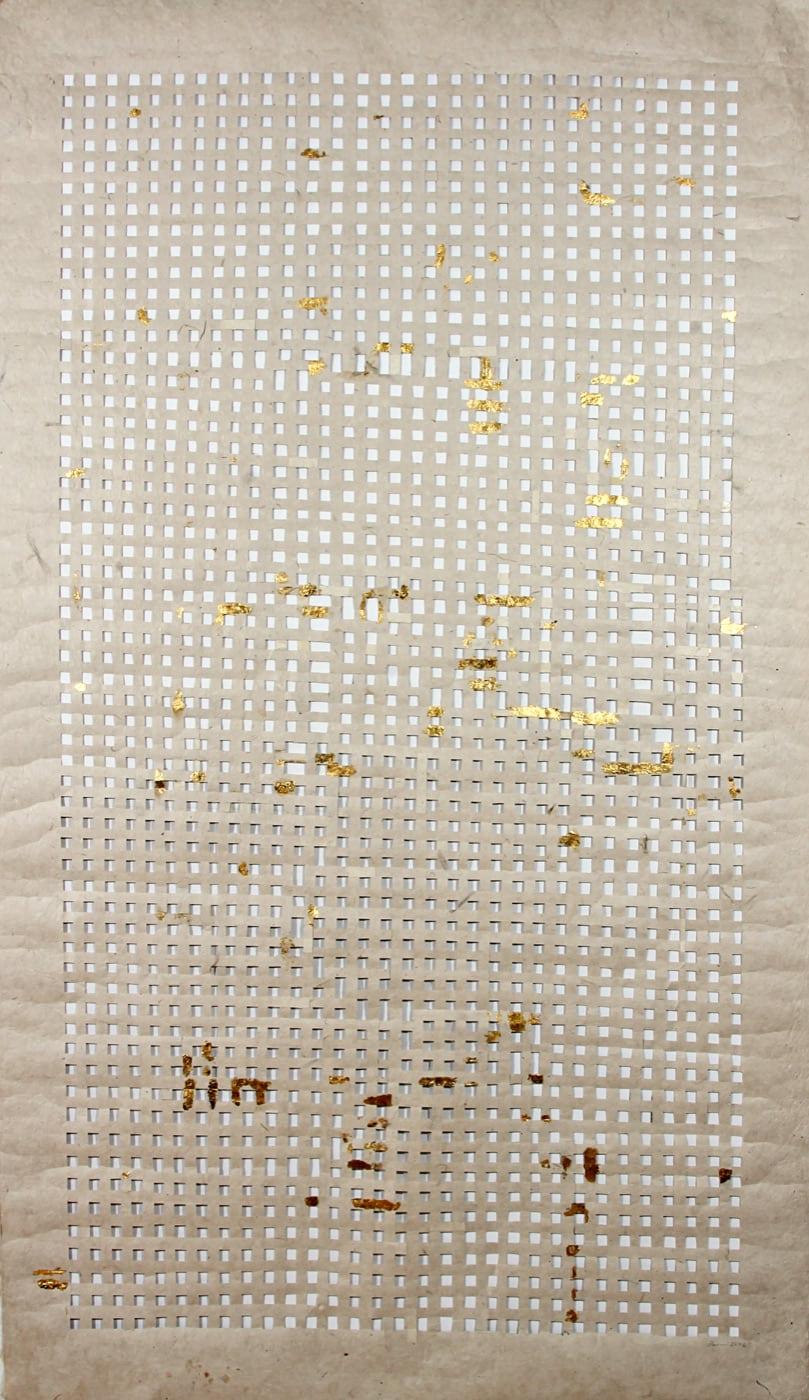
Through the Window Lightly, made in 2008, offers a contemporaneous lens on Zarina’s place within that conversation. A strict checkerboard is built from hand-cut paper whose edges remain irregular; grey absorbs light while gold leaf releases it. The work turns the grid from a fixed system into a tactile field of difference. Repetition carries the patience of making, and luminosity enters through variation rather than ornament.
Group exhibition · curated by Shaheen Merali · 3 May–1 Jun 2008
Frontlines: Notations from the Contemporary Indian Urban
BodhiBerlin · Berlin
Frontlines inaugurated BodhiBerlin with work by seven artists whose practices approached the contemporary Indian urban from different positions. The title refused the city as a neutral backdrop: a frontline could be architectural, economic, political, or psychological, and urban space became a field in which histories of modernity and uneven power were continually rewritten.
Zarina’s maps bring a distinct scale to that conversation. Streets and borders are compressed into carved lines, while the name of a city can hold war, migration, and private memory together. Her spare vocabulary resists the spectacle of the metropolis. It asks instead how a place is carried by the people who leave it, and how a map can register rupture without surrendering intimacy.
Group exhibition · curated by Shaheen Merali · 23 Aug–27 Sep 2008
Everywhere Is War (And Rumours of War)
Bodhi Art and Bodhi Space · Mumbai
Spread across Bodhi Art and Bodhi Space, Everywhere Is War brought artists from India and abroad into a shared reckoning with contemporary violence. The exhibition approached war not as one distant event but as a condition dispersed through cities, borders, bodies, news, memory, and everyday life. Its two-site form made that dispersal physical: viewers moved between distinct spaces while the subject returned through different materials and political positions.
These Cities Blotted into the Wilderness gives Zarina’s response a deliberately quiet force. Nine urban maps—each named in Urdu—hold places marked by siege, massacre, communal violence, or destruction. Their carved streets become fractures, enclosures, and disappearing fields. By keeping every city formally distinct, Zarina refuses the anonymous category of the “war-torn city”; geography remains specific, and distance never cancels human consequence.
International biennale · 5 Sep–9 Nov 2008
Annual Report: A Year in Exhibitions
7th Gwangju Biennale · Gwangju
Directed by Okwui Enwezor with Hyunjin Kim and Ranjit Hoskote, the seventh Gwangju Biennale set aside a single governing theme. Its three strands—On the Road, Position Papers, and Insertions—treated exhibitions themselves as forms of cultural and intellectual exchange. Zarina’s inclusion placed her work within an international network shaped by movement: works and ideas arrived with the histories of other places rather than being absorbed into one universal account.
Travels with Rani, also made in 2008, gives that movement an intimate scale. Its light field binds routes to Urdu place names; its companion reverses the ground into darkness, where a pale itinerary resembles a constellation. Travel is not drawn as an abstract line from origin to destination. It becomes a shared biography, held through language, memory, and the accumulating names of places crossed together.
Inaugural group exhibition · 23 Oct–20 Dec 2008
Expansion–Résonance
Galerie Jaeger Bucher, Espace Marais · Paris
Expansion–Résonance inaugurated Galerie Jaeger Bucher’s Marais space by placing contemporary artists in dialogue with the gallery’s longer history. Works by Zarina and eight artists due to receive solo exhibitions in 2009 and 2010 appeared alongside modern figures including Giacometti, Kandinsky, Klee, Léger, Nevelson, and Vieira da Silva, as well as historical sculptures from several cultures. Space and time were not treated as a linear chronology, but as forms of encounter across generations.
Golden Morning makes that encounter architectural and intimate. An accordion-folded sheet opens into a long, unstable wall of repeated houses, while gold leaf at its ends catches and returns the surrounding light. The object changes as the viewer moves: rooms become rhythm, the line of a roof becomes measure, and a portable sheet briefly occupies real space. Expansion here is inseparable from memory; resonance is what a simple form continues to hold.
Museum survey · curated by Juan Guardiola · 11 Dec 2008–15 Feb 2009
India moderna
IVAM · Valencia
India moderna surveyed more than two centuries of cultural history through hundreds of works by a wide field of artists. Organized in six historical sections, it rejected a single imported model of modernity and instead traced multiple, simultaneous modernisms shaped by colonialism, independence, Partition, urban change, and globalization. Zarina’s work entered that broad history through a language in which abstraction and lived geography could not be separated.
Atlas of My World makes that relation visible. Six familiar maps are cut, darkened, divided, and named in Urdu, turning the authority of the atlas into a personal and political account of place. The Indian subcontinent appears as a ruptured geography rather than a stable national image. Across the sequence, mapping becomes a way to hold migration, memory, and Partition together without pretending that any border is neutral or complete.
Museum exhibition · 9 Nov 2008–8 Feb 2009
Gouge: The Modern Woodcut 1870 to Now
Hammer Museum · Los Angeles
Gouge traced the modern woodcut across more than a century, emphasizing a medium that can be both direct and sculptural: the artist cuts the block, removes material, inks what remains, and transfers that altered surface to paper. The exhibition moved across abstraction, politics, sacred imagery, and the expressive force of the carved mark. Zarina’s Dividing Line appeared within its account of socially conscious woodcuts.
Dividing Line reverses the medium’s familiar relation of light and dark. Zarina carved away the field so that the border between India and Pakistan prints as a dense line surrounded by pale space. The gouge makes political division physically present: the boundary is not a neutral diagram laid onto geography, but a form produced through pressure and removal. Its quiet scale holds the continuing force of Partition without turning history into spectacle.
Museum exhibition · organized by Alexandra Munroe · 30 Jan–19 Apr 2009
The Third Mind: American Artists Contemplate Asia, 1860–1989
Solomon R. Guggenheim Museum · New York
The Third Mind reconsidered American art through the transformative presence of Asian art, literature, music, and philosophy. Spanning more than a century, it traced how artists working in the United States adapted, translated, and sometimes misunderstood ideas encountered across cultures. Zarina’s inclusion complicated any simple division between “American” and “Asian”: her practice had been formed through India, Thailand, Japan, Paris, and New York, and through a life in which movement was a condition rather than a theme adopted from afar.
A Few Steps in the Land of Confucius, made while the exhibition was being prepared, turns graphite and repeated measurement into a field of sustained attention. Thirty rectangles are joined by the pressure of innumerable horizontal marks; order remains visible, but the hand keeps every interval alive. The work suggests that encounter is not quotation. It is a discipline of looking, repetition, and translation through which geometry becomes experience.
Solo exhibition · 20 Jun–31 Jul 2009
Zarina: The Ten Thousand Things
Luhring Augustine · New York
The Ten Thousand Things brought works on paper and sculpture together around home, displacement, journey, and memory. Its title, drawn from the poet Ts’en Shen, imagines the world’s innumerable forms held within an underlying unity and asks what it means to return to a beginning. Zarina answered through elemental materials and exacting acts: carving, folding, casting, puncturing, weaving, and joining.
In Wrapping the Travels, Urdu words and mapped journeys gather into a woven surface. Elsewhere, houses, shadows, prayer beads, and routes appear as concentrated signs whose simplicity rewards slow looking. Geometry never becomes impersonal. The pressure of the hand remains present in each edge and impression, allowing a small form to carry the scale of movement, devotion, and remembered place.
Museum collection exhibition · organized by Alexandra Schwartz and Sarah Suzuki · 5 May–16 Aug 2010
Mind and Matter: Alternative Abstractions, 1940s to Now
The Museum of Modern Art · New York
Mind and Matter brought together twelve international artists whose abstractions remain closely tied to the body, pliable materials, craft, and lived experience. Drawings, prints, books, and sculptures unsettled the idea that abstraction must be detached or impersonal. In this company, Zarina’s measured geometry could be seen not as formal reduction alone, but as a language shaped by touch, movement, memory, and gendered histories of making.
MoMA’s installation included Home Is a Foreign Place. Its thirty-six woodcuts move between floor plans, thresholds, weather, distance, and darkness, each joined to an Urdu word. The portfolio makes mind and matter inseparable: memory is given the resistance of a carved block, language occupies physical space, and the repeated sheet becomes a structure through which an absent home can be approached without being restored.
Group exhibition · 10 Oct–18 Dec 2010
Orientations: Trajectories in Indian Art
Foundation De 11 Lijnen · Oudenburg, Belgium
Orientations resisted a single account of contemporary Indian art. It set a materially attentive, often abstract current alongside practices grounded in the changing social realities of urban India. Deepak Ananth’s accompanying text described Zarina’s work through refined geometry, concision, and subtle materiality—qualities that place restraint in dialogue with history rather than outside it.
Broken Roads, made in the same year, offers a close lens on that position. A route is reduced to a spare, damaged trace: direction remains possible, but no longer continuous or secure. The work turns abstraction into lived geography. Its economy of means allows the line to hold movement, interruption, political division, and the private effort of finding one’s way through a world whose coordinates have shifted.
Traveling artists’ books exhibition · curated by Kathleen Walkup · 8 Dec 2010–winter 2013
Hand, Voice & Vision: Artists’ Books from Women’s Studio Workshop
Grolier Club · New York · six-venue tour
Hand, Voice & Vision surveyed three decades of artists’ books published by Women’s Studio Workshop. Its forty works emphasized three intertwined qualities: the handmade trace of the maker, the distinct voice of each artist, and the book as a form capable of opening new artistic directions. The exhibition began at the Grolier Club and traveled through libraries and colleges where books could be encountered as intimate objects, public records, and structures for shared thought.
Zarina’s 1991 Women’s Studio Workshop project, Ten Woodcuts by Zarina: Based on Urdu Proverbs, joins all three ideas. Rani selected sayings the sisters had carried from childhood and youth; Zarina answered them with images carved into wood. Hand, voice, and vision meet in the pressure of the print, the cadence of remembered Urdu, and a collaborative act through which oral inheritance takes material form without losing its wit or intimacy.
Solo exhibition · 15 Jan–15 Feb 2011
Zarina Hashmi: Recent Work
Gallery Espace · New Delhi
Recent Work returned Zarina to New Delhi with art made at a moment when Urdu, darkness, and reflected light were becoming increasingly direct presences in her practice. Black paper, carved lines, gold leaf, and repeated forms gave the exhibition a restrained radiance: illumination did not erase loss, but made its edges newly perceptible.
The accompanying catalogue placed these works within histories of Delhi, migration, and language. Zarina described Urdu as a historical and lived position rather than decorative calligraphy, while S. Kalidas read her geometry through inquiry, knowledge, love, and spiritual intensity. The work remains political without becoming declarative: maps, words, and elemental forms create spaces in which belonging can be questioned rather than resolved.
Group exhibition · a Green Cardamom project · 15 Jan–26 Mar 2011
Drawn from Life
Abbot Hall Art Gallery · Kendal, England
Drawn from Life placed contemporary work from the Middle East, South Asia, and the United Kingdom beside Abbot Hall’s British collection. Organized around landscape, the everyday, the diary, and body politics, the exhibition treated drawing as a way of thinking through experience rather than simply recording appearances. Old and new works met across different histories, allowing intimate marks to carry public questions of place, identity, and power.
Travels with Rani, made shortly before the exhibition, offers a close lens on Zarina’s position in that conversation. Place names and traced routes move across a pale field before returning as a constellation on black. The paired sheets make travel resemble a diary written through geography: a shared life is held not by portraiture, but by the names of places, the intervals between them, and the language through which they are remembered.
Solo exhibition · 25 Feb–31 Mar 2011
Zarina Hashmi: Anamnesis 1970–1989
Lakeeren—The Contemporary Art Gallery · Mumbai
Anamnesis returned to work made between 1970 and 1989, a period in which Zarina moved from the dense geometry of early serigraphs toward paper that was cut, pierced, sewn, embossed, and cast. The exhibition’s title names recollection as an active process: the past is not simply retrieved, but made present again through material, touch, and renewed attention.
The 1972 serigraphs documented in the exhibition hold black form against open paper with remarkable pressure. Later works allow the sheet itself to carry the image through thread, indentation, or raised pulp. Seen together, these works make Zarina’s early abstraction inseparable from the practice that followed: line becomes boundary, surface becomes memory, and a spare geometry begins to hold the emotional weight of enclosure, separation, and home.
First Paris solo exhibition · 26 Mar–21 May 2011
Noor
Galerie Jaeger Bucher · Paris
Noor, Zarina’s first solo exhibition in Paris, joined recent works on paper and installations with paper-pulp sculpture from the 1980s. The span of the presentation made tactile continuities visible across decades: paper could be cast, cut, punctured, darkened, or touched with gold, while houses, journeys, and repeated forms held memory without becoming illustration.
The title means light or illumination, yet the exhibition treated light as more than brightness. In works including Tasbih (Gold), Blinding Light, and Dark Nights, black and gold move between the material and the spiritual, between what light reveals and what its intensity can obscure. Illumination becomes a way of thinking through vision, devotion, distance, and the possibility of orientation within darkness.
Group exhibition · curated by Girish Shahane · 2011
Home Spun
Devi Art Foundation · Gurugram, India
Home Spun approached home as both a place and a state of mind. Its architecture, altered domestic objects, and evocations of palaces and crowded city dwellings held longing beside belonging rather than resolving one into the other. The exhibition asked how shelter is imagined, remembered, inhabited, and unsettled—and how private rooms remain connected to larger social histories.
Letters from Home gave Zarina’s response an intimate architecture. Handwritten Urdu from letters sent by Rani is printed within forms that can resemble a house, a floor plan, or a dark enclosure. A letter crosses distance while preserving the voice and hand of its writer; the house surrounding it becomes less a fixed building than a vessel for language, affection, separation, and the home the sisters continued to carry between them.
Group exhibition · Bay Area collections · 25 Feb–4 Sep 2011
Roots in the Air, Branches Below: Modern and Contemporary Art from India
San José Museum of Art · San José
Roots in the Air, Branches Below drew its title from the Bhagavad-Gita’s image of an inverted tree, using roots and branches to consider how the past remains active in the present. Drawn from private Bay Area collections, the exhibition traced modern Indian art through exchange, travel, inheritance, and reinvention rather than through a single national style.
The museum presented Zarina’s A House of Many Rooms, a four-part portfolio in which small architectural grids face brief, isolated sentences. Repetition gives the rooms a shared structure, yet each sheet describes a different condition of enclosure, passage, touch, or despair. The work turns the house into both a formal module and an emotional measure: a place remembered across distance, but never fully recovered.
India’s first official national pavilion · curated by Ranjit Hoskote · 4 Jun–27 Nov 2011
Everyone Agrees: It’s About to Explode
India Pavilion · 54th Venice Biennale
Curated by Ranjit Hoskote, Everyone Agrees: It’s About to Explode marked India’s first official national pavilion at the Venice Biennale. Zarina appeared with Desire Machine Collective, Gigi Scaria, and Praneet Soi in a presentation that treated the nation not as a settled image, but as a field of memory, movement, argument, and unfinished history.
Border, a sheet from Home Is a Foreign Place shown in the pavilion, compresses that unstable belonging into a severe sign. Two pale diagonals divide a black field while the Urdu word below restores the intimacy of a remembered language. Presented within a national pavilion by an artist whose life crossed many countries, the work asks whether a border can define home—or whether it marks the distance between a place and the person who carries it.
International biennial · curated by Adriano Pedrosa and Jens Hoffmann · 17 Sep–13 Nov 2011
Untitled (12th Istanbul Biennial), 2011
Antrepo no. 3 & 5 · Istanbul
The 12th Istanbul Biennial examined the relationship between art and politics through five group exhibitions and a series of concentrated solo presentations. Inspired by Felix Gonzalez-Torres, curators Adriano Pedrosa and Jens Hoffmann paired formal restraint with political directness, asking visitors to become active readers of objects, histories, and the conditions in which they appear.
Zarina’s solo presentation included Blinding Light, a tall field of gold leaf interrupted by a repeated grid of narrow openings. Light is both material and absence: the reflective surface changes as the viewer moves, while the cuts expose what the gold cannot cover. Within a biennial concerned with power and form, its disciplined geometry makes radiance inseparable from vulnerability, and beauty from the pressure of history.
Traveling group exhibition · developed by Green Cardamom · 2012–14
Lines of Control: Partition as a Productive Space
Herbert F. Johnson Museum of Art · Cornell University · Nasher Museum of Art, Duke University
Lines of Control examined borders as physical structures and psychological conditions. Beginning with the 1947 Partition of India and expanding to divided territories across the world, the project brought together artists who showed that a line can create nations while also producing displacement, contested memory, new identities, and lives conducted across its apparent certainty.
Zarina’s Dividing Line gives that argument concentrated material force. The Radcliffe Line is carved into wood and printed as a dark, irregular incision through pale paper. Map, wound, and mark become inseparable. The image exposes the abstraction on which political division depends while returning attention to pressure, rupture, and human consequence—the things a border drawn from above cannot contain.
Group exhibition · curated by Beth Citron · 4 May–16 Oct 2012
Modernist Art from India: Approaching Abstraction
Rubin Museum of Art · New York
Approaching Abstraction was the second chapter of the Rubin Museum’s three-part Modernist Art from India series. It resisted treating abstraction as a style imported intact from Europe or the United States. Instead, the exhibition followed the independent paths through which artists working after Independence and Partition transformed modernist languages in response to local histories, materials, artistic communities, and the ambitions of a newly sovereign nation.
Zarina’s Composition, made in 1965, offers a period lens on that wider history. Interlocking forms press against one another in copper, slate, and black, while the scratched surface keeps the labor of printmaking visible. Made during her years of movement between India and Europe, the work holds international exchange and material specificity together. Its abstraction is not an escape from experience; it is a field in which pressure, enclosure, contact, and change become palpable without illustration.
Touring group exhibition · 1 Sep 2012–23 Jun 2013
Women In-Between: Asian Women Artists 1984–2012
Fukuoka · Okinawa · Tochigi · Mie, Japan
Women In-Between brought together fifty artists from sixteen Asian countries and regions to consider lives formed across boundaries: between inherited roles and self-determination, private experience and public history, home and diaspora, violence and remembrance. Its six thematic sections refused a single definition of Asian womanhood. Difference—between generations, nations, materials, and political conditions—became the exhibition’s subject as well as its structure.
Zarina’s A House of Many Rooms unfolds that condition through a spare four-part sequence of image and text. A grid of separate rooms begins to open, connect, and overlap before giving way to darkness. The sequence can be read as an architecture of migration: enclosure carries isolation, passage carries the desire for encounter, and the final black field holds despair beside repose. Home is neither recovered nor abandoned. It remains an unsettled form through which memory and identity are continually negotiated.
First retrospective · 2012–13
Zarina: Paper Like Skin
Hammer Museum · Guggenheim Museum · Art Institute of Chicago
Beginning with work made in 1961, Paper Like Skin gave the full range of Zarina’s practice an institutional frame for the first time. Woodcuts, etchings, pin drawings, rubbings, paper-pulp casts, and sculpture showed that paper was never simply a neutral support: its fibres, pressure, fragility, and memory carried meaning.
The exhibition made visible the continuity between Zarina’s spare geometry and the places, borders, languages, and houses that shaped her life. Its title holds that relationship closely. Paper can be marked, folded, pierced, and scarred; like skin, it records contact while remaining vulnerable to time.
Group exhibition · curated by Shanay Jhaveri · 20 Jun–7 Sep 2013
Companionable Silences
Palais de Tokyo · Paris
Companionable Silences placed artists with plural, mobile identities into a conversation about modernism and cultural authority. Rather than absorbing them into one corrective history, curator Shanay Jhaveri preserved the distance between their positions. The exhibition examined how cosmopolitan lives were shaped by assimilation, acculturation, and unequal systems of recognition—and how artists could move among cultures without surrendering the singularity of their work.
The Ten Thousand Things gathered one hundred small works from Zarina’s own archive of forms. Fragments of houses, maps, stars, wounds, grids, and gold become individual acts of recollection and, together, a portable world. At the Palais de Tokyo, their accumulation answered the exhibition’s title with a visual form of companionable silence: each image remains distinct, yet proximity allows meanings to pass between them. The work makes self-archiving an act of renewal rather than a fixed account of the past.
Group exhibition · spirituality and modern art · 28 Jun–27 Oct 2013
Beyond Belief: 100 Years of the Spiritual in Modern Art
Contemporary Jewish Museum · San Francisco
Jointly organized by the Contemporary Jewish Museum and SFMOMA, Beyond Belief approached modern and contemporary art through spiritual ideas that cross religious and cultural traditions. Its sections moved through creation, the invisible, death, redemption, mystical writing, and the idea of the divine architect. By placing abstraction beside devotional thought, the exhibition asked how an artwork might make an unseen presence perceptible without turning it into a literal image.
Zarina’s oversized prayer beads brought that question into the space of the body. Tasbih enlarges an object held and counted in private devotion until repetition becomes sculpture: a hanging line made from touch, weight, darkness, and intermittent gold. The beads remain recognizably connected to prayer, yet their altered scale turns recitation into an experience of time and gravity. Spirituality enters not as illustration, but through the patient accumulation of one form after another.
Group exhibition · curated by Shezad Dawood and Tom Trevor · Nov 2013–Apr 2014
Black Sun: Alchemy, Diaspora and Heterotopia
Devi Art Foundation · Gurgaon
Black Sun brought together artists whose work approached diaspora not only as movement between nations, but as an inner condition shaped by layered identities, inherited symbols, and cultural translation. The exhibition followed the image of an occluded sun across different histories of alchemy and transformation, using darkness as a threshold rather than an end: a place where the self might be divided, remade, or seen from another direction.
Zarina’s Mapping the Dislocations gave that inquiry a geography of fragments. Broken contours stretch across the sheet like interrupted routes, wounds, or pieces of a world that can no longer be joined into one stable map. The work turns displacement into a visual rhythm of separation and relation. Each place remains distinct, yet the shared field allows distance itself to become the connective tissue—an image of diaspora carried through memory, language, and the repeated act of mapping home from elsewhere.
Group exhibition · gallery-history survey · 19 Nov 2013–25 Jan 2014
Matter and Memory: The Patriarch’s Realm
Galerie Jeanne Bucher Jaeger · Paris
Matter and Memory marked Jean-François Jaeger’s ninety years by tracing the artists and long relationships that shaped sixty-six years of gallery history. Staged across the gallery’s Marais and Saint-Germain spaces, it treated memory as a living structure rather than a store of finished moments. Works from different generations showed how material decisions—fibre, pigment, carved surface, weight, and void—can carry encounters forward while allowing their meanings to change.
Zarina’s Folding House, made in 2013, offers a period lens on that meeting of matter and remembrance. Twenty-five houses shift across paper, ink, collage, and gold: one opens, another fractures, another becomes almost entirely dark. Repetition does not recover a single original home. It creates a changing vocabulary through which shelter, absence, movement, and illumination can be held together. The work makes memory physical—cut, folded, aligned, and continually reconstructed by hand.
Group exhibition · sculpture by women artists · 28 Apr–11 Nov 2013
Sculptrices
Fondation Villa Datris · L’Isle-sur-la-Sorgue
Sculptrices gathered an expansive international field of women artists in a manifesto-like exhibition devoted to sculpture made across generations and materials. Rather than propose a single feminine aesthetic, the presentation argued for the breadth of women’s sculptural practice—from monument and architecture to fibre, paper, light, movement, and the intimate object.
Zarina was represented by Shelter and Flight Log, works that give paper mass, edge, and spatial presence. Shelter compresses architecture into a low charcoal form whose rough cast surface is crossed by radiating folds and brief flashes of gold. Flight Log turns handmade paper into a bound object of departure and recollection. Together they show how modest scale can hold sculptural force: weight and fragility, protection and passage, are not opposites but conditions carried within the same material.
Solo exhibition · Jan–Feb 2014
Zarina: Folding House
Gallery Espace · New Delhi
Folding House gathered Zarina’s repeated house forms into a tall, shifting architecture. Paper from earlier projects was cut, torn, stained, gilded, and reassembled so that no single image could stand as the final house. One structure opens into wings, another moves on wheels, while others split, contract, or begin to lose their edges.
The exhibition treated the house as a portable repository of experience rather than a permanent shelter. Folded and unfolded across the sequence, it carries memories of Aligarh, Partition, migration, and the rooms Zarina inhabited afterward. Black gives the forms weight and enclosure; gold introduces illumination and spiritual ascent. Between fracture and radiance, home becomes a structure continually remade to survive unstable conditions.
Group exhibition · tradition as living practice · 10 May–3 Aug 2014
Advance through Retreat
Rockbund Art Museum · Shanghai
Curated by Martina Köppel-Yang, Advance through Retreat took its title from a strategy in The Art of War and considered retreat not as disappearance, but as a way to create distance from dominant systems. The exhibition brought together artists who return to inherited media, vernacular knowledge, and familiar cultural forms in order to test, transform, and sometimes resist the codes that claim authority over them. Tradition appeared as a living practice—something used and remade in the present rather than preserved outside it.
Home Is a Foreign Place embodies that double movement. Zarina turns thirty-six Urdu words remembered from Aligarh into spare woodcut images, carrying language and architecture forward while acknowledging that the original house cannot be recovered unchanged. The portfolio retreats from geographic description into memory, then advances by giving memory a new material form. Each sheet is intimate and self-contained; together they build a home that can travel without pretending that displacement has been resolved.
Group exhibition · art, life, and the body · 27 Jun–21 Sep 2014
artevida
Casa França-Brasil · Rio de Janeiro
Curated by Adriano Pedrosa and Rodrigo Moura, artevida unfolded across Rio de Janeiro as four connected exhibitions about art and life. At Casa França-Brasil, artevida (corpo) approached the body through transformation, incision, organic line, weaving, and participation. Its international and intergenerational field challenged a single Eurocentric account of modern art, bringing geometric abstraction into contact with embodied knowledge and histories from the Global South.
Blinding Light offers a concentrated way into Zarina’s place in that inquiry. Gold leaf makes the tall sheet radiant, but a disciplined grid of cuts interrupts its surface. The work changes with the viewer’s position: reflected light shifts, darkness gathers in the openings, and vision becomes inseparable from movement. Geometry is not detached from the body here. It is encountered through scale, distance, vulnerability, and the physical act of piercing paper.
Group exhibition · printmaking across India and Pakistan · 10 Sep–20 Nov 2014
Trajectories: 19th–21st Century Printmaking from India and Pakistan
Sharjah Art Museum · Sharjah
Curated by Paula Sengupta and Camilla H. Chaudhary, Trajectories traced printmaking in India and Pakistan from its commercial beginnings to an independent artistic language. More than a century of work revealed connected histories shaped by colonial technology, anti-colonial nationalism, Partition, modernist experiment, and contemporary social and political life. The exhibition placed the two countries beside one another without collapsing their distinct paths.
Dividing Line provides a concentrated way to read Zarina’s position within that history. The border between India and Pakistan is not drawn onto the image; it is cut into the block, made through pressure and removal, then transferred to paper. A political abstraction becomes a physical mark that carries separation, memory, and the lasting human consequence of Partition. Zarina uses the old discipline of the woodcut to make the modern border felt as both history and wound.
Group exhibition · garden, memory, and renewal · 23 Sep–8 Oct 2014
Sabza o Gul
Chawkandi Art · Karachi
Curated by Amra Ali, Sabza o Gul took its title from a verse by Ghalib and gathered seven artists around the garden as a changing image of life. Growth and barrenness, cultivation and wilderness, abundance and loss entered the exhibition together. The garden was less a decorative subject than a living structure through which memory, vulnerability, and renewal could be considered.
Zarina’s Rani’s Garden was singled out in contemporary coverage for its intimate history. Black etched leaves gather within a spare rectangular boundary while small squares of gold punctuate the field like light held among branches. Named for her sister, the work turns a garden into a remembered and shared place. Its compressed scale gives private affection a formal structure: enclosure protects the image, while the irregular growth within it refuses perfect order.
Group exhibition · art and nonviolence · 3 Oct 2014–1 Feb 2015
Experiments with Truth: Gandhi and Images of Nonviolence
Menil Collection · Houston
Curated by Josef Helfenstein in collaboration with Amar Kanwar, Experiments with Truth placed historical documents, religious objects, and modern and contemporary art into a sustained inquiry around Gandhi’s ethics of nonviolence. The exhibition did not treat nonviolence as a settled image or an uncomplicated inheritance. It brought histories of Partition, civil rights, spiritual discipline, imprisonment, and political struggle into the same field, asking how inner transformation might meet the unfinished violence of public life.
Zarina made Abyss after curator Josef Helfenstein first asked for Dividing Line. She reversed the earlier work’s dark boundary on pale paper, carving the Radcliffe Line as a white rupture through an expanse of black. The border is immediately legible as geography, but its scale and emptiness make it psychological as well: a division remembered so deeply that it no longer requires an atlas. In the exhibition, Abyss joined Partition’s historical wound to the difficult distance between the ideal of nonviolence and its lived aftermath.
Solo exhibition · 25 Oct–6 Dec 2014
Zarina: Descending Darkness
Luhring Augustine · New York
Descending Darkness brought new prints, collages, and sculpture into a field shaped by black and gold. Houses and disputed cities appeared beside works of spiritual ascent, while handmade paper carried cuts, stains, wax, gilding, and the pressure of the block. The exhibition held despair and hope together without asking one to cancel the other.
In the title installation, dozens of light bulbs carved from black marble descend in widening circles. Their familiar promise of illumination is arrested: stone gives them gravity, and pewter leaf catches light without allowing the bulbs to produce it. Mortality becomes palpable, yet the downward movement also turns attention inward. Darkness is not presented as emptiness, but as a space in which memory, grief, devotion, and the possibility of orientation become newly intense.
Museum exhibition · rubbing, trace, and memory · 7 Feb 2015–3 Jan 2016
Apparitions: Frottages and Rubbings from 1860 to Now
Hammer Museum · Los Angeles / Menil Collection · Houston
Apparitions was the first major museum exhibition devoted to frottage and rubbing across modern art. Moving between drawing, printmaking, and sculpture, the exhibition treated the rubbed image as a record made through contact: an object or surface leaves a trace on paper, yet the result can also appear fugitive, spectral, or shaped by memory. Zarina’s work entered the section devoted to traces, where place and personal history become visible through transferred marks.
A Few Steps in the Land of Confucius began with Zarina’s memory of the stone path leading to the Xi’an Beilin Museum, a former Confucian temple and home to an extraordinary collection of inscribed steles. She carved the path into a woodblock and rubbed it onto a tall sheet, translating physical contact into recollection. Repetition slows the eye into a measured walk: each dark interval is both a step and an act of remembering, allowing a travelled route to persist as a spare poem in paper and graphite.
Museum exhibition · architecture and acts of making · 23 Apr–29 Nov 2015
Constructs | Constructions
Kiran Nadar Museum of Art · New Delhi
Curated by Roobina Karode, Constructs | Constructions brought artists across generations together to consider both the built structures around us and the mental constructions through which they are imagined. Architecture appeared not as a neutral container but as a psychological, social, and material condition. The exhibition moved between cities, scaffolds, interiors, dwellings, and the visible processes through which an idea becomes an object.
Zarina’s Folding House gives that passage an intimate scale. Across the portfolio, the house is folded, opened, divided, darkened, and edged with gold. A familiar sign never settles into one fixed home; it becomes a sequence of propositions shaped by memory and movement. The handmade paper carries each change as a physical event, so construction is also recollection: the house survives by being remade, compact enough to travel yet marked by every transformation.
Group exhibition · paper as material and meaning · 2015
Possibilities of Paper
Montalvo Arts Center · Saratoga
Possibilities of Paper gathered work by Lucas Artists Program fellows and guests to examine paper as both a carrier of marks and a material with its own structure. Handmade sheets, cardboard, ink, graphite, cuts, folds, weaving, and moulded forms opened onto themes including hidden histories, the built environment, migration, displacement, and home. Paper was not merely a support for an image; its weight, fragility, and capacity to change were part of the meaning.
Shadow House II makes that material intelligence architectural. Zarina cut repeated openings into a long sheet of handmade Nepalese paper, turning absence into the work’s central form. Light passes through the arches and casts a second, shifting structure beyond the paper itself. The house is therefore neither façade nor floor plan, but a threshold between presence and vacancy—portable and delicate, while capable of occupying the surrounding space through shadow.
Solo exhibition · 17 Sep–5 Nov 2016
Life Lines
Jeanne Bucher Jaeger · Paris
Life Lines approached Zarina’s diagrams and maps as vessels for lived memory. A line could hold a place, an event, or the atmosphere of an instant—something heard, seen, touched, or emotionally retained. The exhibition connected this intimate register to a wider history of journeys, shifting borders, Partition, the loss of Urdu from everyday life, and the cities through which Zarina moved.
Across the installation, houses, dark grids, broken skies, constellations, and suspended forms turn biography into a spatial experience. Black absorbs and concentrates light; gold travels across paper as a sign of value, illumination, and the divine. The title makes drawing inseparable from living: these are lines traced through geography and history, but also lines that persist through memory when a place itself can no longer be reached.
Artist-in-residence exhibition · 6 Oct 2017–2 Feb 2018
Zarina: Dark Roads
Asian/Pacific/American Institute at NYU · New York
Co-curated by Zarina and Alexandra Chang during Zarina’s residency at NYU, Dark Roads marked seventy years since the 1947 Partition of India. Its four movements—Dividing Line, Abyss: Into the Darkness, The Year of Sinking Boats, and No Place to Land—carried the history of Partition into the present tense of war, forced migration, and the global refugee crisis.
The exhibition’s maps and boats resist the distance of an aerial view. A border becomes an incision; a field of darkness holds a vulnerable vessel; a route becomes the lived uncertainty of exile. Zarina placed intimate forms—a heartbeat, a remembered house, a paper boat—against systems of violence that are often described through impersonal statistics, asking how political division is registered in memory, language, and the body.
Solo exhibition · 2 Feb–3 Mar 2018
Weaving Darkness and Silence
Gallery Espace · New Delhi
Weaving Darkness and Silence brought together works made in Zarina’s New York home and studio, where paper was woven, crushed, cut, layered, stained with Sumi ink, and touched with gold or pewter leaf. Their intimate scale asks for physical closeness. Darkness is not an empty ground, and silence is not an absence of voice; both become thresholds at which memory and language gather force.
In My Dark House at Aligarh, a pale arched opening is held inside a field of black, turning the remembered house into passage, enclosure, and distance at once. Across the exhibition, plans are sliced and reassembled, walls become uncertain, and titles lead toward night, rain, fences, damaged places, and homes that can no longer be entered. Material restraint allows private recollection and histories of displacement to meet without spectacle.
Solo exhibition · 27 Oct 2018–19 Jan 2019
Zarina
Luhring Augustine · New York
Zarina’s third solo presentation with Luhring Augustine focused on works from the preceding decade. Paper appeared not as a passive support but as a substance worked through cutting, sewing, puncturing, folding, crushing, staining, and collage. Sumi ink, gold leaf, and pewter leaf shifted each surface between absorption and reflection, weight and light.
Works such as Blue Night weave narrow printed strips into a tall, fragile field, allowing fragments left from one process to begin another. The exhibition culminated in The Ten Thousand Things III, one hundred miniature collages gathered as a portable compendium of recurring forms. Together, the works treat reuse as memory: houses, skies, routes, wounds, and constellations return in altered materials, carrying the past without repeating it unchanged.
Museum exhibition · 2019–20
Zarina: Atlas of Her World
Pulitzer Arts Foundation · St. Louis
Atlas of Her World placed prints, sculptures, and collages in conversation with objects that Zarina regarded as artistic touchstones. An engraving by Albrecht Dürer, a drawing by Kazimir Malevich, and an architectural fragment from Mughal India opened different routes into her attention to structure, proportion, surface, and sacred space.
This was not a search for simple influence. The exhibition showed Zarina’s minimal forms as part of a wide visual and intellectual world, where mathematics could meet architecture and a map could become an account of loss. By setting her work beside material from other cultures and centuries, it made abstraction feel inhabited rather than detached.
Museum survey · 2020–21
Zarina: A Life in Nine Lines
Kiran Nadar Museum of Art · New Delhi
A Life in Nine Lines brought Zarina’s work back to New Delhi through a wide view of her career. Woodcuts, etchings, lithographs, and sculptural objects followed the ways paper absorbed pressure, incision, and memory, while maps, architectural plans, and repeated geometries connected the work to the places through which she moved.
The title comes from the floor plans of homes Zarina remembered across cities. Reduced to nine etched outlines, biography becomes structure: each line marks a room once inhabited, while the empty paper around it holds distance and absence. Across the exhibition, minimalism was not an escape from history but a means of concentrating Partition, migration, longing, and the changing idea of home into forms quiet enough to endure.
Group exhibition · 7 Mar 2020–10 Apr 2022
Fault Lines: Contemporary Abstraction by Artists from South Asia
Philadelphia Museum of Art · Philadelphia
Fault Lines placed Zarina in conversation with artists from South Asia who use abstraction to approach memory, home, and belonging. Across paintings, sculpture, textiles, and works on paper, the line shifted from formal element to political and psychological structure: it could measure, divide, connect, disappear, or return as the trace of a damaged place.
Zarina’s Baghdad, from These Cities Blotted into the Wilderness, and an early 1969 woodcut joined two moments in her practice. The city map compresses conflict into streets, Urdu, and carved pressure; the earlier print shows how much feeling a spare line and handmade sheet could already carry. Together they make abstraction inseparable from lived geography—one line acting at once as surface, boundary, route, and wound.
Major solo exhibition · 2026
Zarina: Directions to My House
STPI · Singapore
Drawing together works held across multiple cities, Directions to My House presented Zarina’s practice in Southeast Asia at an unprecedented scale. The exhibition traced a life shaped across cities and continents while returning to the intimate structures that gave her work its force: the remembered room, the drawn route, the Urdu word, and the handmade sheet.
The title turns an ordinary instruction into a meditation on distance. Directions can describe a journey precisely while also revealing that the destination may no longer be reachable. Across Zarina’s work, home survives through language, geometry, repetition, and touch—not as a fixed address, but as something carried and remade.
Posthumous survey · 17 Jan–28 Mar 2026
Zarina: Beyond the Stars
Luhring Augustine Tribeca · New York
Beyond the Stars brought work from across Zarina’s career into the gallery’s Tribeca space, moving between woodcut, collage, portfolios, cast paper, and sculpture. The breadth of the presentation made clear that her visual economy was never a narrowing of experience: a carved line, a house, a square of darkness, or a fragment of gold could open onto histories of migration, devotion, architecture, and loss.
The title work places an Urdu verse within a black field touched by gold. Language is not an explanatory caption placed beside the image; it is part of the image’s structure and atmosphere. Across the exhibition, matter and meaning remain inseparable: paper bears pressure, carved lines hold memory, and small flashes of light turn darkness into a space of orientation, reflection, and possibility.
Exhibition chronology
Selected exhibitions
The chronology traces solo, group, and selling exhibitions across museums, galleries, and cultural institutions worldwide.