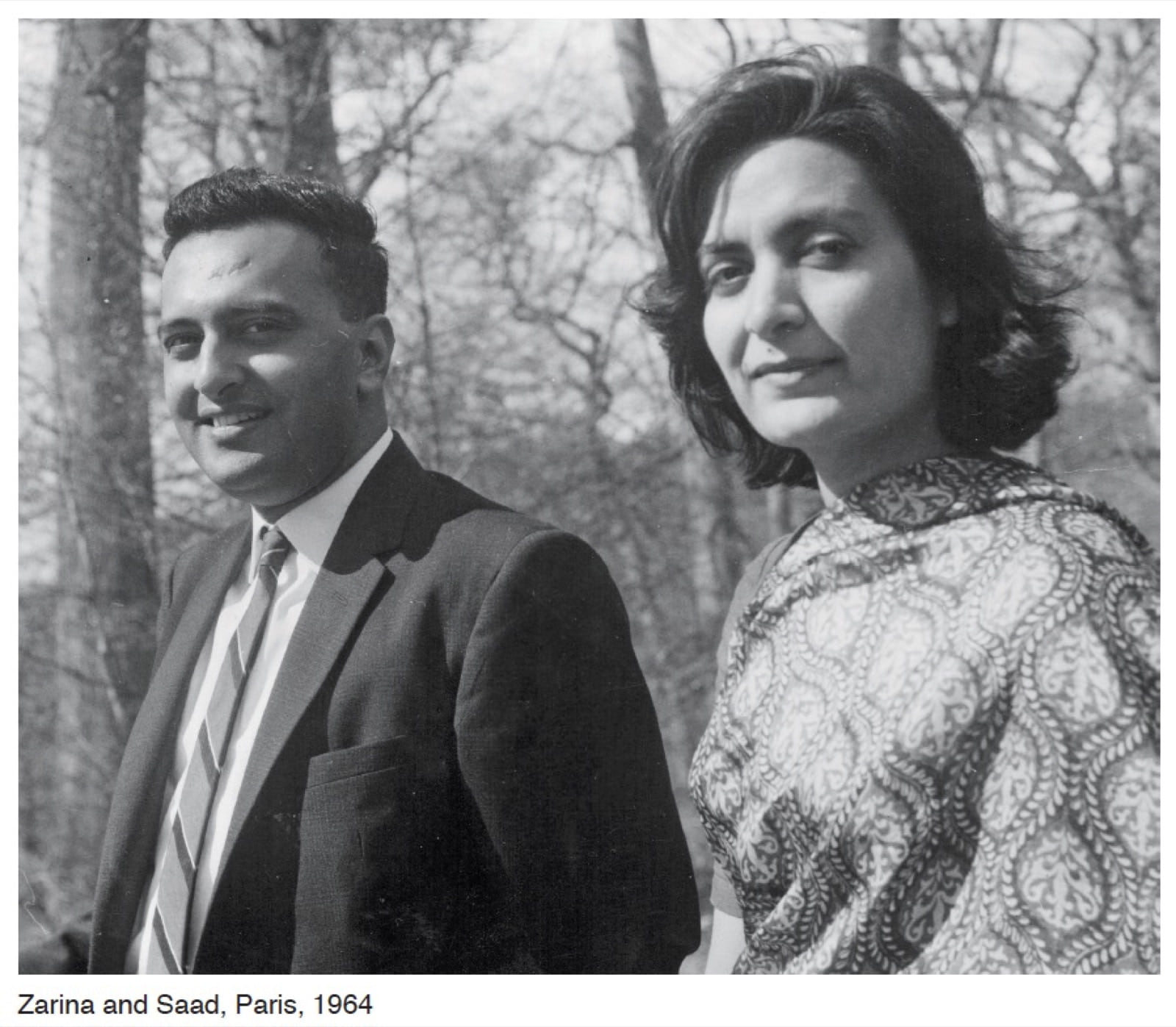
Paris widened both Zarina’s technical vocabulary and her sense of what an artist’s life could be. Atelier 17 placed experimentation, exchange, and printmaking at the center of daily work.
Saad’s next posting brought the couple to Paris from 1963 to 1967. In 1964, Zarina took her woodcuts to Stanley William Hayter at Atelier 17. Although she had not attended art school, Hayter welcomed her into a workshop where artists learned through technical experiment and one another’s work.
She studied etching and viscosity printing, encountered new approaches to abstraction, and formed important friendships with Krishna and Judy Reddy. The workshop differed sharply from the conventional painting culture she had known and helped her claim an artistic life on her own terms.
A city discovered through art
Museums, cinema, books, and streets
Outside the workshop, Zarina visited galleries, watched films at the Cinémathèque française, studied art history at the Louvre, drew maps, and travelled through France. She read writers including Jean-Paul Sartre, Simone de Beauvoir, Nathalie Sarraute, and Alain Robbe-Grillet.
Paris brought her into contact with an international modernist culture and with the work of artists she had previously known only through reproduction. The city was not merely a diplomatic posting; it was a place she learned to read through art.
Technique into language
Freedom within the workshop
Atelier 17 treated printmaking as investigation rather than reproduction. Artists worked beside one another, sharing methods while testing etching, engraving, drypoint, and simultaneous color printing. For Zarina, the workshop’s importance lay not in adopting a house style but in gaining the technical freedom and confidence to follow her own vision.
Prints from the Paris years make that transition visible. Works such as Man and Flight IV use scratched surfaces, layered patterns, restrained color, and fragmented figures or urban forms. Their density differs from the spare geometries of her later work, yet they already join material experiment to displacement, the city, and the pressure of history.
“Many people in the diplomatic crowd thought I was taking my interest in art too far—it was fine for a wife to paint as a hobby, but she shouldn’t want to be an artist.”