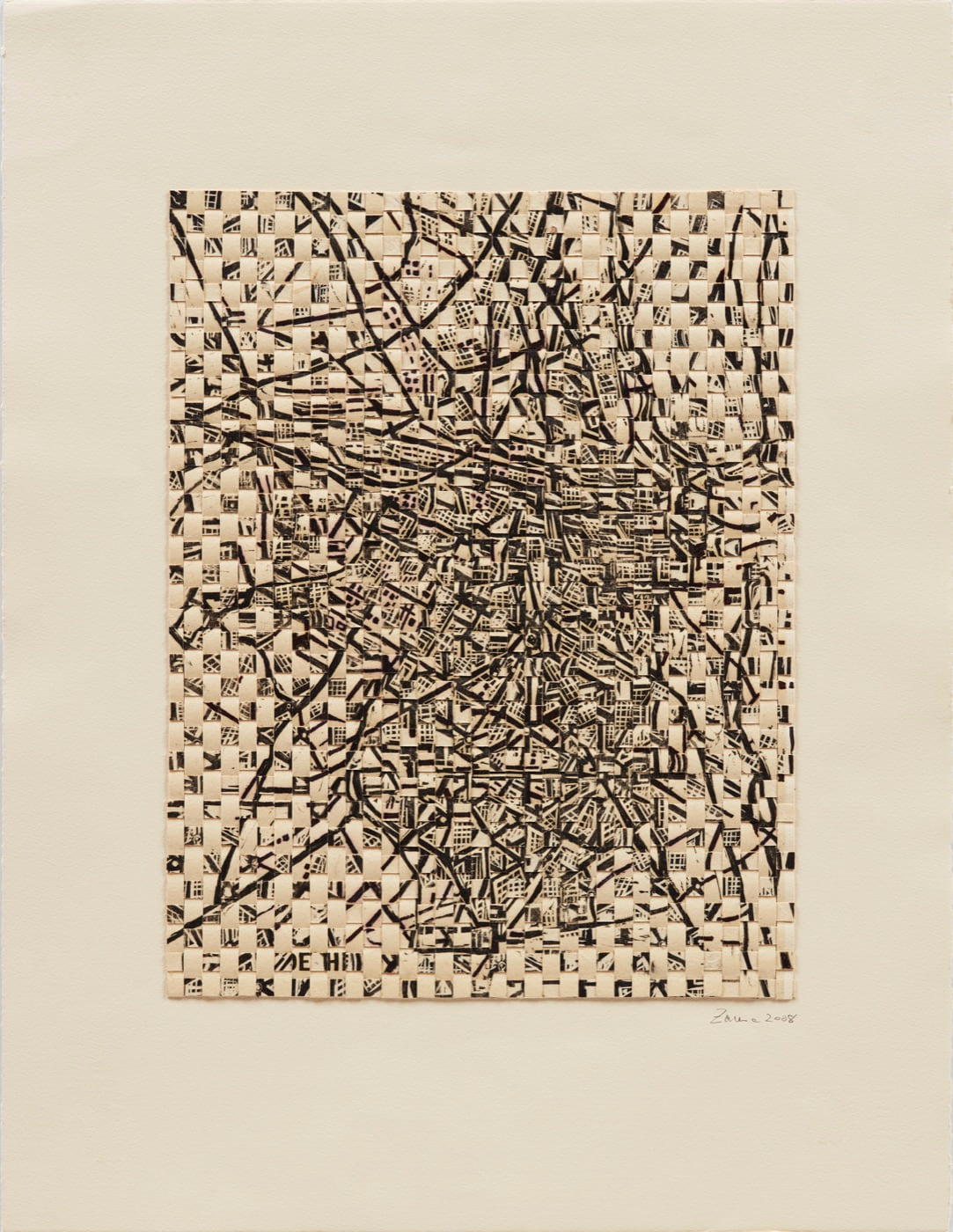
Zarina’s two periods in Delhi framed a decisive change: first the ambition to study printmaking more deeply, then the disciplined life of an artist working independently.
Zarina and Saad returned from Bangkok in 1961. Delhi had a growing art community, and for Zarina and her contemporaries it carried the hopeful possibility that art could participate in shaping a new India.
As her interest in printmaking intensified, one name recurred in her research: Stanley William Hayter. Seeing the work of Krishna Reddy, an Indian artist associated with Hayter’s Atelier 17, helped focus Zarina’s ambition to go to Paris and learn there.
1968–1974
A room of her own
When Zarina and Saad returned to Delhi in 1968, they were increasingly living separate lives. She established her own studio and worked regularly. The period demanded struggle, hard work, and determination, but it also allowed her to live more fully as an artist.
She returned to woodblock without relying only on conventionally carved blocks. She gathered discarded wood from the street, cleaned and oiled it, then inked and printed its worn grain. Influences absorbed in Paris met the physical history of local material.
Paper as structure
From surface to depth
In the barsati studio, handmade khadi paper changed how Zarina understood the print. Its roughness and texture invited embossing and white-on-white work, allowing pressure, shadow, and the thickness of the sheet to carry an image even when color receded. Found wood contributed its own marks: cracks, knots, wear, and grain became records of time rather than neutral printing tools.
A visit to Sanganer, where she watched liquid pulp lifted from vats on screens, revealed that paper could also be cast. She would pursue that possibility after moving to New York, but the idea began in India. Delhi therefore joined independence of life to independence of material: paper became surface, relief, and eventually sculpture.
“When I returned to Delhi in 1967 and began working in my barsati studio, I started with woodcuts on handmade paper. The roughness and texture opened me to the possibilities of working with spatial depth.”