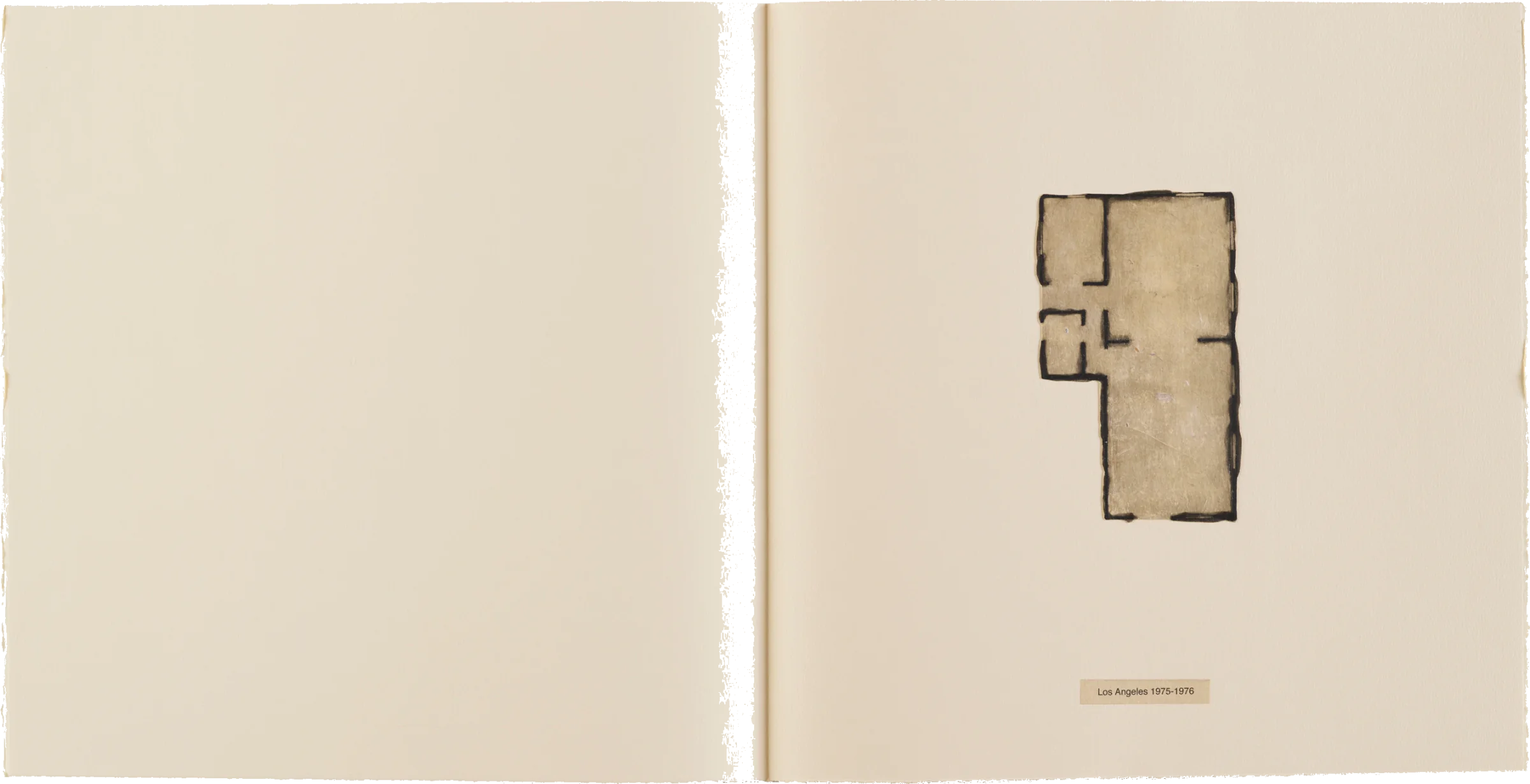
Los Angeles was a place between longer chapters. Zarina arrived from Tokyo, but her attention was already turning toward the independent life she hoped to make in New York.
Los Angeles 1975–1976 · from Homes I Made / A Life in Nine Lines, 1997
From Tokyo to California
A temporary landing
Zarina left Tokyo for Los Angeles in 1975. She had met an American woman in India during the woman’s Peace Corps service; the visitor had come to her studio and bought her work. By the time Zarina wrote to her, she had opened a Los Angeles gallery and had already exhibited Zarina’s work twice. She invited Zarina to stay.
Los Angeles was a welcome change from Tokyo, but not a permanent home for her. Saad was posted to New York, a city Zarina had visited in 1973 and hoped to make her own.
A journey across America
Across America with Rani
While Zarina was moving to New York in 1976, her sister Rani visited with her children. The sisters decided to drive across the country to collect Zarina’s belongings and car in Los Angeles.
Two South Asian women traveling with two young children crossed the United States in the 1970s, stopping at roadside attractions and sleeping in inexpensive motels—and, on one occasion, in a parking lot. After reaching Los Angeles, they returned east in Zarina’s small car. The journey became one of the stories they remembered most vividly.
A place understood later
The edge of temporariness
When Zarina returned to Los Angeles in the 1997 portfolio Homes I Made / A Life in Nine Lines, she titled its sheet “Edge of temporariness.” The phrase gives the brief residence its importance. Los Angeles was neither a settled home nor an empty pause; it was the threshold between the disciplines of Tokyo and the independent studio life she would establish in New York.
Her arrival in the United States also placed her near conversations around minimalism, conceptualism, and process art that treated material, repetition, and the conditions of making as subjects in themselves. Zarina’s work remained rooted in her own histories, but paper increasingly operated as an object with weight, surface, and memory—not merely as support for an image.
“Los Angeles was a welcome change from Tokyo, but it wasn’t for me.”