Tokyo gave Zarina the space to live independently and immerse herself in Japanese printmaking. Work, apprenticeship, and a small rented room structured the year.
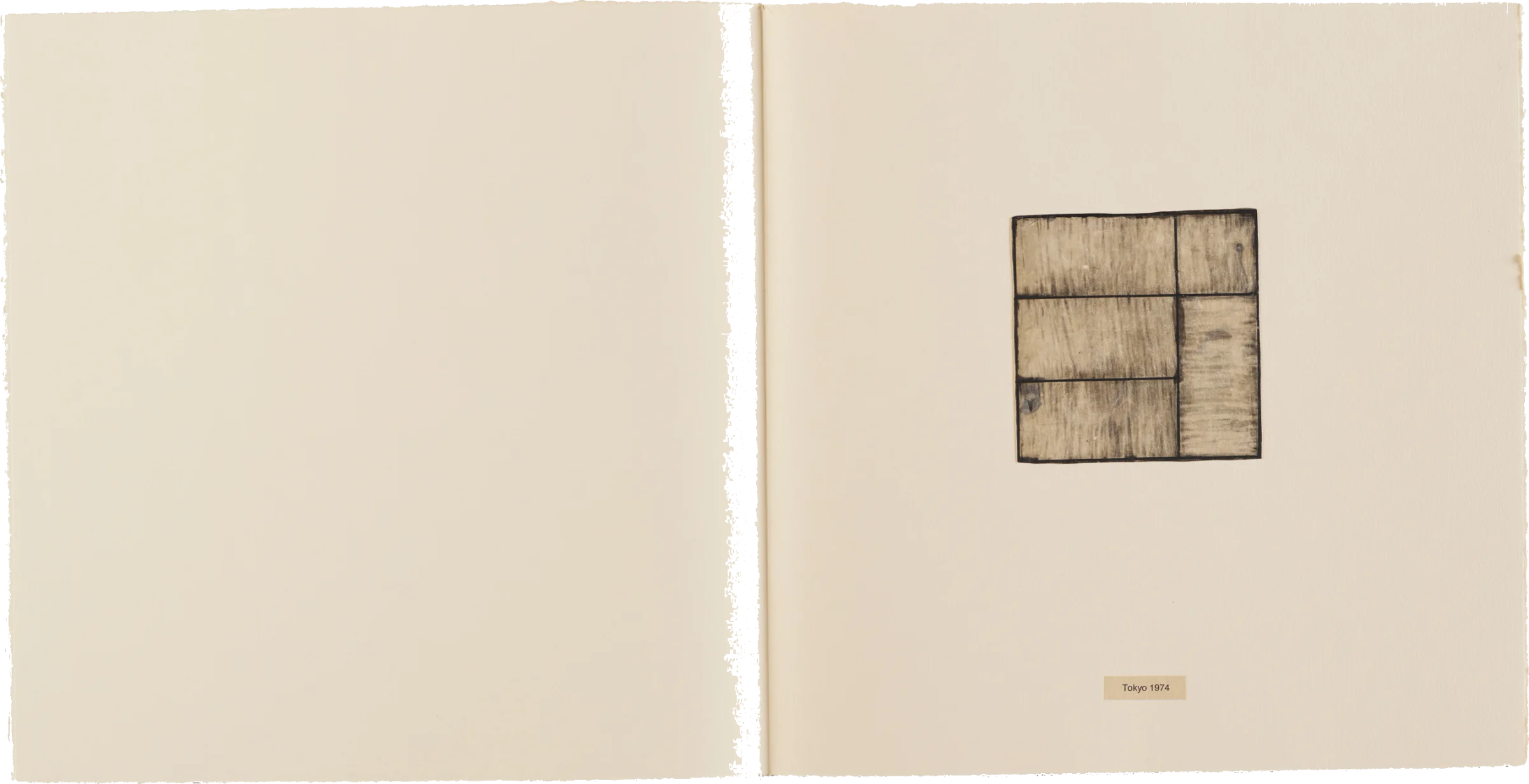
Tokyo 1974 · from Homes I Made / A Life in Nine Lines, 1997
A fellowship becomes a year
Building an independent life
A two-week Japan Foundation visiting-artist grant brought Zarina to Japan in 1974. Once there, she chose to remain and found a way to stay for a year.
In a Tokyo art bookshop she found a Japanese-printmaking book by Father Gaston Petit with a foreword by Stanley William Hayter. She introduced herself to Petit as Hayter’s student; he offered her work and helped her find a place to live. At the Toshi Yoshida Studio, she taught Western printmaking while learning Japanese woodblock printing.
Paper and daily discipline
Work all day, make at the weekend
The year deepened Zarina’s respect for handmade paper, precision, restraint, and the relationship between a carved block and its impression. These were not borrowed effects; they became part of the material discipline through which she developed her own language.
At night she returned to a small tea room rented in Yorigoka, as she named it in her account, where she slept on a tatami mat and could see Mount Fuji from the roof. Weekends were reserved for her own work.
An apprenticeship carried forward
Technique without imitation
Tokyo clarified how technique and material could carry meaning without description. The pressure of carving, the absorbency and edges of handmade paper, and the measured relation between an image and the unprinted field became durable parts of Zarina’s visual language.
Her year in Japan belongs to a longer path of apprenticeship connecting Bangkok, Atelier 17, Bonn, and later New York. Each place added a process; Tokyo sharpened the attention to paper that would support her woodcuts, pin drawings, cast-paper reliefs, and sculpture without turning those works into imitations of Japanese prints.
“I worked all day either printing for Father Petit, or working as an apprentice at the Toshi Yoshida Studio teaching everyone about Western printmaking, and finally learning about Japanese woodblock printing.”