A short posting
Making use of the provisional
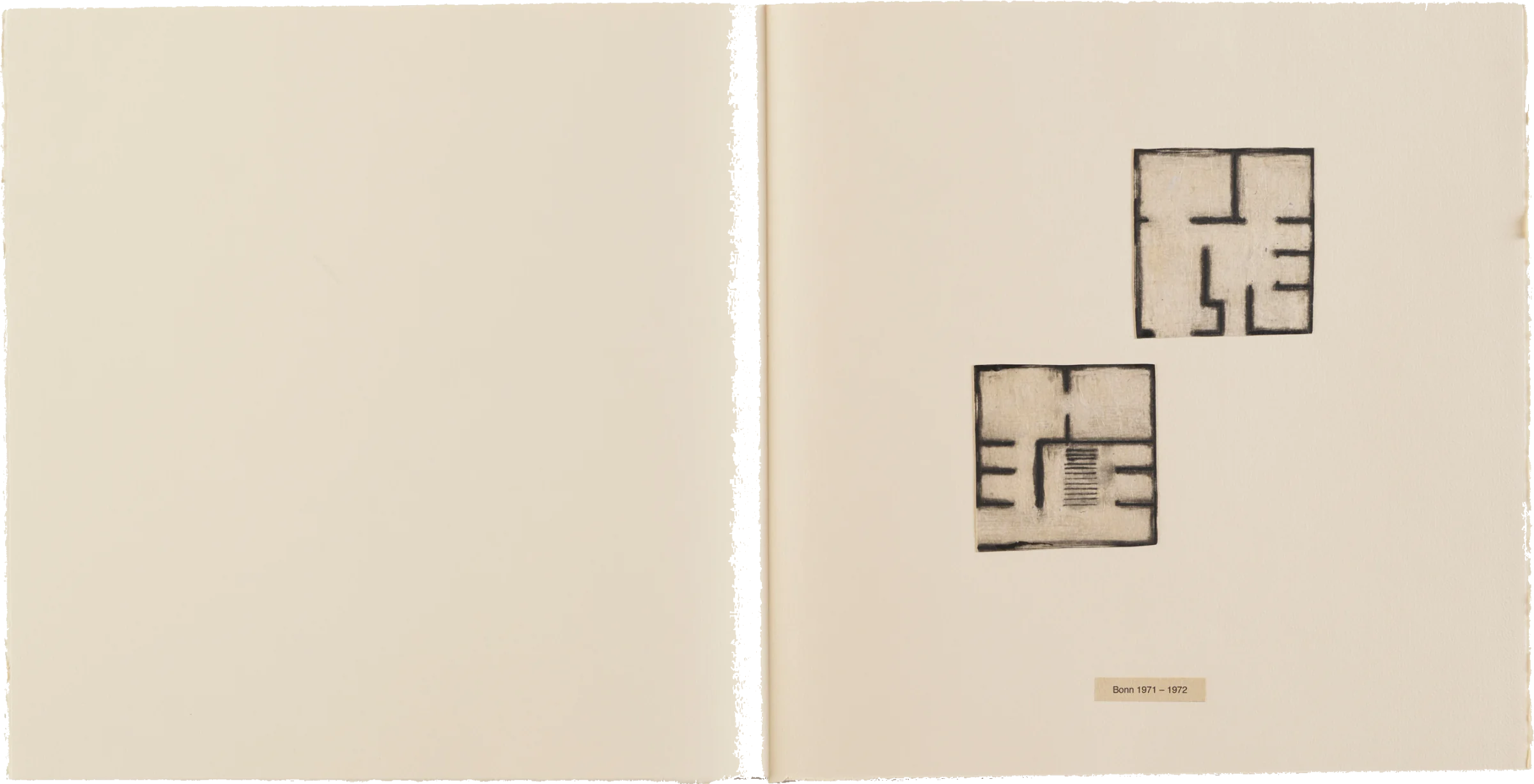
Saad’s 1971 posting took them to Bonn. There Zarina learned to make silkscreens, continued drawing maps, and saw American art in person for the first time, including work by Carl Andre, Nancy Graves, and Robert Rauschenberg. She also encountered Joseph Beuys’s work.
She remembered driving between Bonn and Düsseldorf on the autobahn. The city was a short posting, but its workshops and exhibitions widened what she could do with a printed image.
Back in Delhi
Color gives way to white paper
After returning to Delhi, Zarina made more silkscreens, then gradually removed color from her work. She embossed, scratched, pierced, and sewed white paper; when she printed, she sometimes used white ink on white paper.
In Homes I Made / A Life in Nine Lines, the Bonn sheet later marked this period as “an uncertain time.” The phrase belongs to the portfolio’s account of a life carried between addresses.
Surface becomes structure
White paper is not empty
Bonn sits at a material threshold in Zarina’s practice. Silkscreen offered a way to build an image through flat layers, while the relief prints she was making by 1971 pushed attention toward the sheet itself. Paper could hold pressure, indentation, abrasion, and shadow rather than simply receive a colored image.
The white-on-white works that followed were therefore not a retreat from meaning. By embossing, scratching, piercing, and sewing the sheet, Zarina made light reveal what pigment no longer described. The map also changed in this process: it could become less a neutral diagram than a scar, boundary, route, or memory pressed into material.