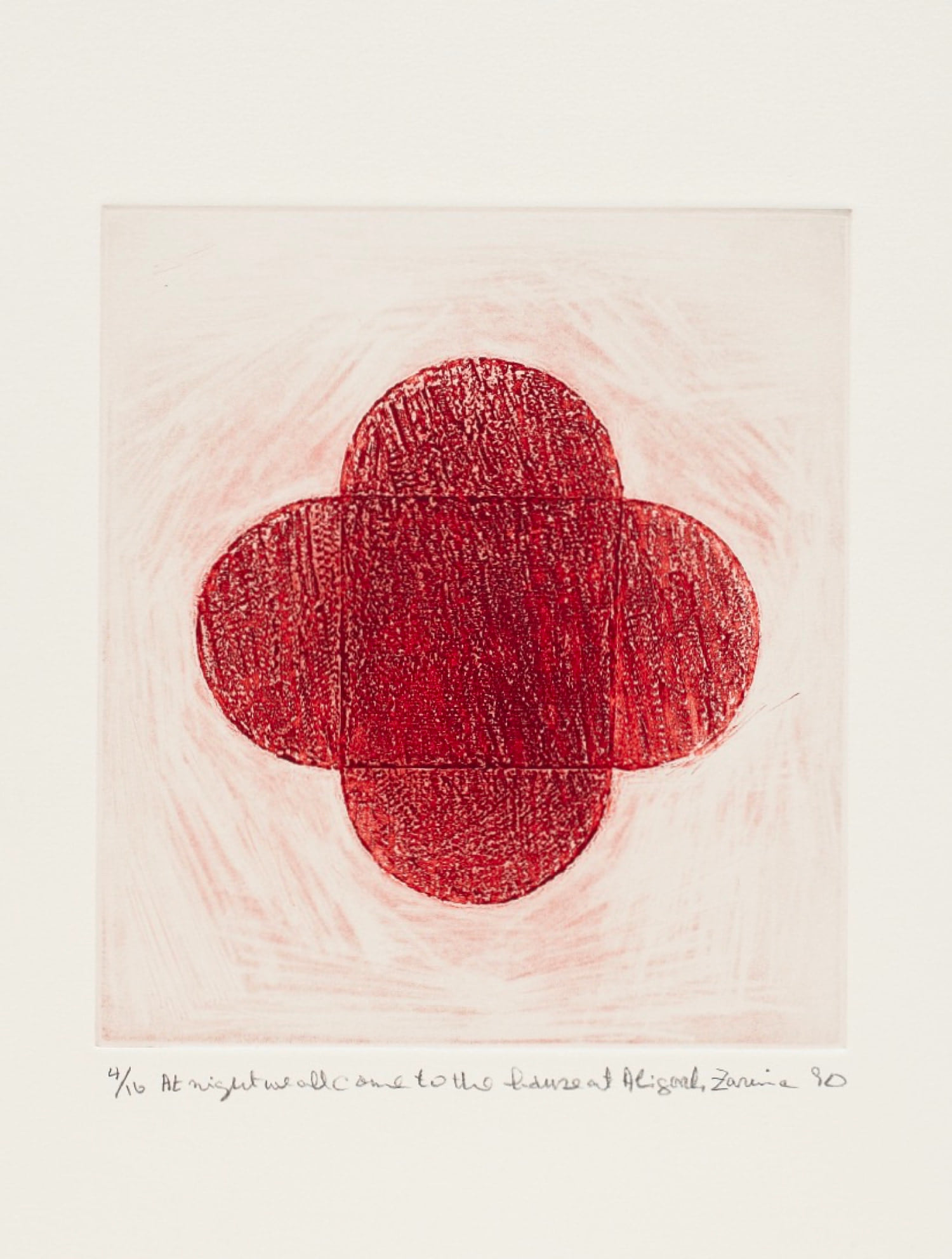
The first house
A whole world within four walls
Zarina was born in Aligarh on 16 July 1937, the youngest child of Sheikh Abdur Rasheed and Fahmida Begum. Her older siblings were Saeeda, Aslam, and Kishwar, known as Rani; Hamid had died before Zarina was born. Her father taught history at Aligarh Muslim University. Urdu was the language of the family home.
The family lived in university faculty housing at 8 Shibli Road. Their house of unbaked brick had distinct front and back quarters and an open courtyard. Its verandas, thresholds, and plan became recurring structures in her work. Aligarh was not simply a birthplace; it remained a measure against which later homes were remembered.
Books and printed words
Prints as part of the book
In the house at Aligarh I grew up surrounded by books. My father was professor of history at the AMU, we had a large collection of books at home. Even before I learned to read I loved to look at the printed words and images. This is what drew me to printmaking and the book.
One is influenced by so many things, words, images, sounds and smells. For me prints are part of the book, I see no need for prints to compete with painting on canvas. These are two different means of expression, two different sensibilities.
ZarinaPartition and return
A line through home
Zarina was ten when British India was divided in 1947. Her father and brother remained in Aligarh while Zarina, her mother, and her sister Rani travelled by guarded truck to a refugee barrack in Delhi and then to Karachi, where her elder sister Saeeda lived. After Gandhi’s assassination, her father came to Karachi and brought the family home through Sargodha and on to Aligarh. Partition marked her understanding of borders as forces that could divide land, language, families, and memory.
On a later visit, an old friend of her mother described the strangeness of apartment life, where neither the floor nor the roof belonged to the occupant. Zarina connected that remark to a wall of numbered funerary boxes she had seen in Southeast Asia: another gridded architecture in which dwelling had been separated from belonging.
Memory into form
The house as plan, word, and return
Across The House at Aligarh (1990), House with Four Walls (1991), and Home is a Foreign Place (1999), Zarina did not reconstruct the house as an illusion. She reduced it to plan, courtyard, wall, threshold, and room—forms precise enough to carry memory without pretending that memory was complete.
The thirty-six woodcuts of Home is a Foreign Place begin with the floor plan of the house and pair each image with a single Urdu word. Moving through threshold, door, courtyard, hours of the day, weather, distance, and darkness, the portfolio lets architecture and language hold a place that could no longer be physically recovered.