Theme · zabaan

Language

Urdu as a home that could survive distance and exile.

Urdu enters the work as sound, script, inheritance, and place. Words do not explain the images from outside; they help generate their forms from within.

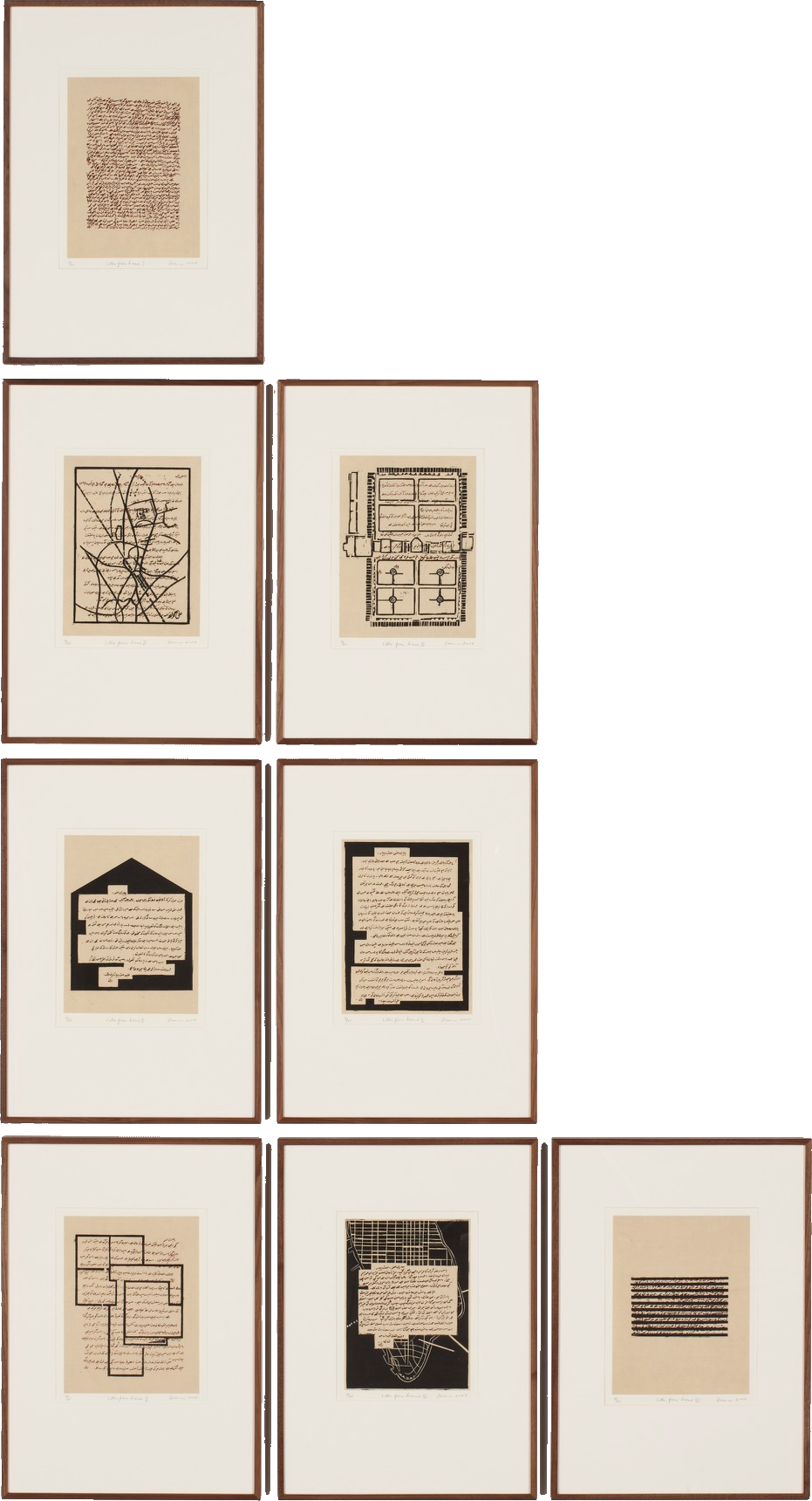
Urdu Proverbs, complete portfolio view, by Zarina
Urdu Proverbs, 2011Complete portfolio view
Ten woodcuts by Zarina: based on Urdu proverbs, 1991, by Zarina
Ten woodcuts by Zarina: based on Urdu proverbs1991

Reading the theme

Language as lived experience

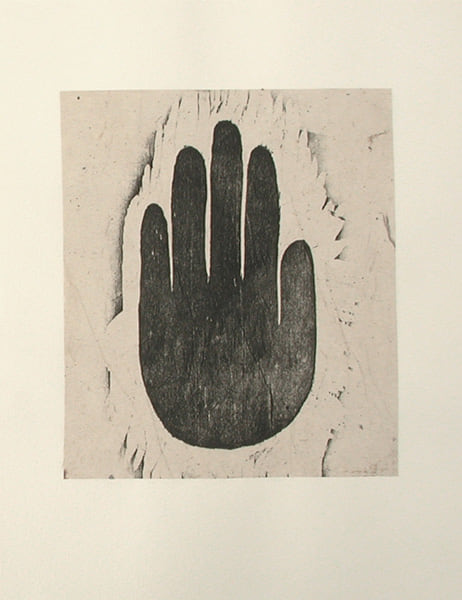
Urdu was not an explanatory caption added to Zarina’s images. It was a working material: a sound, a script, a family inheritance, and a cultural location that remained available across distance.

Urdu offered Zarina a portable home. Words, proverbs, and poetry became visual structures as well as carriers of cultural memory.

Urdu Proverbs began in conversation between sisters. Kishwar “Rani” Chishti gathered the sayings they had carried from childhood and youth—the ones they remembered and loved most—and Zarina answered them with images.

Their exchange belonged to a much longer creative collaboration. Spoken memory became shared material: Rani’s chosen words set each work in motion, while Zarina’s carved forms gave the sayings another life on paper.

The script is not ornament. It asks how language survives migration—and what becomes visible when a reader cannot translate it.

A word often precedes the image in Zarina’s process. Meaning moves between sound, script, carved mark, and printed form rather than settling into a single illustration.

By sometimes withholding translation, she preserves the intimacy of Urdu while allowing its rhythm and graphic presence to address viewers beyond literal reading.

In depth

Six readings of language

History, material, form, and lived experience meet across works made over decades.

01

Mother tongue

A life lived in translation

Zarina described language—especially poetry—as one of exile’s greatest losses. Urdu connected her to the domestic and intellectual world of Aligarh, to family correspondence, to remembered speech, and to literary traditions that continued across borders. Listening, reciting, reading, and writing kept that world available even when everyday life took place largely in other languages.

The work does not turn Urdu into a decorative sign of identity. Its presence establishes a position: these images arise from a particular language and do not abandon that location for the convenience of every viewer. At the same time, line, rhythm, and material allow the work to address people who cannot read the script. Difference is sustained rather than erased.

02

Word and image

Meaning moves in both directions

Zarina often began with a word and made an image in response. In Home is a Foreign Place, terms such as threshold, courtyard, distance, and border carry histories of use that no literal illustration could exhaust. The carved form does not translate the word; it opens another route into its associations.

This is why the pairings can feel both exact and mysterious. A viewer may recognize the image but not the script, read the Urdu but interpret the form differently, or encounter both as abstraction. The gap between word and image remains productive. It makes reading an active negotiation among sound, memory, cultural knowledge, and visual experience.

03

Collaboration

The sisters’ remembered proverbs

Urdu Proverbs began in conversation between Zarina and her sister Kishwar “Rani” Chishti. Rani gathered and selected the sayings the sisters most loved and remembered from childhood and youth; Zarina answered them with woodcuts. The collaboration joins oral memory to printed form. Familiar phrases—comic, cautionary, sharp, or paradoxical—become a shared structure for looking.

The ten-print 1991 portfolio and the related book Urdu kay aik so aik mahavray (One Hundred and One Urdu Proverbs) are distinct but connected projects. Rani compiled the larger gathering of proverbs; Zarina illustrated and published it. In the 2011 re-strike, the Urdu moves beneath each image, changing the pacing and making the encounter between saying and form immediate on every sheet.

04

Script and form

Calligraphy without ornament

Zarina’s attachment to writing was shaped by Urdu poetry and by encounters with architectural inscriptions, Qur’anic text, and the geometry of Islamic buildings. She was attentive to the way writing could be scaled, repeated, embedded in a surface, or partially obscured. Legibility and visual structure were never simple opposites.

Letters could therefore become verticals, grids, intervals, or fields without losing their cultural resonance. An alif is both a line and a letter; a repeated text can approach pattern while retaining the possibility of reading. The work asks viewers to distinguish between not understanding a language and treating it as mere ornament. Opacity is part of the encounter, not a defect to be corrected.

05

Poetry

A line of verse gives the image another time

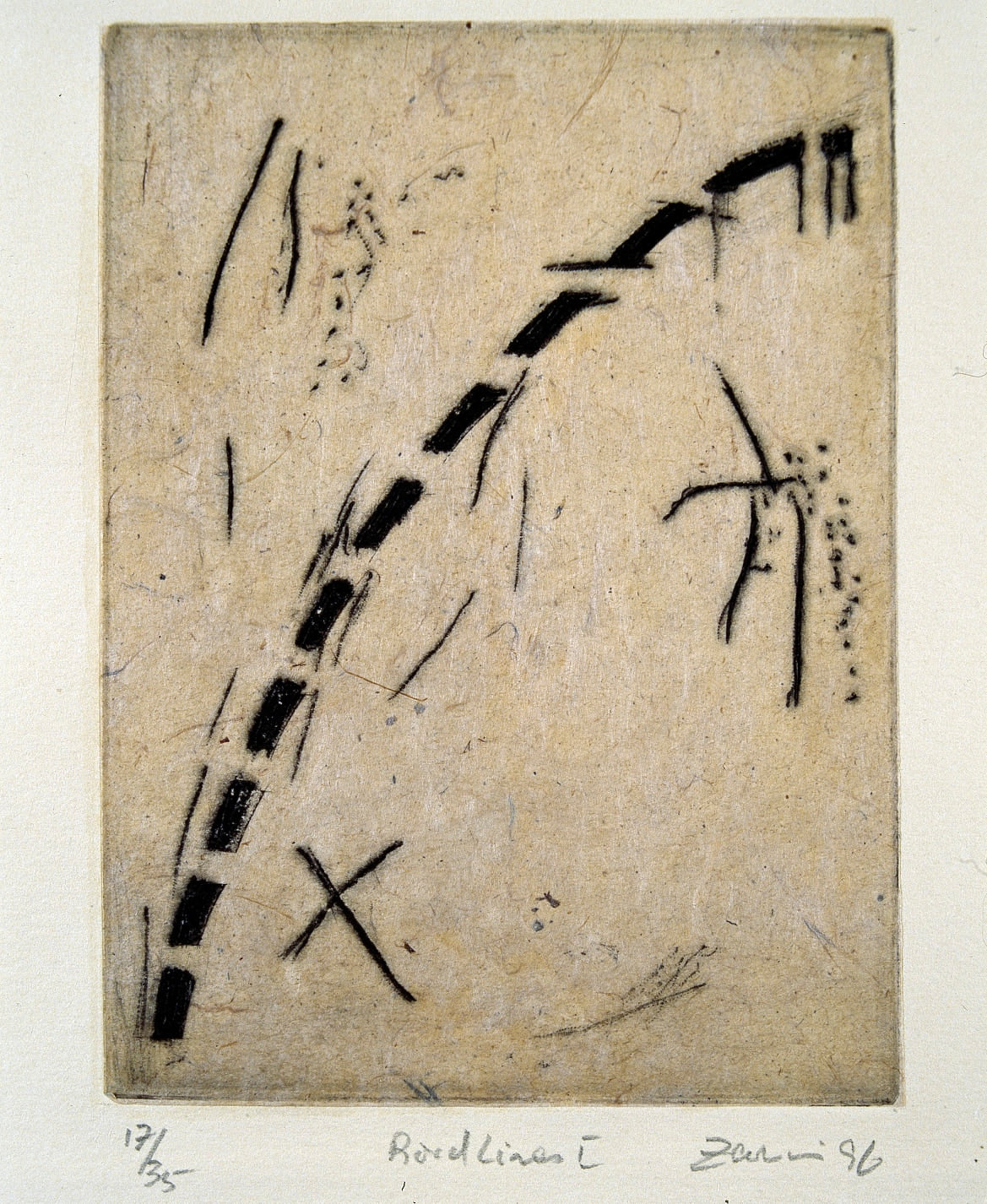
Poetry offered Zarina a language in which journey, estrangement, mortality, and return could remain unresolved. Road Lines concludes with a couplet by Allama Iqbal; Santa Cruz turns to Faiz Ahmad Faiz. The poems are not captions that explain the prints. They carry histories of recitation and recognition, allowing a contemporary image to sound within an older literary field.

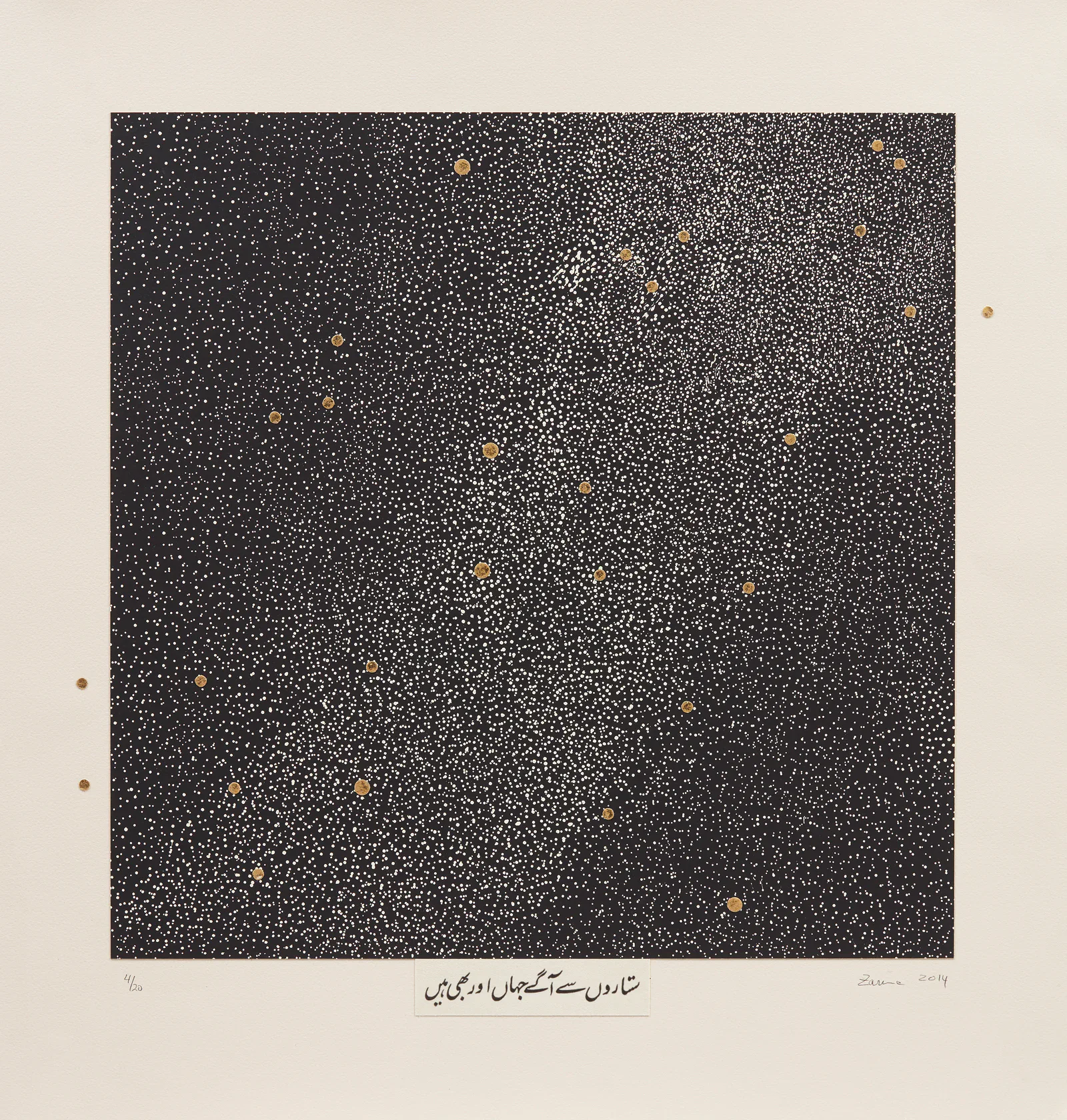
In later works the verse moves into the image itself. Lines from Faiz and Iqbal appear in Companions of the End of the Night and Beyond the Stars, where Urdu, black ink, and gold leaf share the same surface. Poetry becomes spatial: something crossed by the eye, held beneath a form, or encountered as radiance before it is fully read.

06

Translation

Not every meaning should be made equivalent

Zarina’s works often provide an English title while refusing a complete translation of the Urdu. That choice does not close the work. It establishes several positions from which it may be approached: through fluent reading, partial recognition, sound, visual analogy, or the awareness that another viewer knows what one does not.

Home is a Foreign Place makes this plurality structural. Thirty-six Urdu words and corresponding woodcuts unfold like a poem, each pairing carrying domestic and cultural associations larger than a dictionary definition. Translation becomes a relation between languages and viewers—not a replacement in which one language disappears into another.
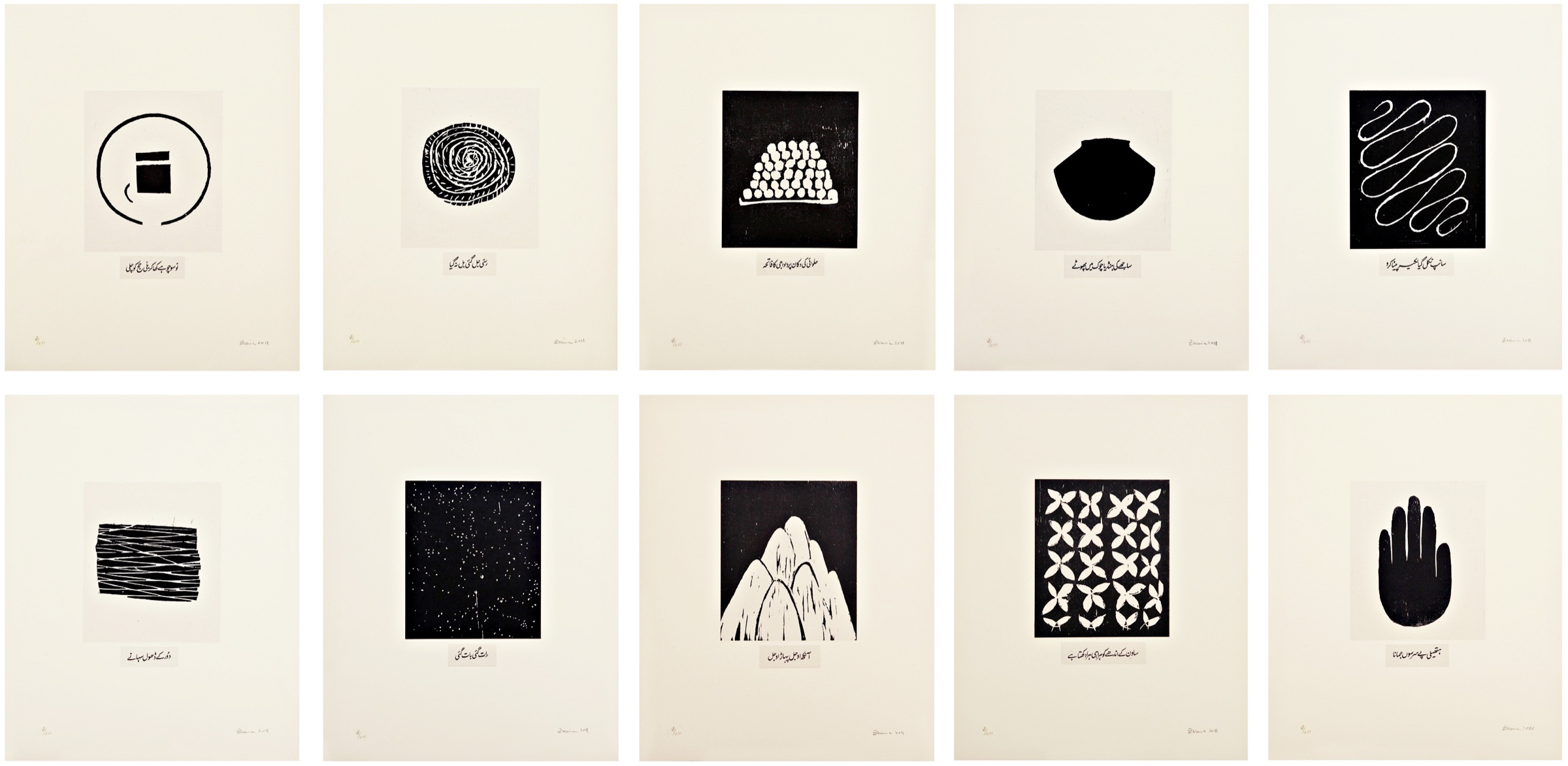
Urdu Proverbs

Ten sayings, remembered together

Rani selected the proverbs the sisters most loved and remembered from childhood and youth; Zarina responded with a sequence of images. In 1991 the Urdu appeared on a separate final leaf. In the 2011 re-strike, word and image share each sheet.

  1. 01

    نو سو چوہے کھا کے بلی حج کو چلی

    After eating nine hundred mice, the cat went on pilgrimage.
  2. 02

    رسی جل گئی، بل نہیں گیا

    The rope burned, but it kept its twist.
  3. 03

    حلوائی کی دکان پر دادا جی کی فاتحہ

    Commemorating grandfather at the sweet-maker’s expense.
  4. 04

    گھر کی ہانڈی چوراہے میں پھوٹی

    The family cooking pot broke in the village square.
  5. 05

    سانپ نکل گیا، لکیر پیٹتے رہے

    The snake escaped while they continued beating its trail.
  6. 06

    دور کے ڈھول سہانے

    Distant drums sound sweet.
  7. 07

    رات گئی، بات گئی

    The night passed; the matter passed with it.
  8. 08

    آنکھ اوجھل، پہاڑ اوجھل

    Out of sight, even a mountain disappears.
  9. 09

    ساون کے اندھے کو ہرا ہی ہرا سوجھے

    One blinded during the monsoon sees green everywhere.
  10. 10

    ہتھیلی پر سرسوں جمانا

    To expect mustard to sprout in the palm of one’s hand.

Ways of looking

Four paths into language

Biography, material, form, and language meet differently in every series.

01

Words before images

Zarina often began with a word or phrase and developed an image in response. Meaning therefore moves in both directions: script prompts form, while form changes how the word is encountered.

02

Translation withheld

Many works leave Urdu untranslated. This protects the intimacy and cultural specificity of the language while asking viewers unfamiliar with the script to experience its visual and material presence.

03

A language carried forward

Rani gathered the proverbs the sisters most loved and remembered from childhood and youth; Zarina answered the chosen sayings with images. Their collaboration also produced the 1991 book Urdu kay aik so aik mahavray (One Hundred and One Urdu Proverbs), compiled by Rani, illustrated and published by Zarina.

04

Poetry as method

Urdu poetry supplied titles, rhythms, and philosophical structures. Its role extends beyond quotation: it shaped how Zarina understood exile, light, journey, mortality, and return.

Across the work

Themes are not separate rooms

Each theme changes when it is read through another.

Language and home

Urdu makes remembered architecture audible and preserves cultural meanings that an image alone cannot carry.

Continue reading →

Language and memory

Handwriting, poetry, and proverbs transmit intimacy across distance and between generations.

Continue reading →

Language and borders

A mother tongue crosses political lines even as migration changes where and how it can be spoken.

Continue reading →

Aligarh · the sound of a first home

Urdu connected everyday speech, reading, poetry, and the remembered architecture of Zarina’s childhood.

Continue reading →

Urdu Proverbs · collaboration in print

A portfolio and related book join remembered sayings to ten woodcuts, preserving humor, rhythm, and cultural specificity through form.

Continue reading →

Urdu Worlds · exhibition context

A focused exhibition follows language as image, inheritance, and an active field of contemporary artistic exchange.

Continue reading →

Continue exploring

HomeHome is a Foreign Place →BordersDividing Line →MemoryLetters from Home →