01Correspondence
A letter is both language and physical trace
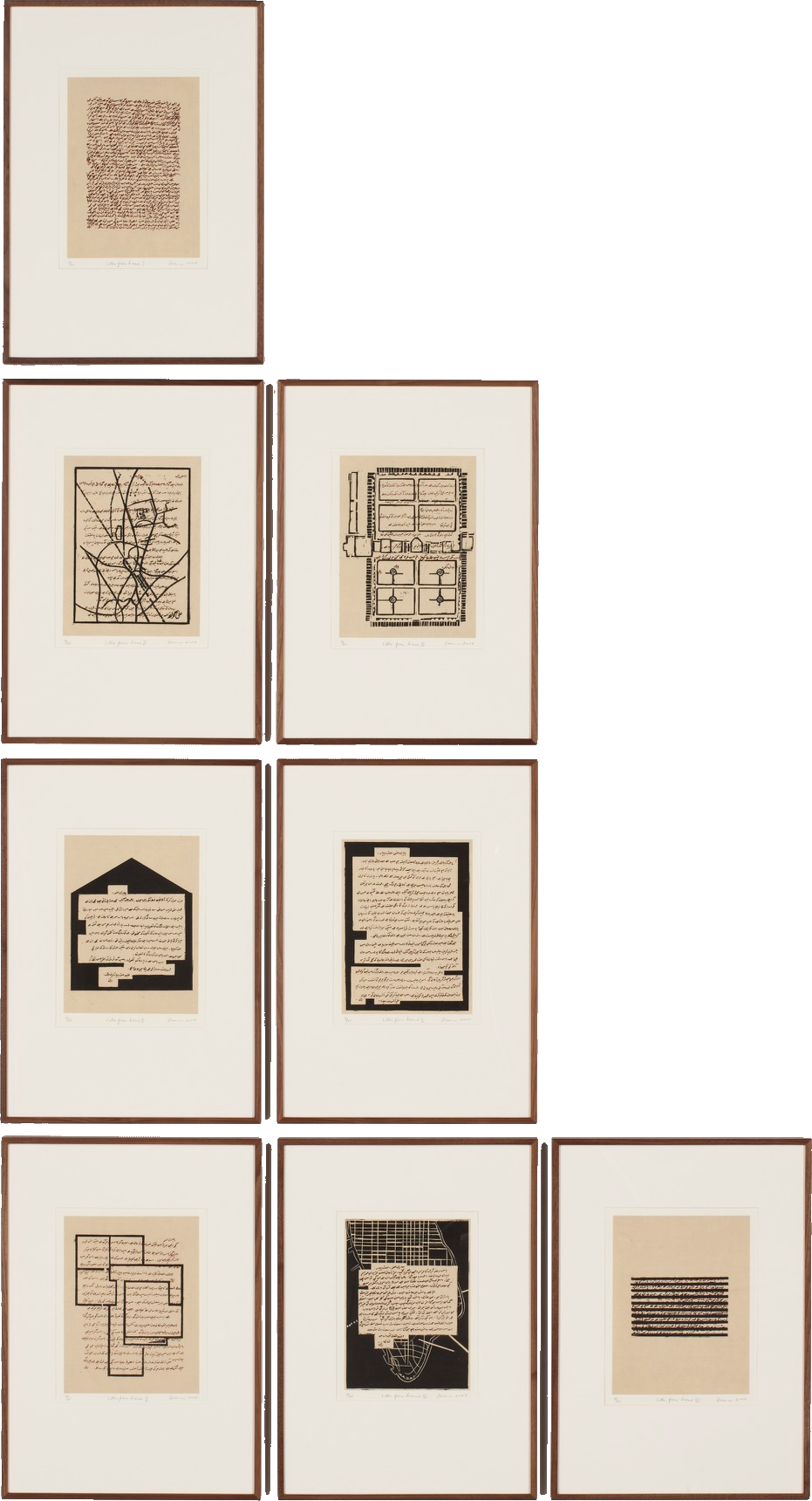
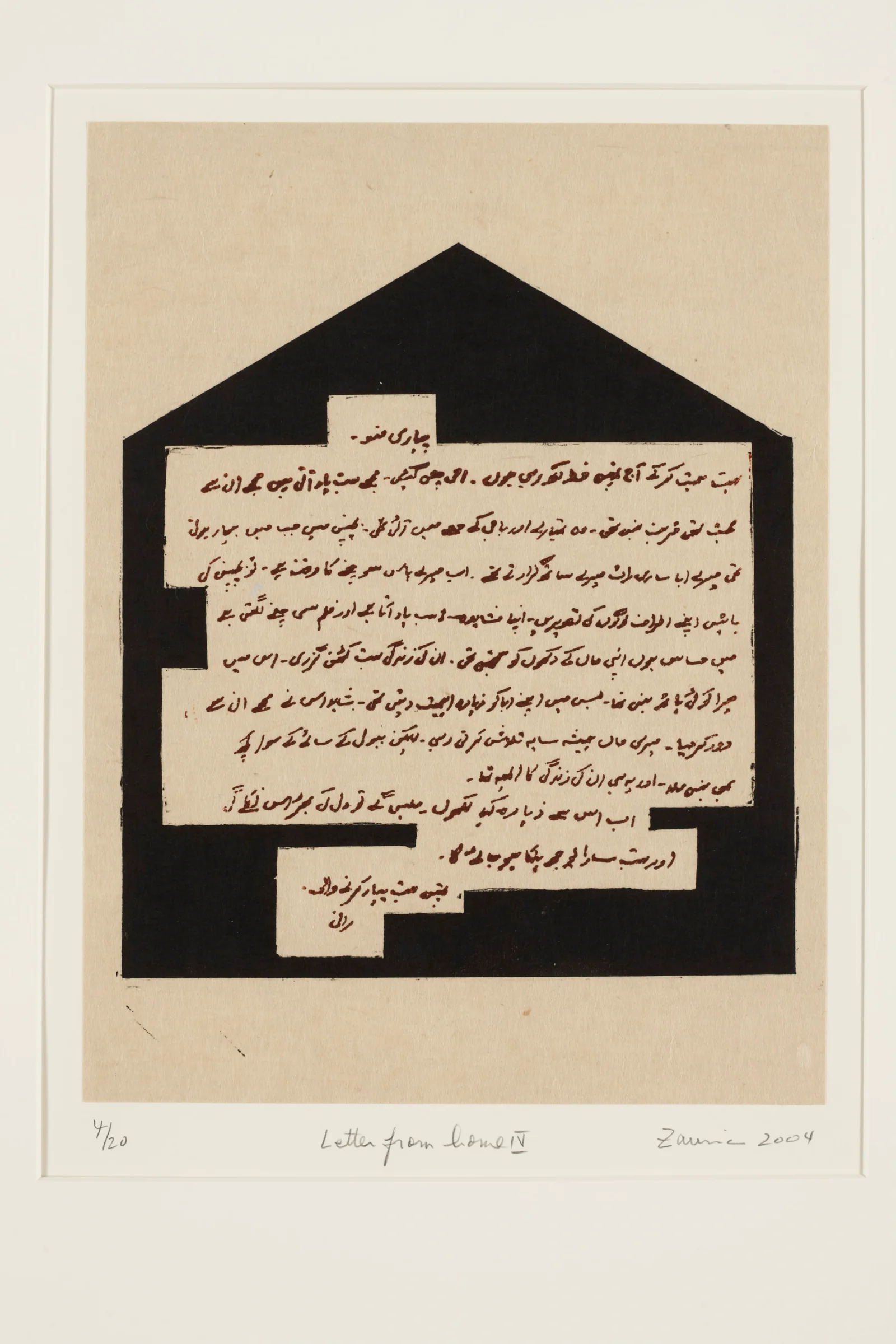
Letters from Home grew from letters written in Urdu by Zarina’s sister Rani—accounts of deaths in the family, the dispersal of possessions, a sold house, separation, and waiting. The letters connect people across distance, but their delayed and unsent character also marks the limits of that connection. They carry news that cannot restore the moment it describes.
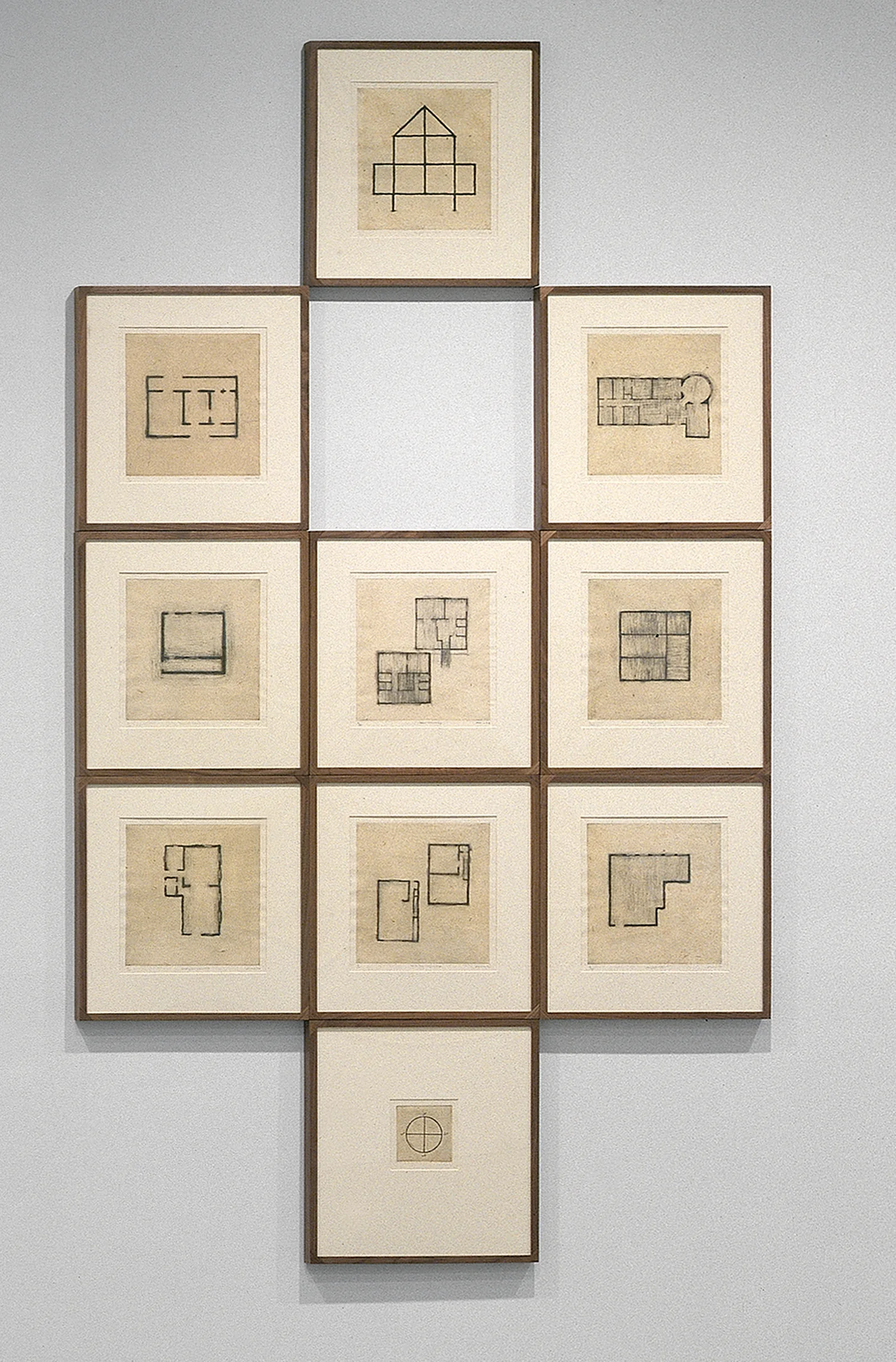
Zarina did not illustrate the correspondence. She reproduced handwriting through metalcut and layered it with plans, maps, and house forms. Script becomes image before it becomes information: density, rhythm, repetition, and the recognition of a familiar hand establish intimacy even when every sentence cannot be read. The portfolio preserves voice without making private grief fully transparent.
02Fragment
What survives is not the whole past
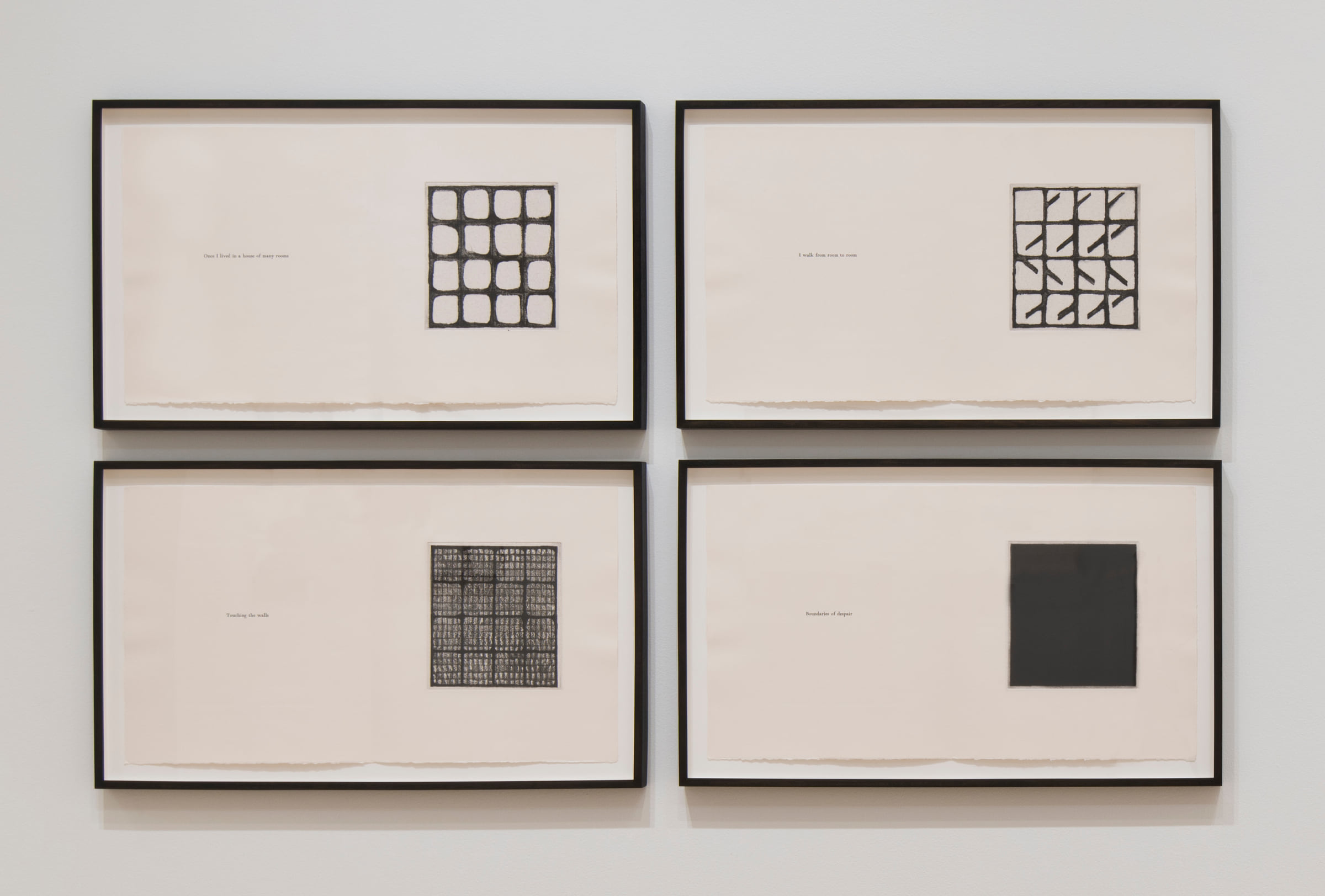
Memory in Zarina’s work is assembled from partial evidence. A floor plan, a route, a word, a torn edge, or a repeated mark can hold enormous emotional weight precisely because it does not reconstruct everything around it. Empty space allows absence to remain active rather than filling it with explanation.
This restraint distinguishes remembrance from nostalgia. The past is neither recovered intact nor treated as a lost paradise. It returns altered by time and by the conditions of the present. The fragment acknowledges that remembering is an act of selection—and that forgetting, silence, and uncertainty are part of the historical record.
03Serial form
Repetition measures change
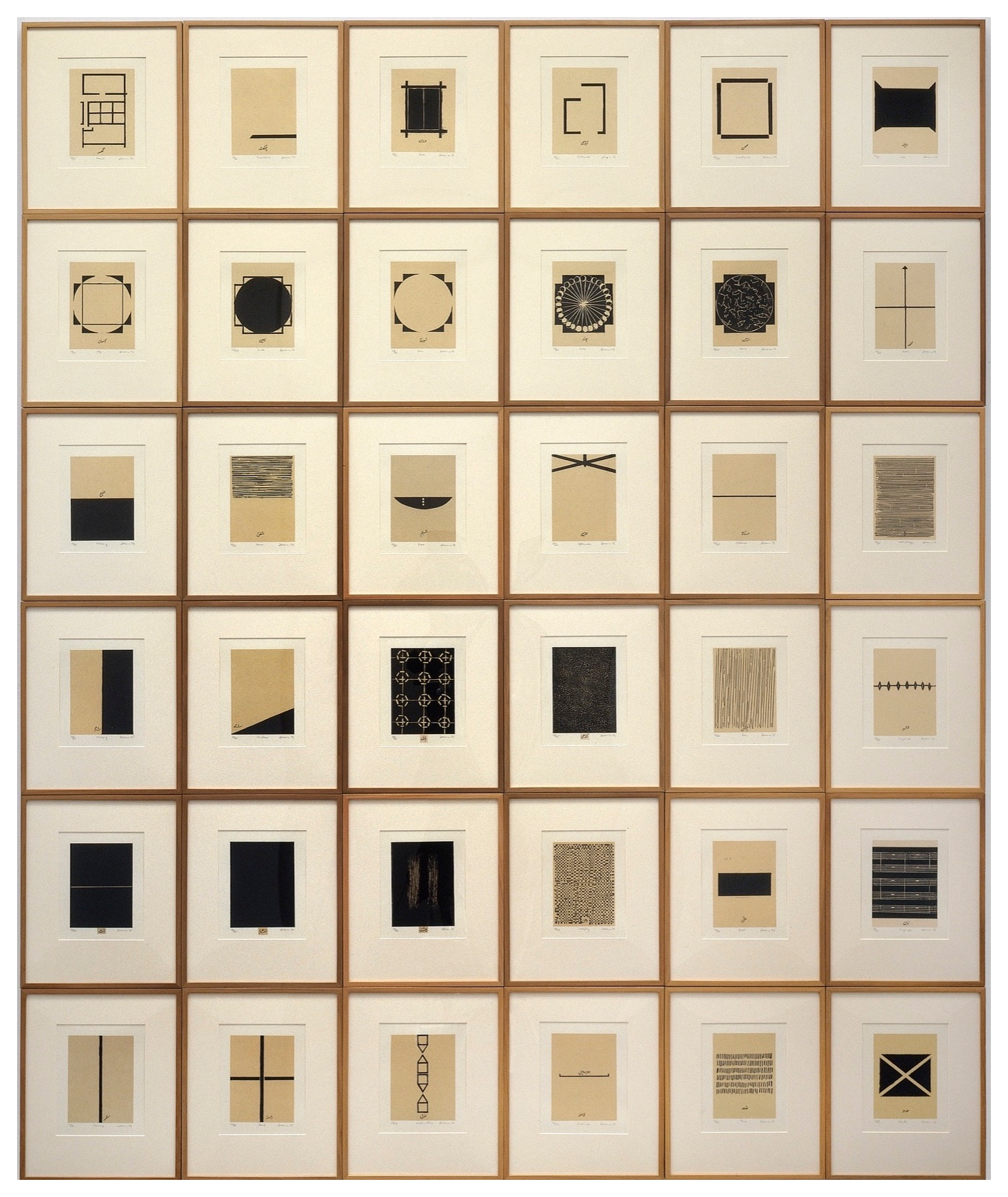
Portfolios give memory a temporal form. A viewer moves from one sheet to another, encountering recurrence with difference: another house, another city, another black field, another interval of silence. No single image is asked to contain the whole experience. Meaning is distributed across sequence and return.
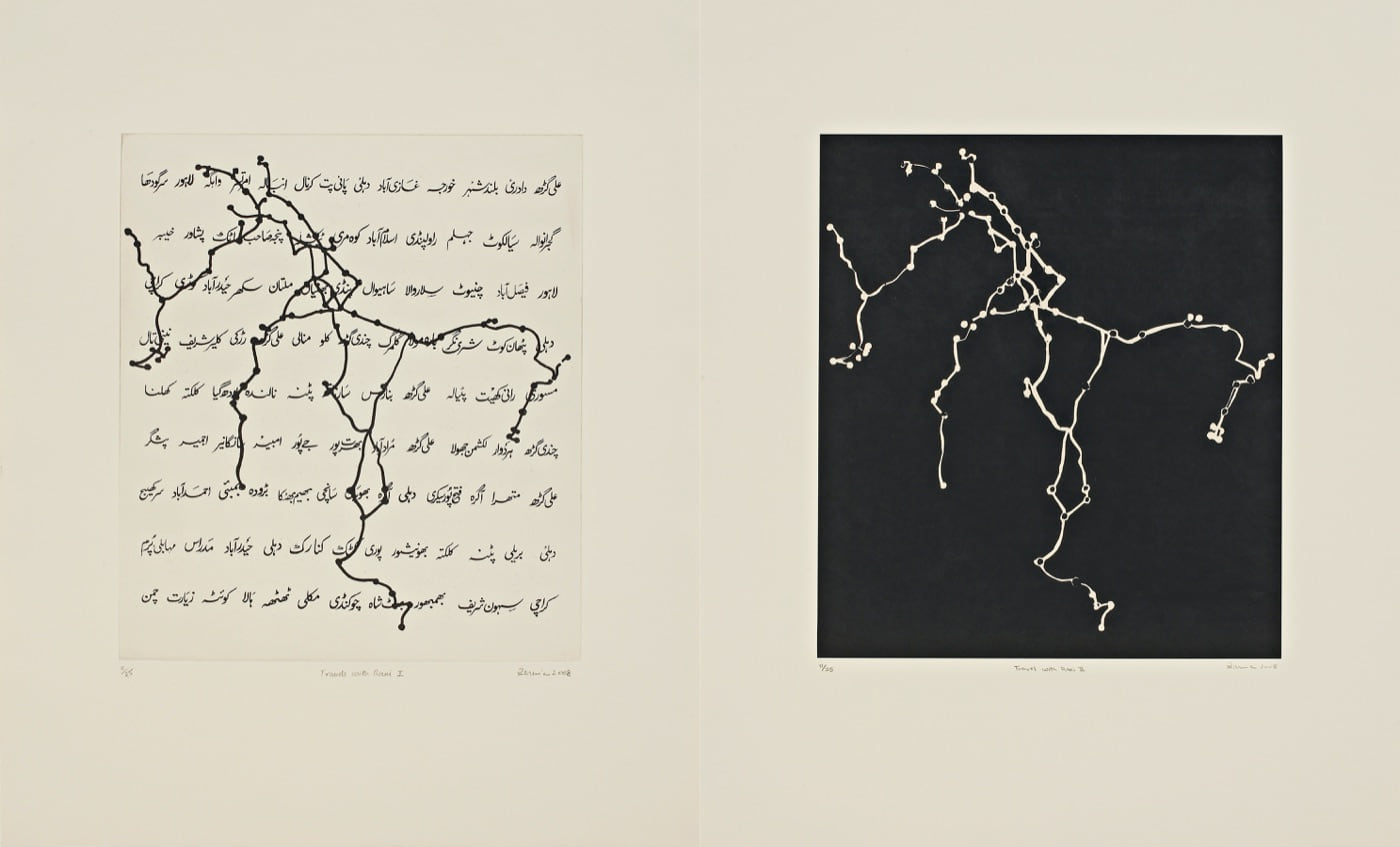
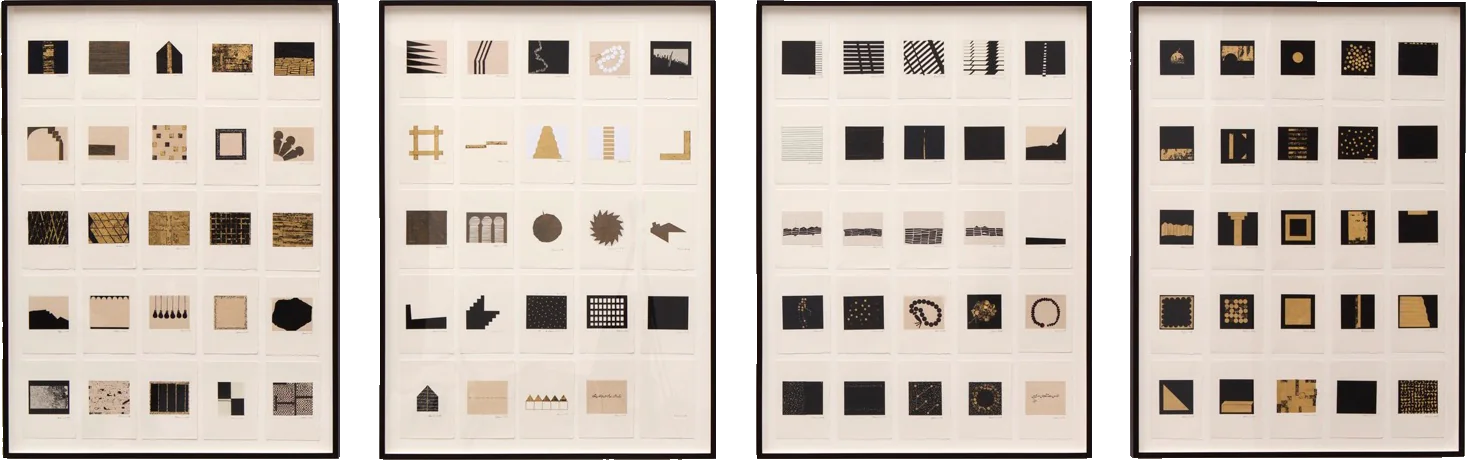
In Travels with Rani, shared journeys become an abstract geography of private history. In The Ten Thousand Things, earlier prints, photographs, and fragments are cut down and remade into a hundred small collages. Zarina connected the paperback scale of those works to reading and described the project as a way of archiving her own practice. The archive becomes creative material rather than a fixed storehouse.
04Material time
Paper remembers pressure
Creases, pierced grids, fibers, embossing, and relief make time visible without depicting a narrative. Paper receives every action performed upon it. In Zarina’s hands it can resemble a page, wall, skin, map, wound, or remnant, moving between the intimacy of a letter and the physical authority of sculpture.
This capacity helps explain the rigor of her monochrome surfaces. Black ink does not simplify experience; it heightens the differences between absorption and reflection, mark and void, presence and shadow. Gold leaf, pewter, thread, and obsidian introduce other temporal registers—radiance, tarnish, counting, mourning—while the sheet continues to bear the evidence of touch.
05Handwriting
The familiar hand becomes a portrait
A person can be present in Zarina’s work without being pictured. Rani’s handwriting moves through Letters from Home as an unmistakable bodily trace: the pressure, spacing, and flow of the script register a living hand across distance. Because Zarina leaves the Urdu untranslated, the correspondence remains intimate while its visual rhythm is available to every viewer.
The same hand returns in later works, among them Travels with Rani and Echo. Repetition does not turn it into a neutral motif. Each reappearance changes its role—from news carried by a letter, to a record of journeys, to a fragment recalled after time has passed. Handwriting becomes a form of portraiture made from recognition rather than likeness.
06Arrangement
Memory gathers through sequence and scale
Zarina’s installations ask the viewer to remember relationally. One sheet establishes a sign; the next revises it; the space between them becomes an interval in which earlier images remain active. A portfolio can therefore behave like memory itself: cumulative but incomplete, ordered yet continually reshaped by return.
Scale directs that encounter. The large field of an installed portfolio makes recollection public and architectural, while the small collages of The Ten Thousand Things II return it to the hand and the dimensions of reading. Across both registers, memory is not a single image preserved unchanged. It is an arrangement made and remade from what can still be touched.